
When did Dr. Vishnu Shridhar Wakankar discover the rock shelters of Bhimbetka ?
- (a)1951 - 1952
- (b)1954 - 1955
- (c)1960 - 1961
- (d)1957 - 1958
Correct — D, 1957-58. Dr Vishnu Shridhar Wakankar, the Ujjain-based archaeologist, first noticed the rock formations of Bhimbetka from a passing train crossing the Vindhyan hills in 1957, went back to explore them, and reported a large group of prehistoric painted rock shelters — the exploration season is recorded as 1957-58. Systematic survey and excavation followed in the 1970s, and the site was inscribed on the UNESCO World Heritage List in 2003. Wakankar is regarded as the father of Indian rock-art research and was awarded the Padma Shri in 1975.
- (a)1951 - 1952 — Too early by half a decade. Nothing at Bhimbetka is dated to the early 1950s — Wakankar's train-window sighting and the exploration that followed belong to 1957.
- (b)1954 - 1955 — Also too early. The mid-1950s pre-date the discovery; the standard record for Wakankar's find is 1957, with the exploration season written as 1957-58.
- (c)1960 - 1961 — Too late. By 1960 the shelters had already been reported; the 1960s and 1970s were the decades of survey and excavation at Bhimbetka, not of its discovery.
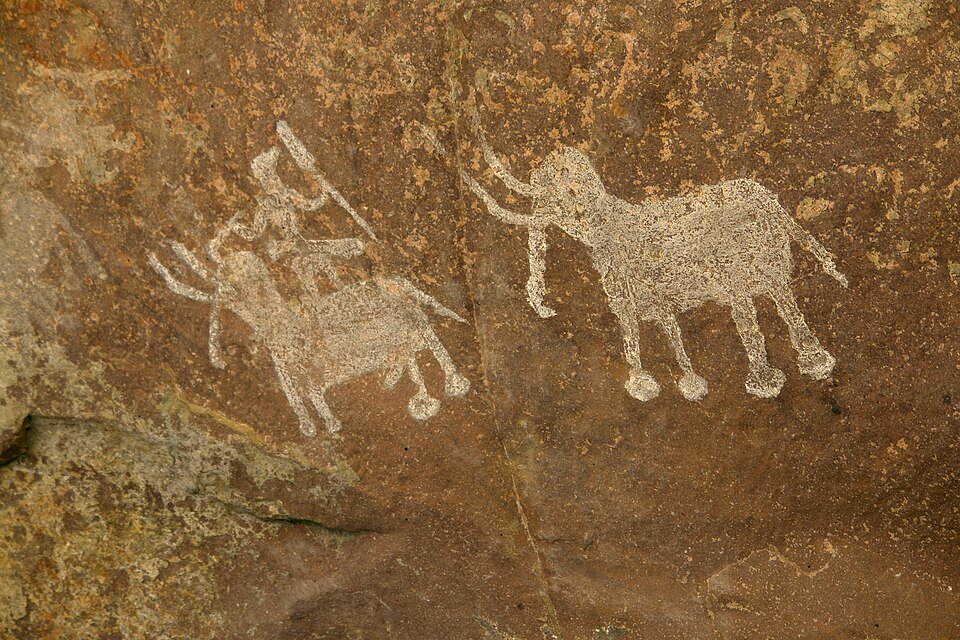
Bhimbetka is India's most important prehistoric rock-art complex — a cluster of natural sandstone shelters in the Vindhyan hills of Raisen district, Madhya Pradesh, about 45 km south-east of Bhopal on the edge of the Ratapani Wildlife Sanctuary. Some 750 shelters have been recorded across the complex and several hundred carry paintings. Occupation evidence runs from the Lower Palaeolithic (Acheulian tools) through the Mesolithic to the historic period, while most of the surviving paintings — hunting scenes, animals, dancers, later horses and riders — are Mesolithic and later. The name links the place to Bhima of the Mahabharata, 'Bhima's sitting place'.
There is an older mention that trips students up: a colonial-era official, W. Kincaid, referred to Bhimbetka in an 1888 paper on the strength of local tribal accounts, but he described it as a Buddhist site. Its prehistoric character was established only when Wakankar reached it in 1957-58. So 'first mentioned' and 'discovered' are two different dates, and the question asks for the second. The other reliable anchor is the pairing 1957-58 discovery, 2003 UNESCO inscription — exams swap those two years freely.
- Discovered by Dr V. S. Wakankar in 1957-58; he spotted the shelters from a train crossing the Vindhyan hills and returned to explore them
- Location: Raisen district, Madhya Pradesh, roughly 45 km south-east of Bhopal, on the edge of the Ratapani Wildlife Sanctuary
- Inscribed on the UNESCO World Heritage List in 2003 — Madhya Pradesh's third World Heritage site after Khajuraho (1986) and the Buddhist Monuments at Sanchi (1989)
- About 750 rock shelters recorded, several hundred painted; occupation evidence from the Lower Palaeolithic onwards, most surviving paintings Mesolithic and later
- W. Kincaid mentioned the site in 1888 as a Buddhist location, based on tribal accounts; its prehistoric rock art was established only by Wakankar
- Treating the 1888 colonial mention as the discovery — the prehistoric identification is Wakankar's, in 1957-58
- Swapping the discovery year (1957-58) with the UNESCO inscription year (2003)
- Assuming all Bhimbetka paintings are Palaeolithic — the stone tools go that far back, but most surviving paintings are Mesolithic and later
MPPSC asks the discoverer, the discovery year, the district or the inscription year of Bhimbetka almost every other cycle; UPSC prefers period-and-place questions on painted and rock-cut sites rather than dates of discovery.
There are only two known examples of cave paintings of the Gupta period in ancient India. One of these is paintings of Ajanta caves. Where is the other surviving example of Gupta paintings?
- (a) Bagh caves
- (b) Ellora caves
- (c) Lomas Rishi cave
- (d) Nasik caves
Answer(a) Bagh caves
The same subject area at UPSC level — India's painted rock and cave sites, and the Madhya Pradesh site (Bagh) that pairs with Bhimbetka in every art-history list of the state.
Which archaeological site, noted for thermoluminescence finds, is also considered the birthplace of Varahamihira?
- (a) Dangwada
- (b) Kayatha
- (c) Navdatoli
- (d) Indragarh
Answer(b) Kayatha
MPPSC's recurring Madhya Pradesh archaeology slot the previous year — identify the state's excavated site behind a named association, exactly the fact block Bhimbetka belongs to.
- practice — not a real PYQ
The Bhimbetka rock shelters are located in which district of Madhya Pradesh?
- (a)Sehore
- (b)Raisen
- (c)Vidisha
- (d)Chhindwara
Answer(b) Raisen — about 45 km south-east of Bhopal in the Vindhyan hills. - practice — not a real PYQ
In which year were the Rock Shelters of Bhimbetka inscribed on the UNESCO World Heritage List?
- (a)1986
- (b)1989
- (c)2003
- (d)2013
Answer(c) 2003 — after Khajuraho (1986) and the Buddhist Monuments at Sanchi (1989).