
 View answer copy →
Yashaswi Raj VardhanRank 11CSE 2025
Answered a very similar question
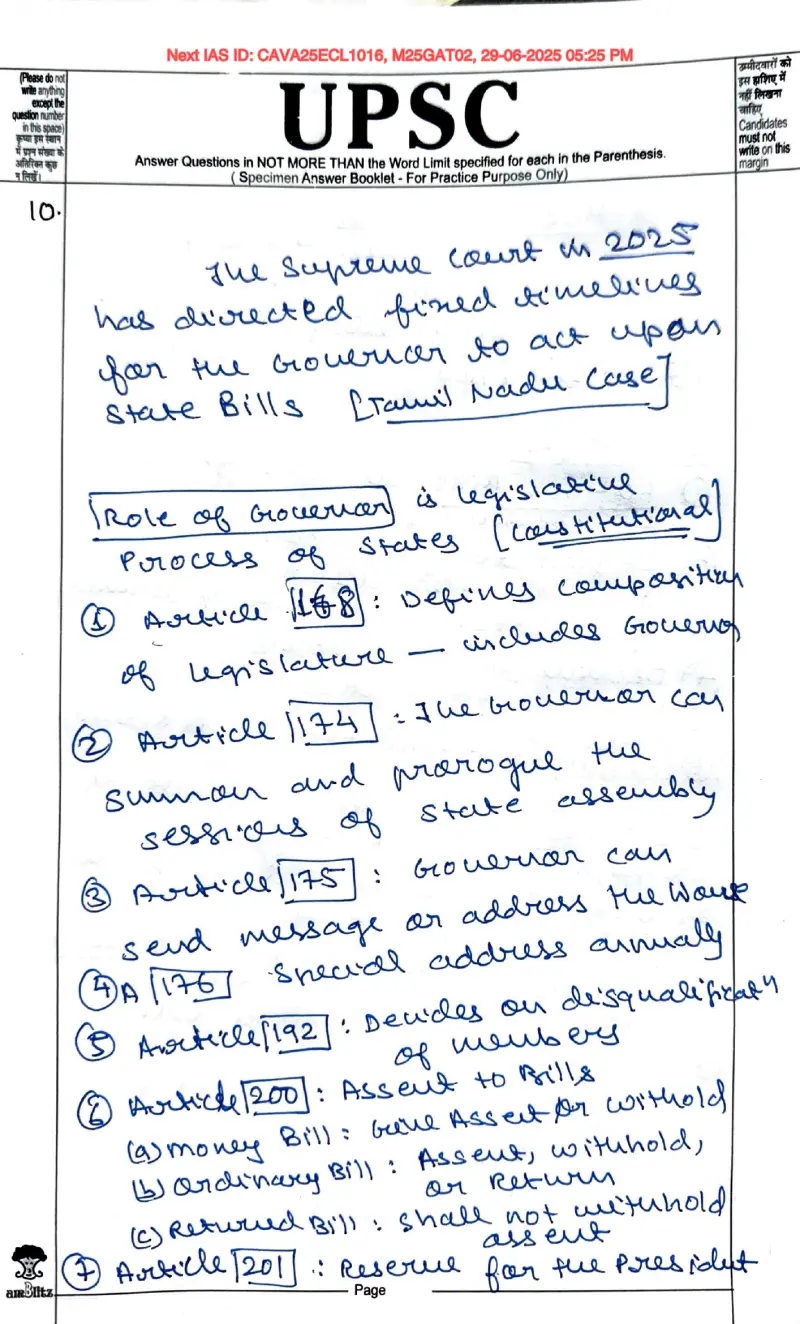
Their question: “Governor's role in state legislative process; assent to Bills”
The topper's Governor-and-assent material with the Tamil Nadu Governor case directly informs the essential conditions for the Governor's exercise of legislative powers.
Key learnings from their answer
- ›Every one of the 10 answers opens with a current-affairs hook tied to the exact provision being asked, '~1.4 lakh contempt-of-court cases pending vs govt' for Q2, 'SC in 2025... Tamil Nadu Governor case' for Q10, '65% of urban bodies lack a master plan (NITI Aayog, 2021)' for Q6 -> Anchor your intro to a specific, recent, on-point statistic or case rather than a generic definition; it instantly signals relevance and currency to the examiner.
- ›Citation is dense but precise and on-point, ~25 Articles (76, 105, 129, 142, 356, 200 etc.), specific Acts (Contempt of Court Act 1971, 52nd Amendment 1985, 74th Amendment 1992), live cases (SR Bommai 1994, Tamil Nadu Governor 2025, Maharashtra 2022), and the matching committees (Sarkaria, Punchhi, 2nd ARC, NCRWC) -> Build per-topic 'evidence kits' of article + act + landmark case + relevant committee so every claim is backed by a named authority, not vague assertion.
What they cited: Cases: KM Nanavati case, SR Bommai (1994), Uttarakhand Assembly/Harish Rawat (2016), Jammu & Kashmir case, Tamil Nadu Governor case (2025), West Bengal/Kerala/Punjab Governor cases, Maharashtra (2022), Himachal Pradesh (2024)