
 View answer copy →
Answered a closely related question
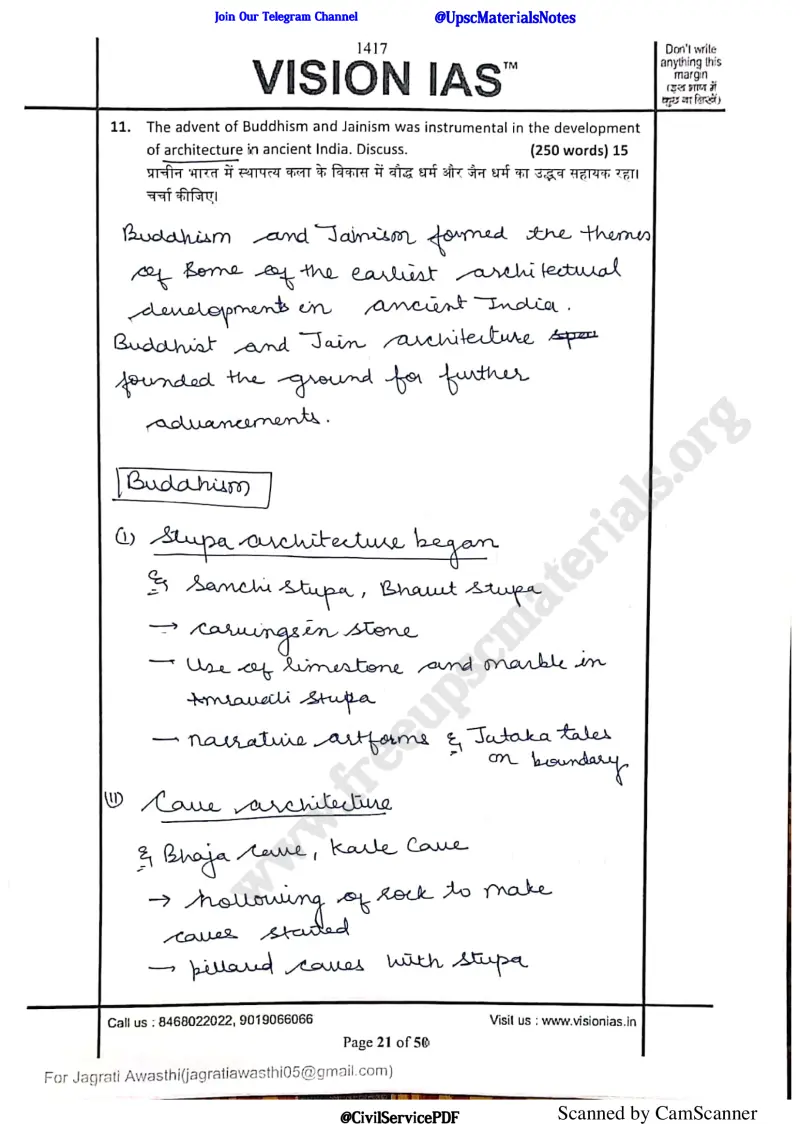
Their question: “Advent of Buddhism and Jainism instrumental in development of ancient Indian architecture - Discuss (15m, 250w)”
The topper's rock-cut examples (Bhaja, Karle, Ajanta, Ellora, Udayagiri caves, chaitya & vihara) are exactly the material needed to discuss rock-cut architecture as a source of early Indian art and history.
Key learnings from their answer
- ›She runs a single repeatable template across nearly every answer: a one-line definitional intro ('Naoroji is often referred to as the Grand Old Man of India...'; 'Social security refers to guarantee of a good standard of life...'), Roman-numeral body points each capped by a concrete 'Eg', and a short thesis-linked conclusion (urban forests as a 'tool for Sustainable Development', eco-tourism tied to 'Incredible India'). -> Build one disciplined intro-points-with-examples-conclusion template you can deploy under time pressure so every answer is fast to skim and structurally complete.
What they cited: Q11 Architecture: Sanchi & Bharhut Stupas, Amravati Stupa (limestone/marble), Jataka tales, Bhaja & Karle caves, Chaitya & Vihara, Gandhara & Mathura art, Sultanganj Buddha, Udayagiri caves (Odisha), Meguti Jain temple (Aihole), Jali work, Udaigiri caves (Vidisha), Durga temple (Aihole), Ajanta caves, Kailashnath temple (Ellora), Ashokan Tirthankara torso