
 View answer copy →
Rishabh BhattRank 363CSE 2023
Answered a very similar question
Their question: “Dravidian temple architecture - Pallavas to imperial Cholas (15 marks)”
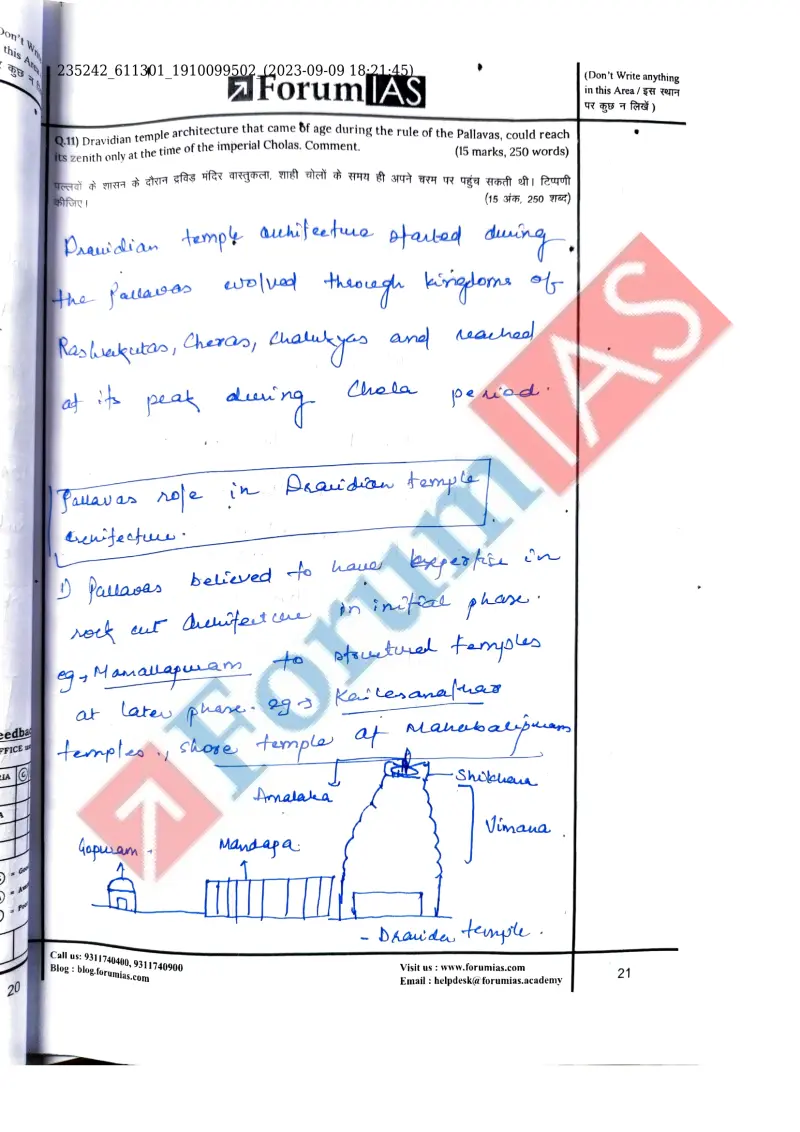
The imperial Chola temples (Brihadeshwara, Airavatesvara) and the labelled Dravida-temple diagram directly serve the PYQ on the Cholas' highest achievements in art and architecture.
Key learnings from their answer
- ›Diagrams carry actual content, not decoration: Q11's hand-drawn Dravida temple is labelled with its real parts (Gopuram, Mandapa, Amalaka, Shikhara, Vimana), and Q16 draws a world map marking the named seismic belts (Circum-Pacific, Mid-Atlantic, Continental) plus a fault-block diagram labelling epicentre/focus/hypocentre. -> When you draw, label it with the technical terms the answer needs to earn marks for; a sketch that names parts or maps locations is worth far more than a generic bubble chart.
- ›Almost every sub-point is anchored with a concrete 'eg ->' rather than a generic claim: Q2 names Faraizi, Eka, Indigo, Tebhaga, Pagalpanthis and Mappila movements instead of just saying 'peasant movements'; Q5 cites Joshimath's NTPC tunnel; Q15 cites the Reasi (J&K) lithium reserve and the South American 'lithium triangle'. -> Don't state a point and move on; immediately bolt a specific named instance onto it so the examiner sees you actually know the topic, not just the template.
What they cited: Q11: Mamallapuram, Kailasanatha & Shore temples, Rajasimha/Mahendravarman/Narasimha, Brihadeshwara temple (Rajaraja Chola), Airavatesvara temple, Hampi (Vijayanagara), Madurai (Pandya), Hoysala Somnatheswara temple