
 View answer copy →
Shakti DubeyAIR 1CSE 2024
Answered a very similar question
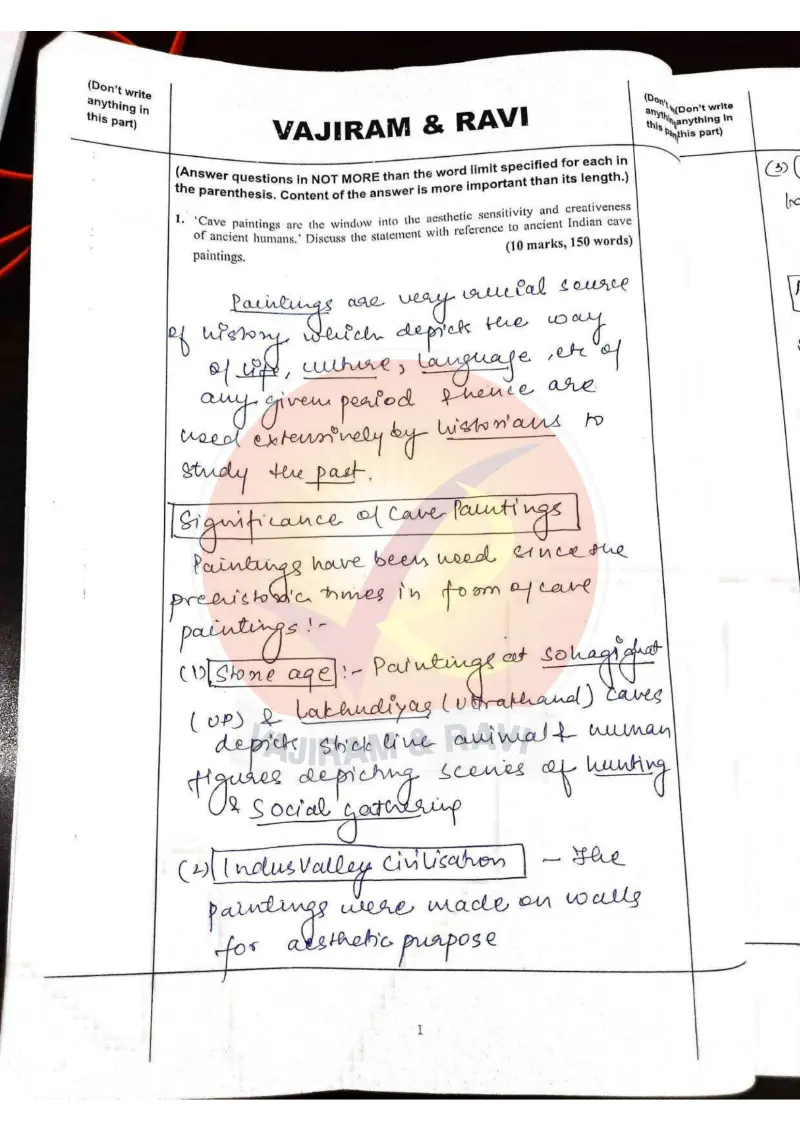
Their question: “Cave paintings as window into aesthetic sensitivity of ancient humans (10m/150w)”
Her prehistoric cave-art answer (stone-age rock paintings as source + aesthetic sense) directly serves this PYQ on Mesolithic rock-cut art reflecting cultural life and aesthetic sense comparable to painting.
Key learnings from their answer
- ›For factual GS1 questions she packs specific, named instances rather than vague description: Q1 cites exact cave sites with their content (Sohagighat & Lakhudiyar stone-age caves, Ajanta Bodhisattvas, Ellora Cave 16 Kailasha showing Ravana shaking Mount Kailash, Udayagiri-Khandgiri with Kharavela and the Jain Namokar mantra) -> memorise 4-5 concrete, attributable examples per static topic so an art/history answer reads as evidence, not generalities.
- ›She opens almost every answer with a one-line definition of the keyword before arguing ('Foreign policy can be defined as...', 'Globalisation can be defined as...', 'Communalism can be defined as...', 'Paintings are a very crucial source of history...') -> build one reusable definition-led intro template so you settle the demand and start the body in seconds instead of burning time hunting for an opening.
What they cited: Q1: Sohagighat (UP) & Lakhudiyar (Uttarakhand) stone-age caves; Ajanta (Bodhisattvas, kings & palaces); Bagh caves MP (Vishnu's boar/Varaha incarnation); Ellora Cave 16 / Kailasha temple (Ravana shaking Mount Kailash); Udayagiri-Khandgiri caves Odisha (Kharavela, Jain Namokar mantra)