
With reference to 'Atal Tunnel' which of the following statements is/are correct ? 1. This tunnel is the world's longest highway tunnel. 2. This tunnel is built in the Pir Panjal range of Himalayas. Select the correct answer from the code given below :
- (a)Only 2
- (b)Both 1 and 2
- (c)Neither 1 nor 2
- (d)Only 1
Correct — A, Only 2. Statement 2 is true: the Atal Tunnel is bored under the Rohtang Pass through the Pir Panjal range of the Himalayas, in Himachal Pradesh. Statement 1 is false as written, and that is the whole point of the question. The Atal Tunnel's record is a heavily qualified one — it is described as the world's longest highway single-tube tunnel above 10,000 feet (about 3,048 metres). It is nowhere near the world's longest highway tunnel: the Laerdal Tunnel in Norway runs about 24.5 km against the Atal Tunnel's 9.02 km, and even within India the Dr Syama Prasad Mookerjee (Chenani-Nashri) tunnel in Jammu and Kashmir is marginally longer at about 9.3 km. Strip the altitude qualifier away and the claim collapses.
- (b)Both 1 and 2 — This accepts the superlative at face value. The Pir Panjal half is right, but 'world's longest highway tunnel' is not — the qualifier 'above 10,000 feet' is doing all the work in the actual record, and Norway's 24.5 km Laerdal Tunnel is nearly three times as long.
- (c)Neither 1 nor 2 — It rejects too much. Statement 1 is indeed false, but statement 2 is correct — the tunnel passes beneath the Rohtang Pass, which lies in the Pir Panjal range of the Lesser (Middle) Himalaya.
- (d)Only 1 — This is the exact inversion of the truth: it keeps the false superlative and rejects the one verifiable geographical fact in the question.
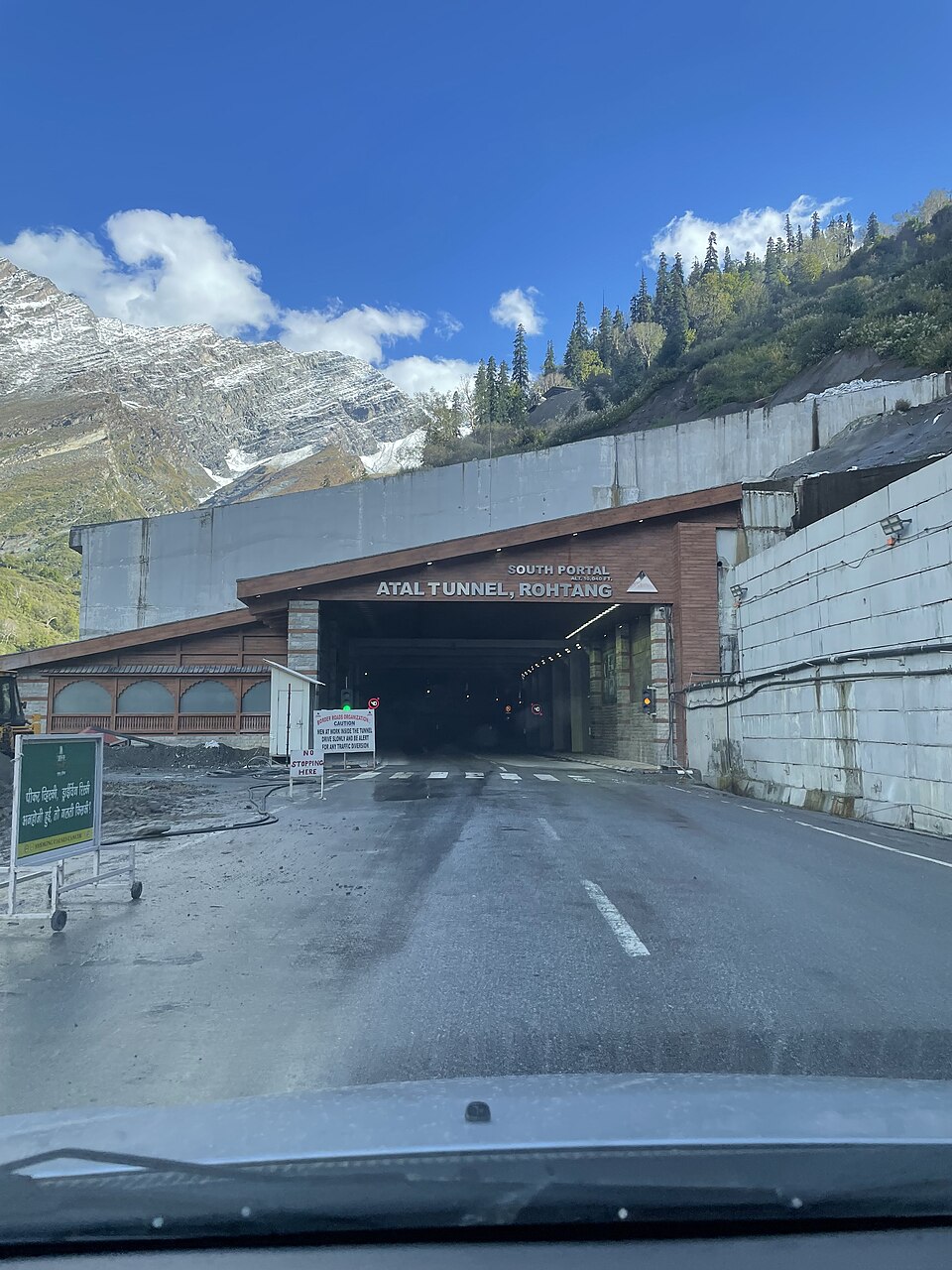
The Atal Tunnel is a 9.02 km horseshoe-shaped, single-tube, bi-lane highway tunnel on the Manali-Leh road, built by the Border Roads Organisation and inaugurated on 3 October 2020. It runs beneath the Rohtang Pass (about 3,978 m) in the Pir Panjal range, so it removes the pass — and the five to six months of snow closure that came with it — from the journey into the Lahaul valley. An emergency escape tunnel is built into the main tunnel section itself. It was renamed after former Prime Minister Atal Bihari Vajpayee in 2019.
Superlatives are the standard UPPSC trap, and the technique is always the same: check whether the record carries a qualifier. Almost every Indian infrastructure 'world record' does — highest railway bridge, longest tunnel above a given altitude, longest expressway of a given type. Here, the moment you recall that a European road tunnel like Laerdal is more than twice as long, statement 1 has to go. Statement 2 is the easier half if you remember that the Rohtang Pass belongs to the Pir Panjal, the most prominent range of the Lesser Himalaya, and not to the Greater Himalaya or the Dhauladhar.
- The Atal Tunnel is 9.02 km long, was built by the Border Roads Organisation and was inaugurated on 3 October 2020; it was renamed after Atal Bihari Vajpayee in 2019
- It is bored under the Rohtang Pass through the Pir Panjal range, which is part of the Lesser or Middle Himalaya, and lies at roughly 3,000 m above sea level
- Its actual record is the qualified one — the world's longest highway single-tube tunnel above 10,000 feet (3,048 m); the world's longest road tunnel is Norway's Laerdal Tunnel at about 24.5 km
- It cuts the Manali-Keylong road distance from about 116 km to about 71 km and the journey from five or six hours to roughly two, giving Lahaul-Spiti year-round road access
- It sits on the Manali-Leh axis, so its value is strategic as well as civilian: all-weather movement towards Ladakh no longer depends on the Rohtang Pass being open
- Accepting an unqualified superlative: the Atal Tunnel's record only holds with the phrase 'above 10,000 feet' attached
- Placing the tunnel in the Dhauladhar or the Greater Himalaya — the Rohtang Pass and the tunnel are in the Pir Panjal
- Confusing the Atal Tunnel with the Dr Syama Prasad Mookerjee (Chenani-Nashri) tunnel in Jammu and Kashmir, which is a slightly longer road tunnel at a much lower altitude
UPPSC likes a two-statement item where one statement is an inflated superlative and the other a plain locational fact; UPSC prefers to ask which range or pass a feature belongs to, or to pair peaks, passes and ranges and ask which pairing is wrong.
Consider the following pairs: Peak — Mountains 1. Namcha Barwa — Garhwal Himalaya 2. Nanda Devi — Kumaon Himalaya 3. Nokrek — Sikkim Himalaya Which of the pairs given above is/are correctly matched?
- (a) 1 and 2
- (b) 2 only
- (c) 1 and 3
- (d) 3 only
Answer(b) 2 only
The same skill as statement 2 — deciding whether a named feature has been assigned to the right Himalayan sub-range. UPSC's wrong pairs there (Namcha Barwa in the Garhwal Himalaya, Nokrek in the Sikkim Himalaya) fail for exactly the reason a candidate would fail here if the Atal Tunnel were placed outside the Pir Panjal.
Which one of the following pairs is not correctly matched?
- (a) Seikan Rail Tunnel — China
- (b) Petronas Tower — Malaysia
- (c) Appalachian Trail — United States of America
- (d) Rogun Dam — Tajikistan
Answer(a) Seikan Rail Tunnel — China
The same test applied to statement 1's half of the question — whether a famous tunnel has been correctly attributed. The Seikan Tunnel is in Japan, not China, and the item rewards a candidate who checks landmark claims instead of accepting a familiar-sounding pairing.
With reference to the Himalayan range, which of the statements is/are correct ? 1. The sedimentary rocks of the greater Himalayas were fossil less. 2. Marine livings fossils are found in the sedimentary rocks of lesser Himalayas. 3. Remains of human civilization are found in outer or Shivalik Himalayas. Select the correct answer using the codes given below : Codes :
- (a) 1 and 2 only
- (b) 2 and 3 only
- (c) 1 and 3 only
- (d) 1, 2 and 3 are correct
Answer(d) 1, 2 and 3 are correct
Same concept in the same exam — the internal structure of the Himalaya and what distinguishes the Greater, Lesser and Outer belts. Knowing that the Pir Panjal sits in the Lesser Himalaya is what settles statement 2 here.
- practice — not a real PYQ
The Atal Tunnel provides an all-weather alternative to which of the following passes?
- (a)Zoji La
- (b)Rohtang Pass
- (c)Baralacha La
- (d)Shipki La
Answer(b) Rohtang Pass — the tunnel runs beneath it, so the Lahaul valley no longer loses road access when the pass closes in winter.
- practice — not a real PYQ
The Pir Panjal range forms part of which division of the Himalayas?
- (a)Trans-Himalaya
- (b)Greater Himalaya (Himadri)
- (c)Lesser or Middle Himalaya (Himachal)
- (d)Outer Himalaya (Shivalik)
Answer(c) Lesser or Middle Himalaya (Himachal) — the Pir Panjal is the longest and most prominent range of this middle belt, with the Dhauladhar and Mahabharat ranges alongside it.