
With reference to 'ozone layer', which of the following statements is/are correct ? 1. Ozone layer shields the surface of the earth from the ultra-violet radiations from the sun. 2. Ozone depletion has been linked to the chlorofluorocarbons. Select the correct answer from the code given below : Code :
- (a)Only 2
- (b)Both 1 and 2
- (c)Neither 1 nor 2
- (d)Only 1
Correct — B, Both 1 and 2. Statement 1 states the defining function of the ozone layer. Ozone is concentrated in the stratosphere, roughly fifteen to thirty-five kilometres above the surface, and it absorbs essentially all of the sun's UV-C and the great bulk of its UV-B before that radiation can reach the ground. That is why the layer is described as a shield, and why its thinning is linked to skin cancer, cataract, suppressed immunity and damage to phytoplankton and crops. Statement 2 states the accepted cause of depletion. In 1974 Mario Molina and F. Sherwood Rowland showed that chlorofluorocarbons, being chemically inert in the lower atmosphere, survive long enough to drift into the stratosphere, where ultraviolet light breaks them apart and frees chlorine atoms; each chlorine atom then destroys ozone molecule after ozone molecule in a catalytic cycle without being consumed itself. That work, which won them the 1995 Nobel Prize in Chemistry together with Paul Crutzen, is the scientific basis of the Montreal Protocol of 1987. Both statements therefore stand, and the answer is 'Both 1 and 2'.
- (a)Only 2 — Accepts the chlorofluorocarbon link but rejects the shielding function. The absorption of ultraviolet radiation is the ozone layer's defining property — it is the reason temperature rises with height through the stratosphere, and the reason life on land was possible at all. Statement 1 is not a planted error; it is textbook.
- (c)Neither 1 nor 2 — Rejects two of the best-established facts in the environment syllabus. The UV-shielding role of stratospheric ozone and the destruction of that ozone by chlorine released from CFCs are both settled science, and the second was recognised with a Nobel Prize in Chemistry in 1995.
- (d)Only 1 — Accepts the shield but denies the chlorofluorocarbon link. This is the option for a candidate who has merged ozone depletion with global warming and assumes the culprit must be carbon dioxide. The two problems are distinct: CFCs, halons and related halocarbons deplete stratospheric ozone and are regulated by the Montreal Protocol, while greenhouse gases drive warming and are dealt with under the UNFCCC and its Kyoto and Paris instruments.
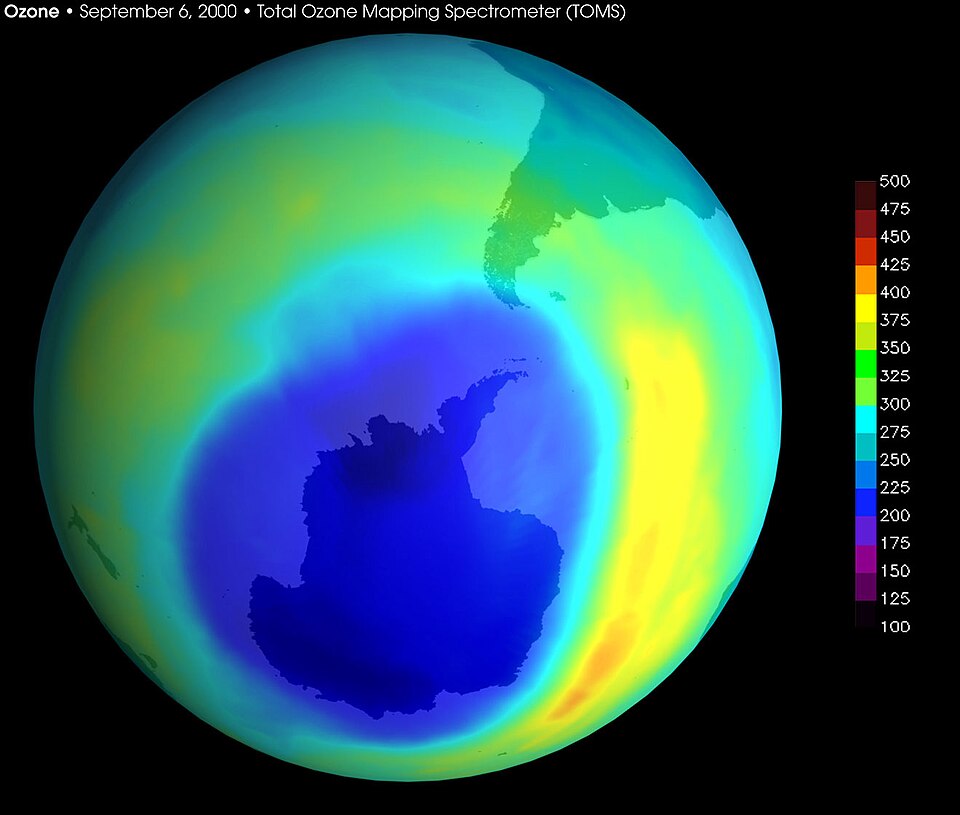
Ozone is a triatomic form of oxygen. Near the ground it is a pollutant and a component of photochemical smog; high in the stratosphere it is protective. A natural balance keeps it there: ultraviolet light splits molecular oxygen into free oxygen atoms, which combine with more oxygen to form ozone, and ultraviolet in turn splits ozone back down — the energy absorbed in that continuous cycle is what heats the stratosphere. Ozone-depleting substances such as chlorofluorocarbons, halons, carbon tetrachloride and methyl chloroform pass through the troposphere unreacted, reach the stratosphere and are photolysed there, releasing chlorine and bromine radicals that catalytically strip ozone. Column ozone is measured in Dobson Units, and the Antarctic 'ozone hole', reported in 1985 by British Antarctic Survey scientists, is a seasonal springtime collapse of that column, made severe by chemistry on polar stratospheric clouds inside the winter polar vortex.
Two-statement questions on famous topics are often 'both correct', and this is one of them: the examiner has written both statements straight, with no planted month, number or agency to catch you. The real risk here is over-reading. Candidates who expect a trap sometimes reject statement 1 on the ground that the ozone layer does not block all ultraviolet radiation — but the statement only claims that it shields the surface, which is true. The distinction genuinely worth carrying away is ozone depletion versus global warming: different gases, different atmospheric layers, different treaties. The one place the two regimes meet is the Kigali Amendment of 2016, which brought hydrofluorocarbons under the Montreal Protocol even though HFCs do not deplete ozone at all — they were added because they are powerful greenhouse gases.
- The ozone layer lies in the stratosphere, roughly 15-35 km above the surface, and absorbs essentially all UV-C and most UV-B radiation before it reaches the ground
- Mario Molina and F. Sherwood Rowland showed in 1974 that chlorofluorocarbons release ozone-destroying chlorine in the stratosphere; they shared the 1995 Nobel Prize in Chemistry with Paul Crutzen
- The Antarctic ozone hole was reported in 1985 by scientists of the British Antarctic Survey; it is a seasonal springtime thinning, deepened by reactions on polar stratospheric clouds inside the winter polar vortex
- The Montreal Protocol on Substances that Deplete the Ozone Layer was adopted on 16 September 1987 and phases out CFCs, halons and other ozone-depleting substances; its Kigali Amendment of 2016 adds hydrofluorocarbons, which are greenhouse gases rather than ozone depleters
- Total column ozone is measured in Dobson Units; ozone in the troposphere, by contrast, is a pollutant and a constituent of photochemical smog
- Assuming the Kyoto Protocol deals with the ozone layer — it deals with greenhouse gases; ozone-depleting substances belong to the Montreal Protocol
- Placing the protective ozone layer in the troposphere; the UV-absorbing ozone is stratospheric, while tropospheric ozone is a pollutant
- Over-reading a plainly written statement and rejecting it for not being exhaustive — 'shields the surface' does not claim that every ultraviolet ray is blocked
UPPSC asks the direct fact — which layer holds the ozone, which day is Ozone Day, whether CFCs are the cause. UPSC asks the mechanism — why the hole forms over Antarctica in particular, where CFCs were actually used, and which treaty governs which set of gases.
The formation of ozone hole in the Antarctic region has been a cause of concern. What could be the reason for the formation of this hole?
- (a) Presence of prominent tropospheric turbulence; and inflow of chlorofluorocarbons
- (b) Presence of prominent polar front and stratospheric clouds; and inflow of chlorofluorocarbons
- (c) Absence of polar front and stratospheric clouds; and inflow of methane and chlorofluorocarbons
- (d) Increased temperature at polar region due to global warming
Answer(b) Presence of prominent polar front and stratospheric clouds; and inflow of chlorofluorocarbons
The mechanism behind statement 2, taken one level deeper: the inflow of chlorofluorocarbons plus polar stratospheric clouds inside the polar front is what produces the Antarctic ozone hole. UPPSC asks whether CFCs are linked to depletion; UPSC asks how.
Which one of the following is associated with the issue of control and phasing out of the use of ozone-depleting substances?
- (a) Bretton Woods Conference
- (b) Montreal Protocol
- (c) Kyoto Protocol
- (d) Nagoya Protocol
Answer(b) Montreal Protocol
The treaty half of the same topic. Once you accept that CFCs deplete ozone, the Montreal Protocol is the instrument that controls them — and the question is built to separate it from the Kyoto and Nagoya Protocols.
Consider the following statements: Chlorofluorocarbons, known as ozone-depleting substances, are used 1. In the production of plastic foams 2. In the production of tubeless tyres 3. In cleaning certain electronic components 4. As pressurizing agents in aerosol cans Which of the statements given above is/are correct?
- (a) 1, 2 and 3 only
- (b) 4 only
- (c) 1, 3 and 4 only
- (d) 1, 2, 3 and 4
Answer(c) 1, 3 and 4 only
Where chlorofluorocarbons were actually used — plastic foams, electronics cleaning and aerosol propellants. Same substances, tested from the industrial side rather than the atmospheric one.
'Ozone layer' absorbing ultra - violet radiation exists in which of the atmospheric layer?
- (a) Troposphere
- (b) Mesosphere
- (c) Thermosphere
- (d) Stratosphere
Answer(d) Stratosphere
Statement 1 of this question, asked directly two cycles earlier: the ultraviolet-absorbing ozone layer sits in the stratosphere. UPPSC returns to the ozone layer repeatedly, alternating between its location, its function and its Ozone Day.
- practice — not a real PYQ
Which one of the following is NOT an ozone-depleting substance regulated under the Montreal Protocol?
- (a)Halons
- (b)Carbon tetrachloride
- (c)Carbon dioxide
- (d)Methyl chloroform
Answer(c) Carbon dioxide — it is a greenhouse gas dealt with under the UNFCCC and does not deplete stratospheric ozone; the other three are ozone-depleting substances controlled by the Montreal Protocol.
- practice — not a real PYQ
The Kigali Amendment of 2016 to the Montreal Protocol provides for the phase-down of:
- (a)Chlorofluorocarbons
- (b)Hydrofluorocarbons
- (c)Halons
- (d)Methyl bromide
Answer(b) Hydrofluorocarbons — HFCs were adopted as replacements for CFCs and do not deplete ozone, but they are potent greenhouse gases, which is why they were brought under the Protocol.