
Which of the following rivers fall into the Arabian Sea ? 1. Periyar 2. Pennar 3. Palar Select the correct answer from the code given below : Code :
- (a)Only 1
- (b)2 and 3
- (c)Only 3
- (d)1 and 2
Correct — A, Only 1. The Periyar is the only one of the three that reaches the Arabian Sea. It is Kerala's longest river, about 244 km, rising in the Western Ghats in Idukki district and flowing west to the Arabian Sea through the Vembanad backwaters near Kochi — the 'lifeline of Kerala', dammed at Mullaperiyar and Idukki. The other two are east-flowing Deccan rivers. The Pennar, or Penna, rises in the Nandi Hills of Chikkaballapur district in Karnataka, runs about 597 km through Karnataka and Andhra Pradesh, cuts the Gandikota gorge on its way through the Eastern Ghats and empties into the Bay of Bengal in coastal Andhra. The Palar also rises in the Nandi Hills, runs about 348 km through Karnataka, Andhra Pradesh and Tamil Nadu, and meets the Bay of Bengal at Vayalur, some 75 km south of Chennai. Only statement 1 is therefore correct.
- (b)2 and 3 — Exactly the two that do not qualify. Both the Pennar and the Palar rise in the Nandi Hills of Karnataka and flow east across the Deccan to the Bay of Bengal — the Pennar into coastal Andhra, the Palar at Vayalur south of Chennai.
- (c)Only 3 — The Palar is a Coromandel-coast river: it drains east through Vellore and Kanchipuram and enters the Bay of Bengal, not the Arabian Sea.
- (d)1 and 2 — Right about the Periyar, wrong about the Pennar. The Pennar's whole course runs eastward from the Karnataka uplands across Andhra Pradesh to the Bay of Bengal; it is the river that carved the Gandikota gorge, which UPSC asked about in 2022.
The Western Ghats are the peninsula's main water divide, and they run close to the west coast. Almost every large peninsular river therefore rises on the eastern flank of the Ghats and flows east across the Deccan into the Bay of Bengal — Mahanadi, Godavari, Krishna, Pennar, Palar, Kaveri, Vaigai — building broad deltas as it goes. Only two big rivers, the Narmada and the Tapi, flow west into the Arabian Sea, and they do so because they occupy rift valleys; they form estuaries rather than deltas. Everything else on the Arabian Sea side is a short, swift coastal stream of the Konkan and Malabar coasts, and the Periyar is one of these.
You do not have to memorise the mouth of every river; you need the divide. Ask where the river starts. If its whole course lies between the Ghats and the Arabian Sea — in Kerala, coastal Karnataka, Goa or the Konkan — it is west-flowing. If it starts on the Deccan side of the Ghats and crosses Andhra Pradesh or Tamil Nadu, it is east-flowing. The Periyar is Kerala's own river, so it goes west. Both the Pennar and the Palar begin in the Nandi Hills country of southern Karnataka and cross the plateau to the Coromandel coast, so both go east. That single rule eliminates options (b), (c) and (d) without any further recall.
- Periyar: about 244 km, the longest river in Kerala and the one with the largest discharge; it rises in the Western Ghats in Idukki district and reaches the Arabian Sea through Vembanad Lake near Kochi
- Pennar (Penna): rises in the Nandi Hills, Chikkaballapur district, Karnataka; about 597 km through Karnataka and Andhra Pradesh; cuts the Gandikota gorge and empties into the Bay of Bengal in coastal Andhra
- Palar: also rises in the Nandi Hills of Karnataka; about 348 km through Karnataka, Andhra Pradesh and Tamil Nadu; meets the Bay of Bengal at Vayalur, roughly 75 km south of Chennai
- Among the large peninsular rivers only the Narmada and the Tapi flow west into the Arabian Sea, along rift valleys, forming estuaries and not deltas
- The Periyar is called the lifeline of Kerala and is dammed at Mullaperiyar and at Idukki, whose arch dam supports a 780 MW hydro station
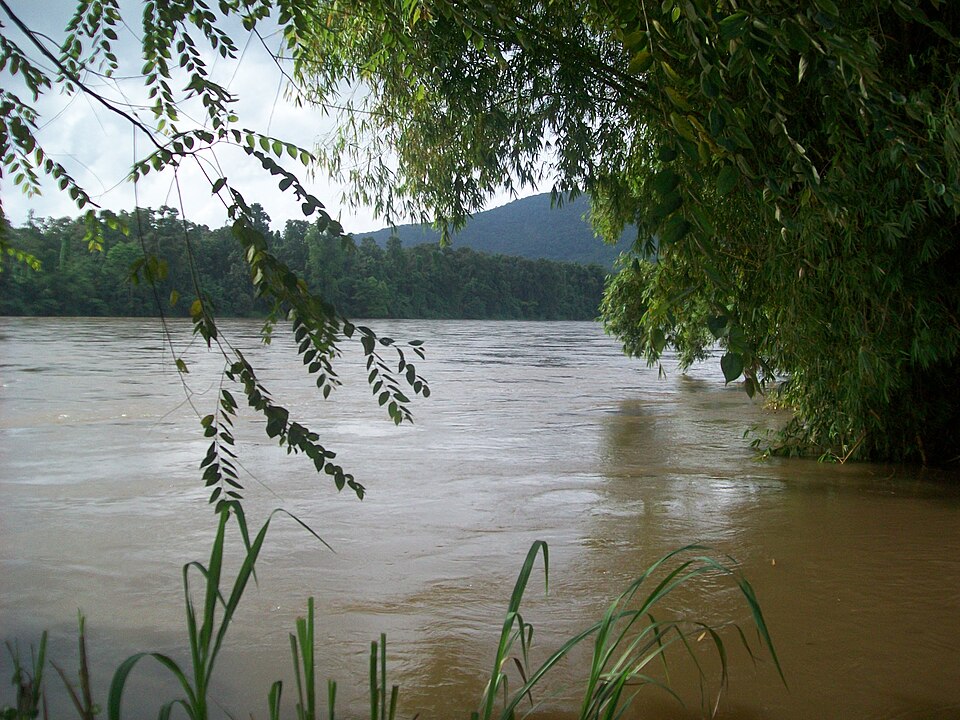
- Assuming that a river with a southern-sounding name in Tamil Nadu or Andhra must reach the nearer coast — the Palar crosses three states before reaching the Bay of Bengal
- Mixing the Periyar River up with Periyar Lake and the Periyar Tiger Reserve, or with the reformer Periyar E. V. Ramasamy
- Forgetting that the Pennar is an independent river flowing to the Bay of Bengal, not a tributary of the Godavari — a trap UPSC set in 2015
UPPSC asks which rivers drain into which sea, or matches a river to its source; UPSC prefers the identifying detail — which river carved a particular gorge, or which of a list are tributaries of a named system.
Gandikota canyon of South India was created by which one of the following rivers?
- (a) Cauvery
- (b) Manjira
- (c) Pennar
- (d) Tungabhadra
Answer(c) Pennar
Fixes the identity of the Pennar, the key distractor here — it is the river that carved the Gandikota canyon in Andhra Pradesh, on its way east to the Bay of Bengal.
The correct sequence of the eastward flowing rivers of the peninsular India from north to south is
- (a) Subarnarekha, Mahanadi, Godavari, Krishna, Pennar, Cauvery and Vagai
- (b) Subarnarekha, Mahanadi, Godavari, Cauvery, Vagai, Pennar
- (c) Mahanadi, Subarnarekha, Godavari, Krishna, Cauvery, Pennar and Vagai
- (d) Mahanadi, Subarnarekha, Krishna, Godavari, Cauvery, Vagai and Pennar
Answer(a) Subarnarekha, Mahanadi, Godavari, Krishna, Pennar, Cauvery and Vagai
Lists the Pennar explicitly among the east-flowing rivers of peninsular India, which is exactly the fact that makes statement 2 false in 2025.
Make the pairs of chief rivers of their place of origin - Rivers: (A) Yamuna (B) Krishna (C) Godavari (D) Mahanadi Place of origin: (1) Sihawa (2) Nasik (3) Mahabaleshwar (4) Yamunotri
- (a) A-(4), B-(2), C-(3), D-(1)
- (b) A-(4), B-(2), C-(1), D-(3)
- (c) A-(1), B-(2), C-(3), D-(4)
- (d) A-(4), B-(3), C-(2), D-(1)
Answer(d) A-(4), B-(3), C-(2), D-(1)
The same reasoning route by a different door — knowing where a peninsular river rises (Krishna at Mahabaleshwar, Godavari near Nasik) is what tells you which way it must flow and which coast it reaches.
- practice — not a real PYQ
Which one of the following pairs of large peninsular rivers flows west into the Arabian Sea?
- (a)Godavari and Krishna
- (b)Narmada and Tapi
- (c)Mahanadi and Kaveri
- (d)Pennar and Palar
Answer(b) Narmada and Tapi — both occupy rift valleys and form estuaries rather than deltas; the rest are east-flowing Bay of Bengal rivers.
- practice — not a real PYQ
The Periyar, the longest river of Kerala, finally discharges into the Arabian Sea through which water body?
- (a)Ashtamudi Lake
- (b)Vembanad Lake
- (c)Sasthamkotta Lake
- (d)Pulicat Lake
Answer(b) Vembanad Lake — the backwater system near Kochi; Pulicat, by contrast, is a lagoon on the Bay of Bengal coast.