
Match List - I with List - II and choose the correct answer using the code given below the lists. List - I (Nuclear Power Plant) A. Kudankulam B. Kakrapar C. Kaiga D. Rawatbhata List - II (State) 1. Karnataka 2. Tamil Nadu 3. Rajasthan 4. Gujarat
- (a)A-4, B-2, C-1, D-3
- (b)A-2, B-4, C-1, D-3
- (c)A-2, B-4, C-3, D-1
- (d)A-4, B-2, C-3, D-1
Correct — B, A-2, B-4, C-1, D-3. Kudankulam is on the southern coast of Tamil Nadu (2), in Tirunelveli district, and runs Russian-supplied VVER-1000 reactors. Kakrapar is in Gujarat (4), in Surat district near the Tapi, and is where India's first indigenously designed 700 MWe pressurised heavy water reactor went into commercial operation. Kaiga is in Karnataka (1), in Uttara Kannada district on the Kali river. Rawatbhata is in Rajasthan (3), in Chittorgarh district beside the Rana Pratap Sagar reservoir on the Chambal. Option (b) is the only code that carries all four correctly.
- (a)A-4, B-2, C-1, D-3 — Kaiga and Rawatbhata are placed correctly, but Kudankulam and Kakrapar are exchanged — Kudankulam is put in Gujarat and Kakrapar in Tamil Nadu. This is the intended trap, because both names begin similarly and both plants are in coastal states. Kudankulam is at India's southern tip in Tirunelveli district; Kakrapar is inland in Surat district, Gujarat.
- (c)A-2, B-4, C-3, D-1 — The first two pairs are right, but it then puts Kaiga in Rajasthan and Rawatbhata in Karnataka. Kaiga is in the Western Ghats of Uttara Kannada district, Karnataka; Rawatbhata is a Chambal-basin site in Chittorgarh district, Rajasthan.
- (d)A-4, B-2, C-3, D-1 — All four pairs are wrong — it swaps Kudankulam with Kakrapar and Kaiga with Rawatbhata at the same time, making it the exact reverse of the correct code.
India's commercial nuclear power stations are built and operated by the Nuclear Power Corporation of India Limited (NPCIL), a public sector undertaking under the Department of Atomic Energy, with the Atomic Energy Regulatory Board as the safety regulator. The backbone of the fleet is the indigenous pressurised heavy water reactor (PHWR), which uses natural uranium and heavy water; the exceptions are the American-built boiling water reactors at Tarapur and the Russian VVER pressurised water reactors at Kudankulam.
Plant-to-state questions are pure map recall, so tie each station to a physical feature rather than to its name. Kudankulam sits on the Gulf of Mannar coast at the very bottom of Tamil Nadu; Kakrapar is on the Tapi in Surat district; Kaiga is on the Kali river in the Western Ghats of Karnataka; Rawatbhata is on the Chambal at the Rana Pratap Sagar dam in Rajasthan. Once the water source is attached to the name, the swaps that the wrong options rely on become obvious. For a UP-focused exam, remember the one this list leaves out — Narora, in Bulandshahr district, is Uttar Pradesh's only nuclear power station.
- All of India's commercial nuclear power stations are operated by NPCIL under the Department of Atomic Energy
- Kudankulam (Tirunelveli district, Tamil Nadu) uses Russian VVER-1000 pressurised water reactors; Units 1 and 2 of 1,000 MWe each are operating and further units are under construction, making it India's largest nuclear station by installed capacity
- Kakrapar (Surat district, Gujarat) is where KAPS-3, India's first indigenously designed 700 MWe PHWR, entered commercial operation in 2023
- Kaiga (Uttara Kannada district, Karnataka) has four 220 MWe PHWRs; Kaiga Unit-1 set a world record for uninterrupted reactor operation, running continuously for 962 days up to December 2018
- Rawatbhata (Chittorgarh district, Rajasthan) is where RAPS-1, India's first pressurised heavy water reactor, was built with Canadian collaboration; Tarapur in Maharashtra (1969) is India's oldest station and Narora in Bulandshahr is Uttar Pradesh's only one
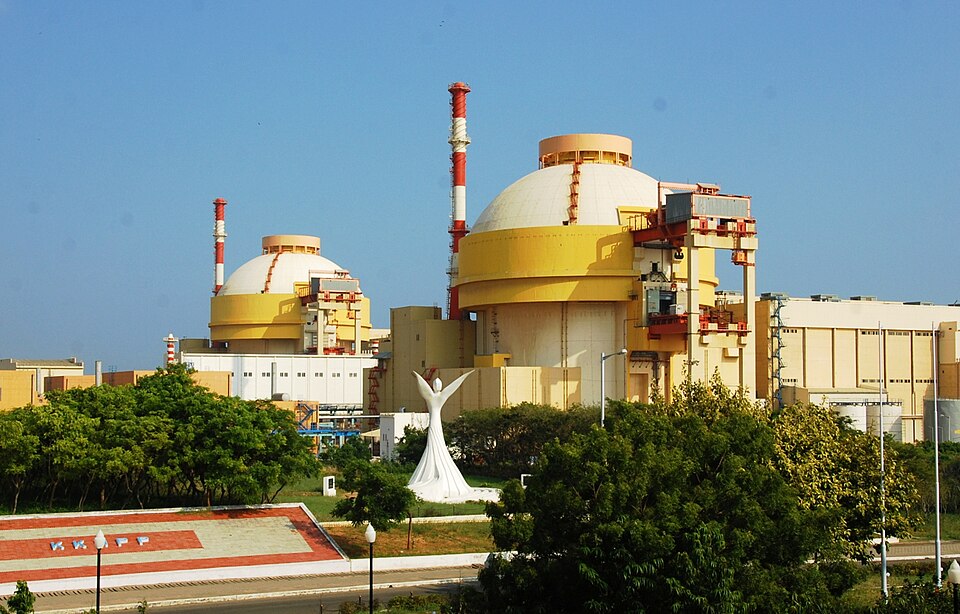
- Swapping Kudankulam and Kakrapar — anchor Kudankulam to Tamil Nadu's southern coast and Kakrapar to the Tapi in Surat district, Gujarat
- Confusing Kalpakkam with Kudankulam: both are in Tamil Nadu, but Kalpakkam houses the Madras Atomic Power Station and the Prototype Fast Breeder Reactor, not the VVER units
- Forgetting Narora — Uttar Pradesh's only nuclear power station, in Bulandshahr district, and a standing favourite for a UPPSC follow-up question
UPPSC asks the plant-to-state match list directly, and often follows it up with a UP-specific item on Narora; UPSC prefers the programme-level angle — reactor types, the three-stage plan, fuel cycles and the institutions involved.
Match List-I (Atomic Power Plants/Heavy Water Plants) with List-II (State) and select the correct answer using the code given below the lists : List-I (A) Thal (B) Manuguru (C) Kakrapar (D) Kaiga List-II (State) 1. Andhra Pradesh 2. Gujarat 3. Maharastra 4. Maha 5. Karnataka
- (a) 2 1 4 5
- (b) 3 5 2 1
- (c) 2 5 4 1
- (d) 3 1 2 5
Answer(d) 3 1 2 5
The same concept and the same format — nuclear and heavy-water plants matched against their states — and it shares two of the four entries with this UPPSC question, Kakrapar (Gujarat) and Kaiga (Karnataka). Note that the store's copy of List-II carries a garbled fourth entry; the answer and the four working pairings are unaffected.
- practice — not a real PYQ
Narora Atomic Power Station is located in which state?
- (a)Uttarakhand
- (b)Uttar Pradesh
- (c)Bihar
- (d)Haryana
Answer(b) Uttar Pradesh — Narora is in Bulandshahr district, on the Ganga, and is the only nuclear power station in the state.
- practice — not a real PYQ
Which type of reactor is used at the Kudankulam Nuclear Power Plant?
- (a)Boiling water reactor
- (b)Pressurised heavy water reactor
- (c)VVER pressurised water reactor
- (d)Prototype fast breeder reactor
Answer(c) VVER pressurised water reactor — the Kudankulam units were supplied under Russian collaboration; PHWRs are the indigenous mainstay elsewhere and the boiling water reactors are at Tarapur.