
Which one of the following pairs (Country – Oil field) is not correctly matched ?
- (a)Iran – Haft Kel
- (b)Kuwait – Kashagan
- (c)Saudi Arabia – Dhahran
- (d)Iraq – Zubair
Correct — B, Kuwait – Kashagan. Kashagan is not a Gulf field at all: it lies offshore in Kazakhstan's sector of the Caspian Sea, in the shallow northern Caspian off Atyrau. It was discovered in 2000 and was, at the time, the largest oil discovery anywhere in about thirty years, with roughly 13 billion barrels of recoverable crude — which is why it is a name examiners like. Kuwait's own fields are elsewhere and have different names: Burgan, discovered in February 1938 (drilling of Burgan No. 1 began in 1937) and one of the largest oil fields ever found, together with Raudhatain, Sabriya and Minagish. Pairing Kuwait with Kashagan therefore crosses two different petroleum provinces — the Persian Gulf basin and the Caspian basin — and that is the pair the question calls broken. Notice how the item is built: the other three pairs sit inside the Gulf, so the odd one is the one that has quietly moved a thousand kilometres north into Central Asia while keeping a plausible-sounding K-name. A useful mental hook is that the Caspian's oil belongs to Kazakhstan, Azerbaijan, Turkmenistan, Russia and Iran, and Kuwait does not touch the Caspian at any point.
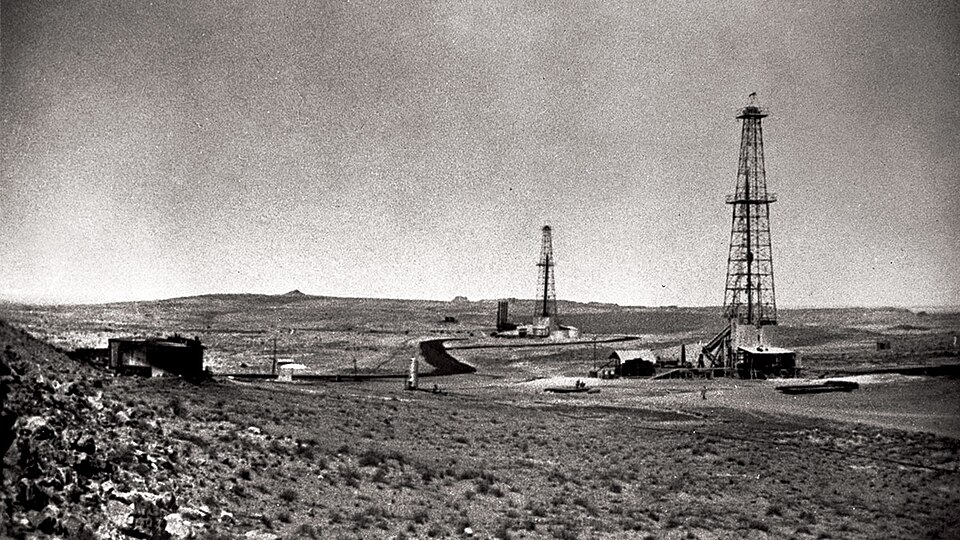
- (a)Iran – Haft Kel — Correctly matched, so it cannot be the answer. Haft Kel (also written Haftkel or Haft Gel) is an oil field in Iran's Khuzestan province, roughly 58 km south-east of Masjed Soleyman. It was discovered in 1928 during the Anglo-Persian Oil Company's inter-war exploration drive and was the company's second great find after Masjed Soleyman, which in 1908 had given the Middle East its first commercial oil. Haft Kel ran on primary production for decades, with an early plateau of about 200,000 barrels a day.
- (c)Saudi Arabia – Dhahran — Correctly matched. Dhahran, in Saudi Arabia's Eastern Province, is where the well Dammam No. 7 — remembered as the 'Prosperity Well' — struck oil in commercial quantity on 3 March 1938, the discovery that turned the kingdom into an oil state and that Aramco was built around. Do not reject this option on the technicality that Dhahran is a town and the reservoir is properly the Dammam field: Indian geography texts and the examiners who write from them list Dhahran as Saudi Arabia's oil centre, and the country is unambiguously right. Saudi Arabia's giant field is Ghawar, found ten years later in 1948.
- (d)Iraq – Zubair — Correctly matched. The Az Zubayr (Zubair) field lies in southern Iraq, west of Basra, and was discovered in 1949; it holds about 4.5 billion barrels of proven reserves and is one of the southern Iraqi fields opened to international operators after 2009. Iraq's other well-known fields follow the same north–south split — Kirkuk in the north, and Rumaila, West Qurna, Majnoon and Nahr Umr in the Basra region alongside Zubair.
World petroleum is concentrated in a handful of sedimentary basins, and prelims questions almost always test whether you can put a named field in the right basin and the right country. Three basins carry most of the names an aspirant will meet: the Persian Gulf basin, by far the richest, holding Ghawar and Safaniya in Saudi Arabia, Burgan in Kuwait, Rumaila, Kirkuk and Zubair in Iraq, and the Khuzestan fields of Iran; the Caspian basin, holding Kashagan and Tengiz in Kazakhstan and the Azeri–Chirag–Gunashli complex off Azerbaijan; and the North Sea, which gives the Brent benchmark. The Gulf fields are mostly onshore or shallow-offshore Cretaceous and Jurassic carbonates; the north Caspian fields are offshore, ice-affected and technically difficult, which is why Kashagan took thirteen years from discovery to first oil.
This is a country-recognition question wearing an oil-field costume, and it is solved by geography rather than by petroleum knowledge. Three of the four names — Haft Kel, Dhahran, Zubair — sit within a few hundred kilometres of the head of the Persian Gulf, in Khuzestan, the Saudi Eastern Province and Basra respectively. Kashagan does not; it is in the Caspian, and Kuwait is a Gulf state with no Caspian coastline. The trap works on three levels at once. Kashagan is unfamiliar enough that a candidate may simply not have heard of it and may hesitate to call a pair wrong on that basis. Its K-sound rhymes with Kuwait. And the other three pairs are pitched to feel slightly shaky — Haft Kel is obscure, and Dhahran is a city rather than a reservoir name — so the eye is tempted away from the pair that is actually broken. The discipline that fixes it: for every named oil field, store the country and the basin together, and remember that Kuwait's field is Burgan.
- Kashagan Field is an offshore oil field in Kazakhstan's zone of the Caspian Sea, discovered in 2000, with roughly 13 billion barrels of recoverable oil — one of the largest discoveries of the last three decades.
- Kuwait's own oil fields are Burgan (discovered in February 1938 (drilling of Burgan No. 1 began in 1937), among the largest in the world), Raudhatain, Sabriya and Minagish — not Kashagan.
- Haft Kel is an oil field in Khuzestan province, Iran, discovered in 1928, about 58 km south-east of Masjed Soleyman, where the Middle East's first commercial oil was struck in 1908.
- Dhahran, Eastern Province, Saudi Arabia, is the site of Dammam No. 7 ('Prosperity Well'), which produced the kingdom's first commercial oil on 3 March 1938; Saudi Arabia's giant Ghawar field was found in 1948.
- The Az Zubayr (Zubair) field is in southern Iraq, west of Basra, discovered in 1949, with about 4.5 billion barrels of proven reserves.
- Rejecting 'Saudi Arabia – Dhahran' because Dhahran is a city. The pair is about the country, and Dhahran is where Saudi oil was first found — this is not the broken pair.
- Assuming an unfamiliar field name must belong to the Gulf. Kashagan, Tengiz and Azeri–Chirag–Gunashli are Caspian, not Gulf.
- Mixing Iraq's oil towns with other countries. Kirkuk and Mosul are Iraqi — UPSC planted exactly that error in 2018.
UPPSC's house style for world economic geography is the NOT-correctly-matched pair — country against a mining town or an oil field — and it reuses the format year after year. UPSC prefers 'towns sometimes mentioned in news — country', or a question on a benchmark crude such as Brent or West Texas Intermediate.
Consider the following pairs: Towns sometimes mentioned in news — Country 1. Aleppo — Syria 2. Kirkuk — Yemen 3. Mosul — Palestine 4. Mazar-i-sharif — Afghanistan Which of the pairs given above are correctly matched?
- (a) 1 and 2
- (b) 1 and 4
- (c) 2 and 3
- (d) 3 and 4
Answer(b) 1 and 4
The same trick in UPSC's hands — West Asian towns deliberately assigned to the wrong countries, with the oil city Kirkuk moved to Yemen and Mosul to Palestine. Both are Iraqi, and the skill being tested is identical: fix a named place to its country before judging the pair.
Consider the following pairs: Sea — Bordering country 1. Adriatic Sea : Albania 2. Black Sea : Croatia 3. Caspian Sea : Kazakhstan 4. Mediterranean Sea : Morocco 5. Red Sea : Syria Which of the pairs given above are correctly matched?
- (a) 1, 2 and 4 only
- (b) 1, 3 and 4 only
- (c) 2 and 5 only
- (d) 1, 2, 3, 4 and 5
Answer(b) 1, 3 and 4 only
Carries the fact that anchors this question — the Caspian Sea borders Kazakhstan. Kashagan lies in that Kazakh sector of the Caspian, which is exactly why it cannot belong to Kuwait, a Gulf state with no Caspian coast.
Which one of the following is NOT correctly matched ? (Country) — (Iron-Ore Producing Area)
- (a) Kazakhstan — Karaganda
- (b) Ukrain — Krivoy Rog
- (c) Germany — Normendy
- (d) France — Pyrenees
Answer(c) Germany — Normendy
The same question type from the same commission, four years earlier — a country matched against a named producing area, with one pair deliberately broken by moving the area into the wrong country. Treat the two as one preparation unit for world resource geography.
- practice — not a real PYQ
The Kashagan oil field, one of the largest discoveries of the past three decades, lies in the offshore waters of which country?
- (a)Azerbaijan
- (b)Kazakhstan
- (c)Turkmenistan
- (d)Kuwait
Answer(b) Kazakhstan — Kashagan is an offshore field in Kazakhstan's zone of the northern Caspian Sea, discovered in 2000; Azerbaijan's flagship offshore complex is Azeri–Chirag–Gunashli.
- practice — not a real PYQ
Which one of the following pairs (Country – Oil field) is correctly matched?
- (a)Kuwait – Ghawar
- (b)Saudi Arabia – Burgan
- (c)Iraq – Rumaila
- (d)Kazakhstan – Zubair
Answer(c) Iraq – Rumaila — Rumaila is in southern Iraq near Basra. Ghawar is Saudi Arabian, Burgan is Kuwaiti, and Zubair is Iraqi, so the other three pairs are all crossed.