
Match List-I with List-II and choose the correct answer using the codes given below the lists : List-I (Place) A. Devprayag B. Rudraprayag C. Karnaprayag D. Tehri List-II (Confluencing Rivers) 1. Alaknanda and Pindar 2. Alaknanda and Bhagirathi 3. Bhagirathi and Bhilangna 4. Alaknanda and Mandakini Codes :
- (a)A-4, B-1, C-2, D-3
- (b)A-2, B-3, C-1, D-4
- (c)A-4, B-1, C-3, D-2
- (d)A-2, B-4, C-1, D-3
Correct — D, A-2, B-4, C-1, D-3. Take the four places one at a time. Devprayag, in Tehri Garhwal district, is where the Alaknanda meets the Bhagirathi, and it is the single most consequential confluence in the Himalaya because below this point the united stream stops being two rivers and becomes the Ganga — so A pairs with 2. Rudraprayag, which gives its district its name, is the meeting of the Alaknanda with the Mandakini, the river that comes down from Kedarnath, so B pairs with 4. Karnaprayag, in Chamoli district, is where the Pindar, fed by the Pindari glacier in Kumaon, joins the Alaknanda, so C pairs with 1. Tehri is not a prayag at all — it is the town, now submerged as Old Tehri beneath the Tehri reservoir, that stood at the junction of the Bhagirathi with the Bhilangana, the stream that rises at the Khatling glacier; so D pairs with 3. Reading the codes off, A-2, B-4, C-1, D-3 is option (d). Notice the structural clue the examiner has left: three of the four places are on the Alaknanda and only Tehri is on the Bhagirathi, so the moment you fix Tehri to the Bhilangana pair you have eliminated every option except (b) and (d), and Devprayag then decides between them.
- (a)A-4, B-1, C-2, D-3 — Gets Tehri right but rotates the three prayags by one step. It puts the Mandakini at Devprayag (that is Rudraprayag), the Pindar at Rudraprayag (that is Karnaprayag) and the Bhagirathi at Karnaprayag (that is Devprayag). This is the classic error of a candidate who remembers the four tributary names and the four places but not which goes with which, and it is why the Panch Prayag should be learned as an ordered upstream-to-downstream chain rather than as a loose list.
- (b)A-2, B-3, C-1, D-4 — Right about Devprayag and Karnaprayag but swaps the last two. It sends the Bhagirathi–Bhilangana confluence to Rudraprayag and the Alaknanda–Mandakini confluence to Tehri — geographically impossible, because the Bhilangana joins the Bhagirathi in the Tehri Garhwal valley while the Mandakini comes down the Kedarnath valley to meet the Alaknanda at Rudraprayag. The two river systems do not touch until Devprayag, far downstream of both.
- (c)A-4, B-1, C-3, D-2 — Every one of its four pairs is wrong. Devprayag is given the Mandakini, Rudraprayag the Pindar, Karnaprayag the Bhilangana and Tehri the Alaknanda–Bhagirathi confluence, which is Devprayag's defining feature. The last of these is the most misleading half-memory in the set: candidates who recall that the Ganga is formed by the union of the Bhagirathi and the Alaknanda, and separately that the Tehri dam is on the Bhagirathi, sometimes fuse the two into a belief that the union happens at Tehri. It happens 80-odd kilometres downstream, at Devprayag.
The Ganga is assembled in the Garhwal Himalaya out of two headstreams and a series of tributaries that join at named confluences called prayags. The Bhagirathi rises at Gaumukh, the snout of the Gangotri glacier, and is joined at Old Tehri by the Bhilangana from the Khatling glacier. The Alaknanda rises at the foot of the Satopanth glacier and collects four tributaries in turn on its 229-kilometre course. Those four meetings, plus its final union with the Bhagirathi, are the Panch Prayag — the five sacred confluences — and each has a temple town at it. Below the fifth, at Devprayag, the river is the Ganga.
This item is a memory test with a built-in shortcut, and the shortcut is to learn the Panch Prayag in order from the source downstream: Vishnuprayag (Alaknanda + Dhauliganga, near Joshimath), Nandprayag (Alaknanda + Nandakini), Karnaprayag (Alaknanda + Pindar), Rudraprayag (Alaknanda + Mandakini) and Devprayag (Alaknanda + Bhagirathi). Read as a chain, each place has exactly one tributary attached to it and the confusion disappears. Tehri is thrown in as the odd item out — it is on the other headstream entirely, and it is the one place in the list that is famous for a dam rather than for a temple. Recognising that Tehri belongs to the Bhagirathi–Bhilangana system, not the Alaknanda system, is the fastest single move available in this question.
- Panch Prayag, upstream to downstream: Vishnuprayag (Alaknanda + Dhauliganga, Chamoli), Nandprayag (Alaknanda + Nandakini, Chamoli), Karnaprayag (Alaknanda + Pindar, Chamoli), Rudraprayag (Alaknanda + Mandakini, Rudraprayag district), Devprayag (Alaknanda + Bhagirathi, Tehri Garhwal).
- Below Devprayag the combined stream is called the Ganga — which is why Devprayag, not Gangotri or Haridwar, is treated as the birthplace of the river.
- The Bhilangana rises at the Khatling glacier and joins the Bhagirathi at Old Tehri, the town now under the Tehri reservoir. Tehri is not one of the Panch Prayag.
- The Tehri Dam, on the Bhagirathi in Tehri Garhwal district, is a 260.5-metre rock-and-earth-fill embankment — India's tallest dam — with 1,000 MW of installed capacity; it became operational in 2006.
- Source glaciers to remember with the confluences: Bhagirathi from Gaumukh (Gangotri glacier), Alaknanda from the Satopanth glacier, Pindar from the Pindari glacier, Mandakini from the Chorabari glacier above Kedarnath.
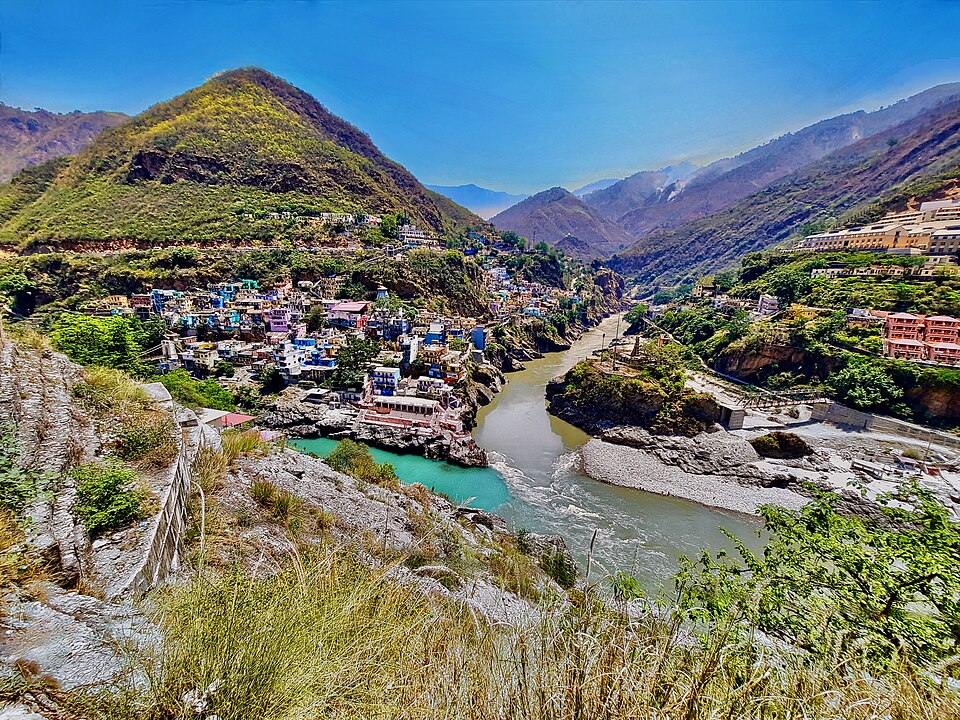
- Believing the Ganga is formed at Tehri or at Gangotri. It is formed at Devprayag, where the Alaknanda and the Bhagirathi unite; Gangotri is the source region of the Bhagirathi alone.
- Swapping Rudraprayag and Karnaprayag. Rudraprayag takes the Mandakini from Kedarnath; Karnaprayag takes the Pindar from the Pindari glacier. Fix them by the shrine and the glacier, not by the place name alone.
- Counting Tehri among the Panch Prayag. It is a Bhagirathi–Bhilangana junction and a dam town, not one of the five confluences of the Alaknanda system.
UPPSC asks this as a match-list of place against confluencing rivers, or as a direct single-answer question naming one confluence; UPSC prefers to ask which river a named project or shrine stands on, or to pair glaciers with the rivers they feed.
On which one of the following rivers is the Tehri Hydropower Complex located?
- (a) Alaknanda
- (b) Bhagirathi
- (c) Dhauliganga
- (d) Mandakini
Answer(b) Bhagirathi
Fixes item D from the other side. Tehri sits on the Bhagirathi, not the Alaknanda — which is exactly why the only List-II entry it can take is 'Bhagirathi and Bhilangna', and why options (b) and (c) collapse.
Consider the following pairs: Glacier — River 1. Bandarpunch : Yamuna 2. Bara Shigri : Chenab 3. Milam : Mandakini 4. Siachen : Nubra 5. Zemu : Manas Which of the pairs given above are correctly matched?
- (a) 1, 2 and 4
- (b) 1, 3 and 4
- (c) 2 and 5
- (d) 3 and 5
Answer(a) 1, 2 and 4
The same headwater geography one rung upstream — which glacier feeds which Himalayan river. The falsified pair there is Milam–Mandakini (Milam actually feeds the Gori Ganga), so knowing that the Mandakini comes off the Chorabari glacier above Kedarnath and meets the Alaknanda at Rudraprayag answers both questions.
Which one of the following place is the confluence of the river Alakhnanda and the Bhagirathi?
- (a) Dev Prayag
- (b) Karn Prayag
- (c) Rudra Prayag
- (d) Vishnu Prayag
Answer(a) Dev Prayag
The very pair A-2, asked as a direct one-liner the year before. UPPSC has now used the Panch Prayag in two consecutive papers, first as a single confluence and then as a full match-list, which tells you how to prepare it.
- practice — not a real PYQ
Which one of the following is the correct upstream-to-downstream order of the Panch Prayag on the Alaknanda?
- (a)Devprayag, Rudraprayag, Karnaprayag, Nandprayag, Vishnuprayag
- (b)Vishnuprayag, Nandprayag, Karnaprayag, Rudraprayag, Devprayag
- (c)Nandprayag, Vishnuprayag, Rudraprayag, Karnaprayag, Devprayag
- (d)Vishnuprayag, Karnaprayag, Nandprayag, Devprayag, Rudraprayag
Answer(b) Vishnuprayag, Nandprayag, Karnaprayag, Rudraprayag, Devprayag — the Alaknanda picks up the Dhauliganga, Nandakini, Pindar and Mandakini in that order before meeting the Bhagirathi at Devprayag, below which the river is the Ganga.
- practice — not a real PYQ
The Bhilangana river joins the Bhagirathi at which of the following places?
- (a)Devprayag
- (b)Uttarkashi
- (c)Old Tehri
- (d)Rudraprayag
Answer(c) Old Tehri — the Bhilangana rises at the Khatling glacier and meets the Bhagirathi at Old Tehri, the town submerged by the Tehri reservoir. Devprayag is the Alaknanda–Bhagirathi confluence and Rudraprayag is the Alaknanda–Mandakini confluence.