
CPR stands for :
- (a)Cardio Programme Rescue
- (b)Cardiac Pulsatile Revision
- (c)Cardiopulmonary Resuscitation
- (d)Cardiopulmonary Revision
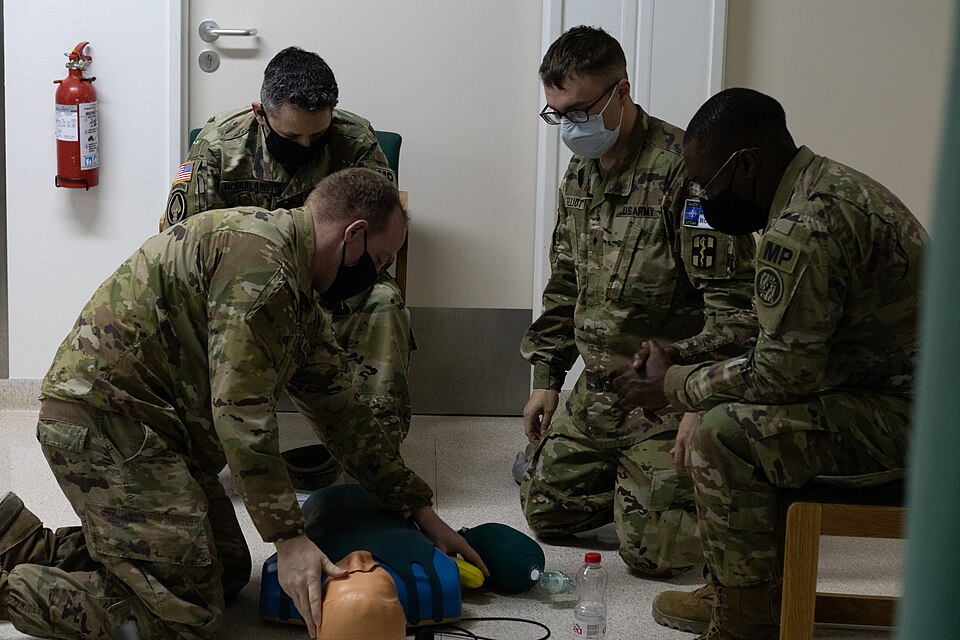
Correct — C, Cardiopulmonary Resuscitation. Take the word apart and the answer builds itself: cardio- is the heart, pulmonary is the lungs, and resuscitation means bringing back from apparent death. CPR is therefore the emergency procedure that artificially takes over the two functions that stop together in cardiac arrest — the pumping of blood and the movement of air — and keeps them going until a defibrillator or an advanced-care team arrives. The technique is chest compressions, which squeeze the heart between the sternum and the spine and push blood forward, combined with rescue breaths. Standard adult guidance from the American Heart Association and the international resuscitation bodies is compressions at a rate of 100 to 120 per minute, to a depth of about 5 cm (and not beyond about 6 cm), allowing the chest to recoil fully between compressions, in cycles of 30 compressions to 2 breaths for a single rescuer; a bystander who is untrained or unwilling to give breaths is told to do compression-only, or 'hands-only', CPR rather than nothing. The reason the acronym matters at all is a clock: once circulation stops, the brain begins to sustain irreversible damage within roughly four to six minutes, and survival from out-of-hospital cardiac arrest falls sharply with every minute that passes before compressions begin. That is why the correct expansion is Resuscitation — the act of restoring life — and not any of the three plausible-sounding alternatives on offer.
- (a)Cardio Programme Rescue — Not a term used in medicine at all. 'Programme' belongs to the vocabulary of administration and public health campaigns, not to a bedside clinical procedure, and the word order is not how medical acronyms are built — they name the system involved and then the action performed on it. There is no recognised emergency technique by this name.
- (b)Cardiac Pulsatile Revision — Every word here exists in medicine but the combination does not. 'Pulsatile' describes a flow pattern — it is used, for instance, to distinguish pulsatile from continuous-flow mechanical heart pumps — and 'revision' is a surgical term meaning an operation done again to correct or replace an earlier one, as in revision joint surgery. Neither describes an emergency manoeuvre performed by a bystander on a collapsed person, and this option also drops 'pulmonary', so it leaves out the lungs entirely.
- (d)Cardiopulmonary Revision — This is the designed trap: the first two-thirds of the expansion are exactly right, and only the last word is swapped. But 'revision' means re-doing or re-examining something, which is not what is being done to a person in cardiac arrest — the aim is to revive, and the word for reviving is resuscitation. In an options set where three choices share the 'cardio-' opening, the whole question turns on recognising which final noun denotes an act of revival.
CPR is the first-aid response to cardiac arrest — the sudden failure of the heart to pump, in which the person collapses, is unresponsive, and has no pulse and no normal breathing. The single most examinable idea here is that cardiac arrest is not the same thing as a heart attack. A heart attack (myocardial infarction) is a plumbing failure: a coronary artery is blocked and a patch of heart muscle starts to die, but the person is usually awake and can describe the pain. Cardiac arrest is an electrical failure: the heart's rhythm collapses, most often into ventricular fibrillation, and pumping stops within seconds. A heart attack can trigger a cardiac arrest, but only cardiac arrest calls for CPR.
The question is a pure full-form item, so the reasoning is linguistic rather than clinical: three of the four options are built from real medical roots and are meant to look equally technical. Split each into its parts and ask which one names both organs and an act of revival. Only (c) does — cardio (heart) plus pulmonary (lungs) plus resuscitation (revival). Option (d) is the near-miss, differing in one word; the discipline of reading all four options to the end, rather than stopping at the first two familiar words, is exactly what UPPSC is testing. Around this sits the Chain of Survival, the sequence that decides whether a collapsed person lives: recognise the arrest and call for help, start high-quality CPR at once, defibrillate as early as possible with an AED, hand over to advanced life support, and then post-arrest hospital care.
- CPR = Cardiopulmonary Resuscitation: chest compressions plus rescue breaths, used when a person is in cardiac arrest — unresponsive, with no pulse and no normal breathing.
- Standard adult technique per the American Heart Association and international resuscitation guidelines: compress at 100–120 per minute, about 5 cm deep (not beyond ~6 cm), allow full chest recoil, and use a 30 compressions : 2 breaths cycle for a single rescuer.
- Untrained bystanders are advised to give compression-only ('hands-only') CPR for an adult collapse — doing compressions without breaths is far better than doing nothing.
- Cardiac arrest (an electrical failure of rhythm, person collapses and has no pulse) is not the same as a heart attack (a blocked coronary artery, person usually conscious). CPR is for the former.
- An AED — Automated External Defibrillator — delivers the shock that can restore a normal rhythm in ventricular fibrillation; CPR buys the minutes until it arrives, because irreversible brain damage begins within roughly four to six minutes of stopped circulation.
- In India, Section 134A of the Motor Vehicles Act, 1988 (inserted by the Motor Vehicles (Amendment) Act, 2019) protects a Good Samaritan who helps an accident victim from civil and criminal liability.
- Stopping at the first two words. Options (c) and (d) both begin 'Cardiopulmonary' and differ only in Resuscitation versus Revision — the whole mark rides on the last word.
- Treating CPR as the response to a heart attack. It is the response to cardiac arrest; a conscious person with chest pain needs an ambulance and aspirin protocol, not chest compressions.
- Confusing resuscitation with 'artificial respiration'. Artificial respiration is only the breathing half; CPR combines it with circulation support through compressions, and compressions are the part that must never be delayed.
UPPSC uses straight full-form and abbreviation items in its general-science block — CPR, AED, MRI, ECG, ELISA — so the safe preparation is to know both the expansion and one line on what the thing does. UPSC almost never asks a bare full form; it converts the same content into a physiology or health-policy question, such as which organ or receptor is involved, or how India's emergency care system is organised.
No directly related past PYQ was found.
- practice — not a real PYQ
In emergency care, 'AED' stands for :
- (a)Acute Emergency Diagnosis
- (b)Automated External Defibrillator
- (c)Assisted Endotracheal Device
- (d)Automatic Electrocardiac Detector
Answer(b) Automated External Defibrillator — a portable device that analyses the heart's rhythm and, if it finds a shockable rhythm such as ventricular fibrillation, delivers a controlled electric shock. CPR keeps blood moving until the AED arrives; the AED is what can actually restore a normal rhythm.
- practice — not a real PYQ
CPR should be started immediately in which one of the following situations?
- (a)A person with severe chest pain who is conscious and talking
- (b)A person who has collapsed, is unresponsive and has no normal breathing or pulse
- (c)A person who has fainted but is breathing normally
- (d)A person with a fractured leg after a fall
Answer(b) A person who has collapsed, is unresponsive and has no normal breathing or pulse — that is cardiac arrest, the only one of these that CPR treats. Conscious chest pain suggests a heart attack (call for help, do not compress); a fainted person who is breathing needs the recovery position; a fracture needs immobilisation.