
Milk is an example of :
- (a)Foam
- (b)Sol
- (c)Aerosol
- (d)Emulsion
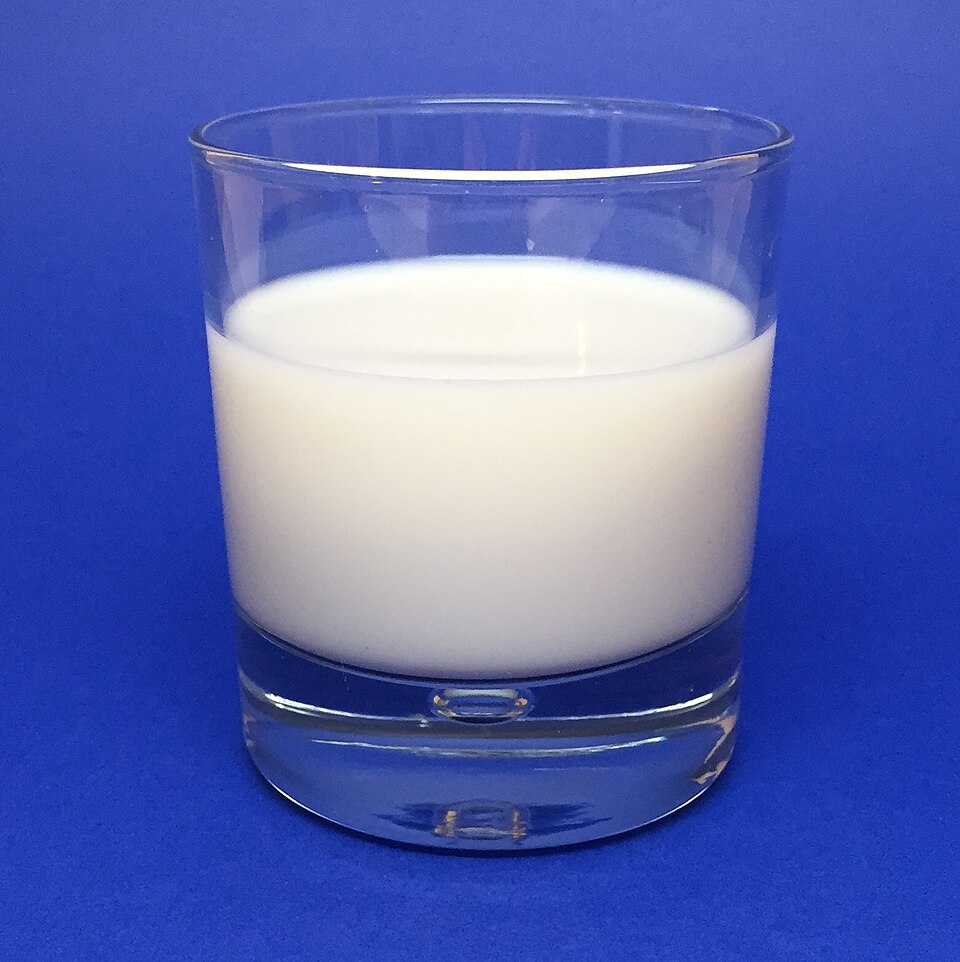
Correct — D, Emulsion. Colloids are named by a single rule: take the physical state of the dispersed phase and the physical state of the dispersion medium, and the pair of states gives you the name. Milk is fat dispersed through water. The fat is liquid butterfat, the medium is liquid water, and a liquid dispersed in a liquid is called an emulsion — more precisely an oil-in-water emulsion. Cow's milk carries roughly three to four per cent fat, present not as a dissolved substance but as separate globules a few micrometres across, which is why milk is not a true solution. Left alone, those globules would float upwards and separate as a layer of cream; they do not, because milk's own proteins, chiefly the caseins together with whey proteins, coat each globule and act as natural emulsifying agents, and because commercial homogenisation forces the milk through fine openings to break the globules much smaller so they stay dispersed. That is the emulsion the key marks. One honest refinement. Milk is in truth a composite system: an emulsion of fat in water, plus a colloidal dispersion of casein micelles (which behaves like a sol), plus lactose and mineral salts genuinely in true solution. Chemistry textbooks and every exam key classify milk by its defining feature, the fat-in-water emulsion, and that is why (b) Sol is the strongest distractor rather than an outright error of the setter. Answer 'emulsion', and know why 'sol' is not absurd.
- (a)Foam — A foam is a GAS dispersed in a liquid — soap lather, shaving foam, whipped cream, the froth on boiling milk or on a glass of beer. Milk in the glass contains no dispersed gas phase at all. You can turn milk into a foam by whipping air into it, as in the frothed milk of a cappuccino, but that is something done to milk, not what milk is.
- (b)Sol — A sol is a SOLID dispersed in a liquid — paints, muddy water, starch stirred into water, cell fluid. This is the most defensible wrong answer, because milk really does carry casein protein micelles dispersed through water, which is sol-like behaviour, and those micelles contribute to milk's whiteness. But the classification a chemistry paper is asking for keys on the dispersed FAT, which is liquid, not solid; milk's textbook identity is the oil-in-water emulsion, and it is listed as the standard example of an emulsion in every syllabus table.
- (c)Aerosol — In an aerosol the dispersion MEDIUM is a gas: a liquid dispersed in gas gives fog, mist, clouds and insecticide sprays, and a solid dispersed in gas gives smoke and dust. Milk's medium is plainly water, a liquid, so the option fails at the first test. This distractor works only on a candidate who remembers the word 'aerosol' as meaning 'a fine dispersion' without remembering which phase is which.
Mixtures are graded by particle size. In a true solution, such as sugar in water, the dissolved particles are smaller than about one nanometre, the mixture is transparent and nothing settles. In a suspension, such as chalk powder in water, the particles are larger than about one micrometre, the mixture is visibly cloudy and the particles settle on standing. Between the two lies the colloid, with particles roughly one nanometre to one thousand nanometres: too small to settle, too large to let light pass undisturbed. A colloid always has two parts — the dispersed phase and the dispersion medium — and the eight classical types are named by the states of those two: emulsion (liquid in liquid), foam (gas in liquid), sol (solid in liquid), gel (liquid in solid), aerosol (liquid or solid in gas), solid sol, solid foam and solid aerosol.
The way to answer any question of this family in seconds is to identify the two phases before looking at the options. Ask 'what is spread through what?' For milk the answer is fat through water: liquid in liquid, therefore emulsion. Run the same test on the distractors and each one identifies itself — soap lather is gas in liquid (foam), muddy water is solid in liquid (sol), fog is liquid in gas (aerosol). A second thing worth carrying out of this question is why milk looks the way it does. Its opaque white appearance is not a dye; it is light scattered by the dispersed fat globules and casein micelles, which is the Tyndall effect — the standard proof that a mixture is colloidal rather than a true solution. A sugar solution is clear because its particles are too small to scatter light; milk is white because its particles are exactly the right size to scatter all wavelengths.
- A colloid has a dispersed phase spread through a dispersion medium, with particle sizes of roughly 1 to 1000 nanometres — larger than the particles of a true solution, smaller than those of a suspension.
- Colloid types by state: emulsion (liquid in liquid — milk, hair cream), foam (gas in liquid — soap lather, whipped cream), sol (solid in liquid — paints, muddy water), gel (liquid in solid — cheese, butter, jellies), aerosol (liquid or solid in gas — fog, mist, insecticide spray, smoke).
- Milk is an oil-in-water emulsion of butterfat globules in water, stabilised by milk proteins — chiefly casein — acting as the emulsifying agent; homogenisation reduces the globule size so that cream does not separate on standing.
- Colloidal particles scatter a beam of light and make its path visible — the Tyndall effect. This is why milk is opaque white while a sugar solution is transparent, and it is the standard test distinguishing a colloid from a true solution.
- Emulsions are of two kinds: oil-in-water, of which milk is the classic example, and water-in-oil, such as cold cream. Both need an emulsifying agent — casein in milk, soap in an oil-and-water mixture — or the two liquids separate.
- Choosing 'sol' because milk contains casein protein. Milk is a composite colloid, but its exam classification keys on the dispersed liquid fat, which makes it an emulsion.
- Calling milk a solution because it looks uniform to the eye. Uniform appearance is not the test; light scattering is, and milk scatters strongly.
- Reversing aerosol and foam. In a foam the DISPERSED phase is gas and the medium is liquid; in an aerosol the MEDIUM is gas. Fix the medium first and the name follows.
UPPSC asks it as a bare one-line identification — 'milk is an example of', 'smoke is an example of' — with the four colloid names as options. UPSC prefers the concept applied rather than named: the Tyndall effect, the cleansing action of soap, or a physical-versus-chemical-change item built around milk, as in its 2014 question on the souring of milk.
No directly related past PYQ was found.
- practice — not a real PYQ
Which one of the following is an example of an aerosol?
- (a)Milk
- (b)Fog
- (c)Soap lather
- (d)Muddy water
Answer(b) Fog — tiny liquid water droplets dispersed in air, i.e. a liquid in a gas, which is an aerosol. Milk is an emulsion (liquid in liquid), soap lather is a foam (gas in liquid) and muddy water is a sol (solid in liquid).
- practice — not a real PYQ
The scattering of a beam of light by colloidal particles, which makes the path of the beam visible, is known as :
- (a)Brownian motion
- (b)Tyndall effect
- (c)Dialysis
- (d)Coagulation
Answer(b) Tyndall effect — colloidal particles are large enough to scatter light and make the beam's path visible, which a true solution cannot do. Brownian motion is the random zig-zag movement of colloidal particles, dialysis removes dissolved impurities from a colloid, and coagulation is the aggregation of colloidal particles into a precipitate.