The joint where the neck joins the head is :
- (a)Pivotal joint
- (b)Saddle joint
- (c)Hinge joint
- (d)Ball and socket joint
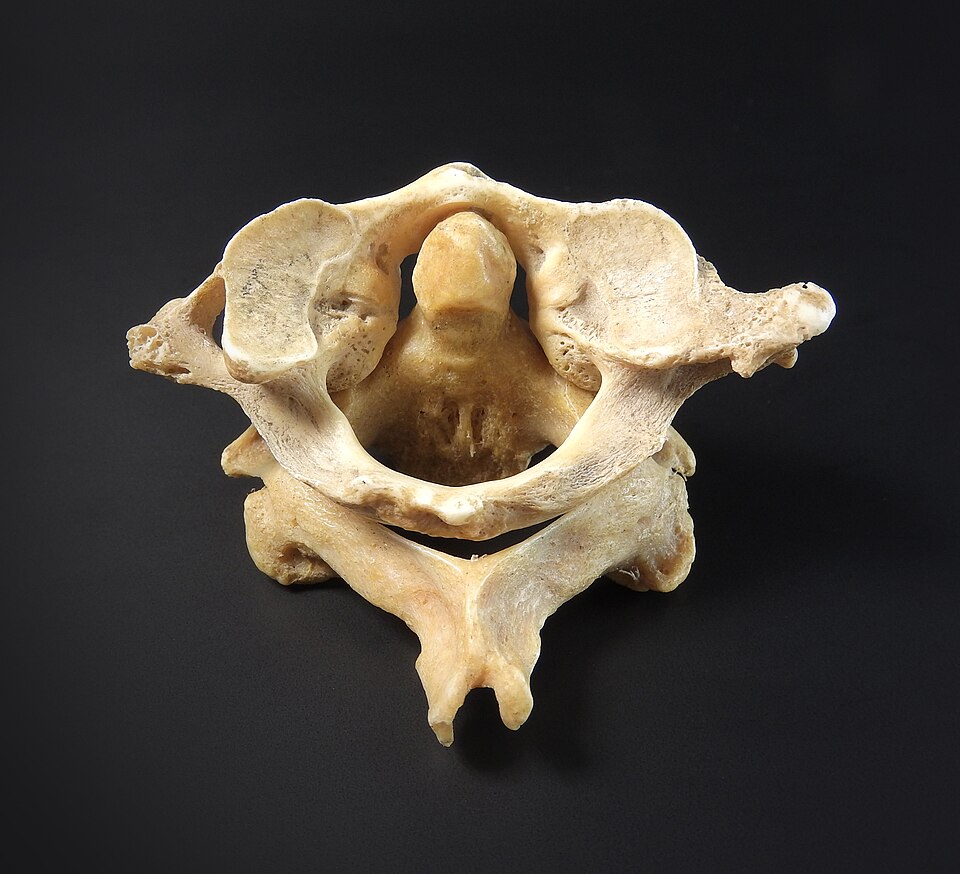
Correct — A, Pivotal joint. A pivot joint is one in which a peg or cylinder of bone rotates inside a ring, so the movement it permits is rotation about a single axis. That is exactly the arrangement at the top of the neck. The first cervical vertebra, the atlas (C1), is a bony ring that carries the skull; the second, the axis (C2), sends up a peg called the dens or odontoid process, which stands inside that ring and is held against its front arch by the transverse ligament. When you shake your head to say 'no', the atlas — and with it the whole skull — swivels around the peg of the axis. Peg inside a ring, rotation about one axis: a textbook pivot joint, which is why school science calls the head-and-neck junction a pivot joint and why (a) is the marked answer. One honest refinement worth carrying, because a careful student will notice the head also nods. The head-neck junction is really a complex of two joints working together: the atlanto-occipital joint, between the base of the skull and the atlas, is a condyloid (ellipsoid) joint and produces the forward-and-backward nodding of 'yes'; the atlanto-axial joint, between atlas and axis, is the pivot and produces the side-to-side rotation of 'no'. NCERT-level science compresses the pair into the single label 'pivot joint', and that is the answer the key rewards. None of the other three options can even produce rotation of the skull, so the question is safe on its face.
- (b)Saddle joint — A saddle joint has two saddle-shaped surfaces, each convex in one direction and concave in the other, seated across one another. It allows movement in two planes plus a limited swivel, but not free axial rotation. The classic human example is the carpometacarpal joint at the base of the thumb, between the first metacarpal and the trapezium of the wrist — the joint that lets the thumb swing across the palm and oppose the fingers, which is one of the anatomical foundations of the human grip. There is no saddle joint at the head-neck junction.
- (c)Hinge joint — A hinge joint moves in one plane only, like a door on its hinges — bending and straightening, and nothing else. The elbow, the knee, the ankle and the joints of the fingers and toes are hinge joints. A hinge could account for the head nodding forwards and backwards, and that is why the option is placed here, but it cannot produce the left-and-right turning of the head that everyone can perform. Since the question asks what kind of joint the head-neck junction is, and rotation is its defining movement, hinge is wrong.
- (d)Ball and socket joint — In a ball-and-socket joint the rounded head of one bone sits in a cup-shaped hollow of another, giving movement in all directions — the widest range of any joint in the body. The two human examples are the shoulder (head of the humerus in the glenoid cavity of the scapula) and the hip (head of the femur in the acetabulum of the pelvis). It is a tempting answer because the head can be moved in many directions, but that freedom comes from the whole chain of seven cervical vertebrae acting together, not from a ball sitting in a socket at the skull base. The skull rests on the atlas through paired condyles, not a ball.
Joints are the junctions where two or more bones meet, and they are classified by how much and in what way they move. Fixed (immovable) joints, such as the sutures between the flat bones of the skull, allow no movement. Slightly movable (cartilaginous) joints, such as those between successive vertebrae with their intervertebral discs, allow a little give. Freely movable (synovial) joints are subdivided by the shape of the meeting surfaces: ball-and-socket (shoulder, hip), hinge (elbow, knee, ankle, fingers), pivot (atlas on axis at the neck; also the proximal radio-ulnar joint of the forearm), gliding (between the small carpal bones of the wrist and the tarsal bones of the ankle) and saddle (base of the thumb). Naming each type with one human example is the whole examinable content of this topic.
The quickest route to the answer is to ask which movement is unique to the joint in question. Only one of the four types listed produces rotation about an axis, and that is the pivot. Bending in a single plane is a hinge, movement in all directions is a ball-and-socket, and a two-plane swivel at the thumb base is a saddle. The trap the setter is relying on is the sheer mobility of the head — a candidate who thinks 'my head moves in every direction, so it must be the most mobile joint' reaches for ball-and-socket. The correction is to remember that the neck's overall range is produced by seven cervical vertebrae stacked in series, while the specific joint where the neck meets the head is the peg-in-ring atlanto-axial arrangement. The names carry the anatomy: the atlas is named for the Titan who bore the sky on his shoulders because it bears the skull; the axis is named for the axis of rotation it provides.
- A pivot joint allows rotation of one bone around another about a single axis; in the neck the dens (odontoid process) of the axis (C2) sits inside the bony ring of the atlas (C1), held by the transverse ligament, and the atlas with the skull rotates around it.
- Nodding 'yes' happens chiefly at the atlanto-occipital joint between skull and atlas (a condyloid joint), while shaking 'no' happens at the atlanto-axial joint (the pivot). School science labels the head-neck junction as a whole a pivot joint.
- Another pivot joint of the human body is the proximal radio-ulnar joint (standard anatomy lists three trochoid joints — median atlanto-axial, proximal and distal radio-ulnar), which lets the radius roll over the ulna so the palm can be turned up (supination) and down (pronation).
- Movable joint types with their standard examples: ball-and-socket (shoulder, hip), hinge (elbow, knee, ankle, fingers), pivot (neck, forearm), gliding (wrist and ankle bones), saddle (base of the thumb). Fixed joints: the sutures of the skull.
- Humans have seven cervical vertebrae — the same number as almost all mammals, including the giraffe; the neck's wide range of movement comes from the whole column, not from any one joint.
- Confusing hinge and pivot. A hinge bends in one plane only (elbow, knee); a pivot rotates about an axis (neck, forearm). Ask what movement the joint uniquely allows.
- Choosing ball-and-socket because the head moves so freely. That range comes from the seven cervical vertebrae acting as a column; the specific head-neck joint is a pivot.
- Forgetting the saddle joint at the base of the thumb, which is the only human example examiners use and therefore the one they expect you to name.
UPPSC asks this as bare NCERT-level identification — name the joint, name the bone, name the organ — while UPSC usually buries the same skeletal facts inside a multi-statement item (for example its 2004 question testing that the femur is the longest bone) or inside a matching list of common and anatomical bone names.
Match List I with List II and select the correct answer using the codes given below the Lists: List I (Bone) I. Breast-bone II. Collar-bone III. Knee-cap IV. Shoulder blade List II (Name) A) Clavicle B) Patella C) Scapula D) Sternum
- (a) I-D, II-A, III-C, IV-B
- (b) I-A, II-D, III-C, IV-B
- (c) I-A, II-D, III-B, IV-C
- (d) I-D, II-A, III-B, IV-C
Answer(d) I-D, II-A, III-B, IV-C
The bones half of the same skeletal-system topic — UPPSC asks you to name the type of joint, UPSC asks you to name the bone behind its everyday name (sternum, clavicle, patella, scapula). Both reward one thing: knowing the human skeleton by its proper anatomical vocabulary.
Consider the following statements: 1. Femur is the longest bone in the human body. 2. Cholera is a disease caused by bacteria. 3. 'Athlete's foot' is a disease caused by virus. Which of the statements given above are correct?
- (a) 1 and 2
- (b) 2 and 3
- (c) 1 and 3
- (d) 1, 2 and 3
Answer(a) 1 and 2
Shows how UPSC packages the same basic human-body content — the femur being the longest bone is exactly the kind of skeletal fact this UPPSC item tests, only embedded in a multi-statement format instead of asked directly.
- practice — not a real PYQ
The joint at the base of the human thumb, which allows it to be moved across the palm, is an example of a :
- (a)Hinge joint
- (b)Saddle joint
- (c)Pivot joint
- (d)Ball and socket joint
Answer(b) Saddle joint — the carpometacarpal joint between the first metacarpal and the trapezium of the wrist is the standard human example of a saddle joint, and it is what makes the thumb opposable.
- practice — not a real PYQ
Which one of the following joints of the human body is an immovable (fixed) joint?
- (a)Elbow joint
- (b)Joints between the bones of the skull
- (c)Shoulder joint
- (d)Knee joint
Answer(b) Joints between the bones of the skull — these sutures are fixed joints allowing no movement. The elbow and knee are hinge joints and the shoulder is a ball-and-socket joint.