Match List-I with List-II and choose the correct answer using the codes given below the lists : List-I (Country) A. Spain – France B. Switzerland C. Bulgaria D. Italy List-II (Mountain) 1. Alps 2. Apennine 3. Pyrenees 4. Balkan Codes :
- (a)A-3, B-1, C-2, D-4
- (b)A-3, B-1, C-4, D-2
- (c)A-2, B-3, C-1, D-4
- (d)A-4, B-1, C-2, D-3
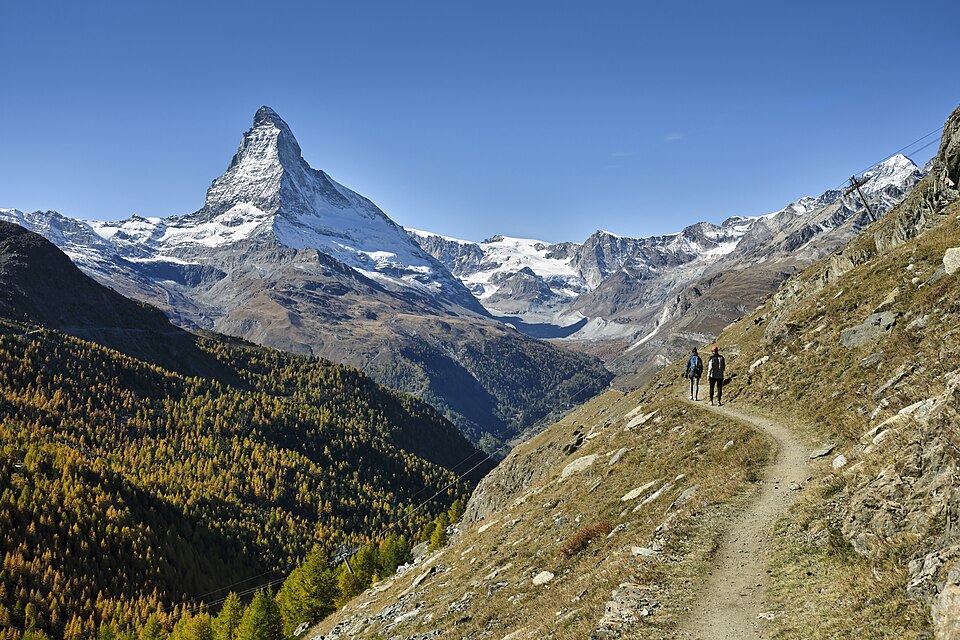
Correct — B, A-3, B-1, C-4, D-2. Each pair is a straight fact of European physical geography. Spain–France goes with the PYRENEES (List-II 3): the range runs for roughly 430 kilometres from the Bay of Biscay to the Mediterranean and forms the political frontier between the two countries, with the tiny state of Andorra tucked inside it and Aneto, at about 3,400 metres, as its highest peak. Switzerland goes with the ALPS (List-II 1): the Alps sweep in a great arc through France, Switzerland, Italy, Austria, Germany, Slovenia, Liechtenstein and Monaco, but Switzerland is the country most completely defined by them, with roughly three-fifths of its territory Alpine and its icons — the Matterhorn, the Jungfrau, the Eiger — standing in the range. Bulgaria goes with the BALKAN mountains (List-II 4): the Stara Planina, literally 'old mountain', runs west to east across the whole width of Bulgaria from the Serbian border to the Black Sea, and it is this range that gave its name to the entire Balkan Peninsula. Italy goes with the APENNINES (List-II 2): they form the spine of the Italian peninsula, running some 1,200 kilometres from the Ligurian Alps in the north down to Calabria, with Corno Grande in the Gran Sasso, at about 2,900 metres, as their highest point. That gives A-3, B-1, C-4, D-2, which is option (b).
- (a)A-3, B-1, C-2, D-4 — This is the designed near-miss and the option that catches most candidates. It gets the two easy pairs right — Spain–France with the Pyrenees, Switzerland with the Alps — and then swaps the last two, giving Bulgaria the Apennines and Italy the Balkan mountains. It is exactly the wrong way round: the Apennines are the backbone of the Italian peninsula, while the Balkan range, the Stara Planina, crosses Bulgaria and lent its name to the peninsula it stands on. Whenever two options share their first half, the answer is decided entirely by the second half — compare only C and D and you settle this in one step.
- (c)A-2, B-3, C-1, D-4 — Every pair is wrong. It puts the Apennines on the Spanish–French border, the Pyrenees in Switzerland, the Alps in Bulgaria and the Balkan range in Italy. Switzerland with anything other than the Alps should end the discussion immediately; that single check is enough to eliminate this option.
- (d)A-4, B-1, C-2, D-3 — Only the Alps pairing survives. It sends the Balkan mountains to the Spanish–French border, the Apennines to Bulgaria and the Pyrenees to Italy. The Pyrenees are the classic textbook example of a mountain range serving as an international boundary between Spain and France, so A-4 is the first pair to strike out.
The Alps, Pyrenees, Apennines, Balkan mountains, Carpathians and Caucasus are all young fold mountains of the Alpine orogeny, thrown up when the African plate pushed north into Eurasia and the Tethys Sea between them was closed — the same collision belt that continues eastward through the Zagros and on to the Himalaya. That is why they share a family look: high relief, sharp crests, folded and thrust sedimentary rock, and continuing seismic activity. Their political significance is just as examinable. Ranges make frontiers: the Pyrenees separate Iberia from the rest of Europe and carry the Spain–France border, the Alps historically divided the Italian peninsula from central Europe, and the Balkan range fragments the peninsula it names.
A four-way matching question is never four separate recalls; it is a process of elimination driven by the one or two pairs you are certain of. Here two pairs are near-automatic for any candidate — Spain and France with the Pyrenees, Switzerland with the Alps — and three of the four options already agree that Switzerland goes with the Alps. So the whole question reduces to a single decision: does Bulgaria go with the Balkan mountains or with the Apennines? Fix it with the names themselves. 'Apennine' belongs to the Italian peninsula, which is why an Italian dish, an Italian city and the Apennines all sit in the same mental frame; 'Balkan' is the peninsula that contains Bulgaria, Serbia, Greece and their neighbours, and it takes that name from the Bulgarian range at its heart, the Stara Planina. Once that pair is settled, only option (b) survives.
- The Pyrenees run about 430 kilometres from the Bay of Biscay to the Mediterranean and form the border between Spain and France; Andorra lies within them and Aneto, at roughly 3,400 metres, is the highest peak.
- The Alps arc through France, Switzerland, Italy, Austria, Germany, Slovenia, Liechtenstein and Monaco; Mont Blanc on the France–Italy border, at about 4,800 metres, is the highest peak in the range and in western Europe. Roughly three-fifths of Switzerland is Alpine.
- The Balkan mountains, known in Bulgarian as Stara Planina, run west to east across Bulgaria from the Serbian border to the Black Sea and give their name to the Balkan Peninsula; Botev, at about 2,400 metres, is the highest peak.
- The Apennines form the spine of peninsular Italy, running roughly 1,200 kilometres from the Ligurian Alps in the north to Calabria in the south; Corno Grande in the Gran Sasso, at about 2,900 metres, is the highest point.
- All four ranges are young fold mountains of the Alpine orogeny, raised by the northward collision of the African plate with Eurasia and the closure of the Tethys Sea — the same event that built the Himalaya at the eastern end of the belt.
- Swapping the Apennines and the Balkan range. Apennines equal Italy, Balkan equals Bulgaria. Two of the four options in this question differ on nothing else.
- Reading the Alps as belonging to a single country. Eight countries share them; the question pairs them with Switzerland because Switzerland is the country most defined by the range, not because the Alps are exclusively Swiss.
- Confusing the Southern Alps of New Zealand with the European Alps — a distinction UPSC has itself tested in a feature-to-country matching question.
UPPSC returns to mountain-to-country matching almost every cycle — European ranges, volcanic peaks, African and American ranges — so keep a single list of world ranges with their countries and highest peaks. UPSC asks the same material one level deeper: the type of mountain (fold, block, volcanic), the orogeny it belongs to, or which range a named river rises in.
Match List I with List II and select the correct answer using the code given below the lists : List I (Geographic feature) A. Great Victoria Desert B. Grand Canyon C. Lake Winnipeg D. Southern Alps List II (Country) 1. Australia 2. Canada 3. New Zealand 4. USA Code :
- (a) A-1 B-2 C-4 D-3
- (b) A-1 B-4 C-2 D-3
- (c) A-3 B-2 C-4 D-1
- (d) A-3 B-4 C-2 D-1
Answer(b) A-1 B-4 C-2 D-3
The identical exercise in UPSC's hands — a physical feature matched to its country, and it even includes an 'Alps' that is not the European one. The Southern Alps are New Zealand's, a useful reminder that the name alone does not fix the place.
Which one of the following pairs is correctly matched? Geographical Feature : Region
- (a) Abyssinian Plateau : Arabia
- (b) Atlas Mountains : North-Western Africa
- (c) Guiana Highlands : South-Western Africa
- (d) Okavango Basin : Patagonia
Answer(b) Atlas Mountains : North-Western Africa
The same feature-to-region test, and the Atlas Mountains belong to the same Alpine fold belt as the Pyrenees, Alps, Apennines and Balkan range — the collision of Africa with Eurasia raised all of them.
Match List – I with List – II and select the correct answer using the codes given below the lists : List – I (Mountain) A. Atlas B. Kalimanjaro C. Chimbrozo D. Pyrenees List – II (Country) 1. France/Spain 2. Ecuador 3. Tanzania 4. Morocco Codes :
- (a) A-4 B-3 C-2 D-1
- (b) A-4 B-1 C-2 D-3
- (c) A-2 B-3 C-4 D-1
- (d) A-1 B-3 C-4 D-2
Answer(a) A-4 B-3 C-2 D-1
The very same pairing four years earlier — UPPSC 2020 matched the Pyrenees to France and Spain, and 2024 asks it again from the other direction. Proof that the commission recycles its world-mountain list, and a reason to learn it once, thoroughly.
Match List - I with List - II and select the correct answer using the codes given below the lists. List - I (Volcanic Mountains): A. Mount Rainier B. Mount Etna C. Mount Pericutine D. Mount Apo List - II (Country): 1. Italy 2. Mexico 3. Philippines 4. U.S.A. Codes:
- (a) A-4, B-2, C-1, D-3
- (b) A-4, B-1, C-2, D-3
- (c) A-2, B-1, C-4, D-3
- (d) A-4, B-3, C-2, D-1
Answer(b) A-4, B-1, C-2, D-3
The same format applied to volcanic peaks, and it pairs Mount Etna with Italy — the country that also owns the Apennines here. Keeping one master list of world mountains against their countries answers all three of these questions.
- practice — not a real PYQ
The Stara Planina, the range that gives its name to the Balkan Peninsula, lies mainly in which country?
- (a)Greece
- (b)Bulgaria
- (c)Croatia
- (d)Romania
Answer(b) Bulgaria — the Stara Planina or Balkan mountains run west to east across the full width of Bulgaria, from the Serbian border to the Black Sea, and the peninsula takes its name from them. Romania's mountains are the Carpathians and the Transylvanian Alps.
- practice — not a real PYQ
Which one of the following pairs (Mountain range – Region) is NOT correctly matched?
- (a)Apennines – Italian peninsula
- (b)Pyrenees – Spain–France border
- (c)Carpathians – Iberian peninsula
- (d)Caucasus – between the Black Sea and the Caspian Sea
Answer(c) Carpathians – Iberian peninsula — the Carpathians form a great arc through Slovakia, Poland, Ukraine and Romania in central and eastern Europe, not in Iberia. The other three pairs are correct.