
What is R21/Matrix-M™ ?
- (a)Vaccine against Malaria developed by Serum Institute of India
- (b)Vaccine against Malaria developed by Bharat Biotech International
- (c)Vaccine against AIDS developed by Serum Institute of India
- (d)Vaccine against AIDS developed by Bharat Biotech International
Correct — A, a vaccine against malaria associated with the Serum Institute of India. R21/Matrix-M is the world's second WHO-recommended malaria vaccine. The World Health Organization recommended it in October 2023 and prequalified it at the end of December 2023, clearing the way for United Nations agencies and Gavi to procure it; Ghana's Food and Drugs Authority had granted the first national approval in April 2023, with Nigeria following. Read the name and it tells you the two halves of the product: 'R21' is the antigen — a circumsporozoite-protein-based particle targeting the sporozoite stage of Plasmodium falciparum, designed at the University of Oxford's Jenner Institute — and 'Matrix-M' is the saponin-based adjuvant licensed from Novavax that sharpens the immune response. The Serum Institute of India in Pune is the development partner that took it through late-stage trials and manufactures it, and it is on the strength of Indian manufacturing at scale, with capacity spoken of in the range of a hundred million-plus doses a year, that R21 is a cheap enough vaccine to be deployed across Africa. That is why the key marks (a). Be precise about the wording for a tougher paper: the antigen was designed at Oxford's Jenner Institute and the adjuvant is Novavax's, so 'developed by Serum Institute of India' is shorthand for a partnership in which SII is the development-and-manufacturing partner rather than the sole inventor. Nothing in that qualification touches the answer, because the other three options are wrong on the disease, the company, or both.
- (b)Vaccine against Malaria developed by Bharat Biotech International — Right disease, wrong company — the classic half-correct distractor. Bharat Biotech International of Hyderabad is a major Indian vaccine maker, known for Covaxin, the Rotavac rotavirus vaccine and the typhoid conjugate vaccine, but R21/Matrix-M is not its product. R21 belongs to the Oxford Jenner Institute–Serum Institute of India partnership, with the Matrix-M adjuvant from Novavax.
- (c)Vaccine against AIDS developed by Serum Institute of India — Wrong on the disease, and wrong in a way that should be an instant reject. There is no licensed vaccine against HIV/AIDS anywhere in the world; despite four decades of research, candidates have repeatedly failed in efficacy trials because HIV mutates rapidly and integrates into the host genome. Any option claiming a marketed AIDS vaccine can be eliminated on sight, whichever company is named.
- (d)Vaccine against AIDS developed by Bharat Biotech International — Wrong on both counts — there is no licensed AIDS vaccine, and Bharat Biotech has no connection with R21/Matrix-M. This option exists only to complete the two-by-two grid of disease and manufacturer.
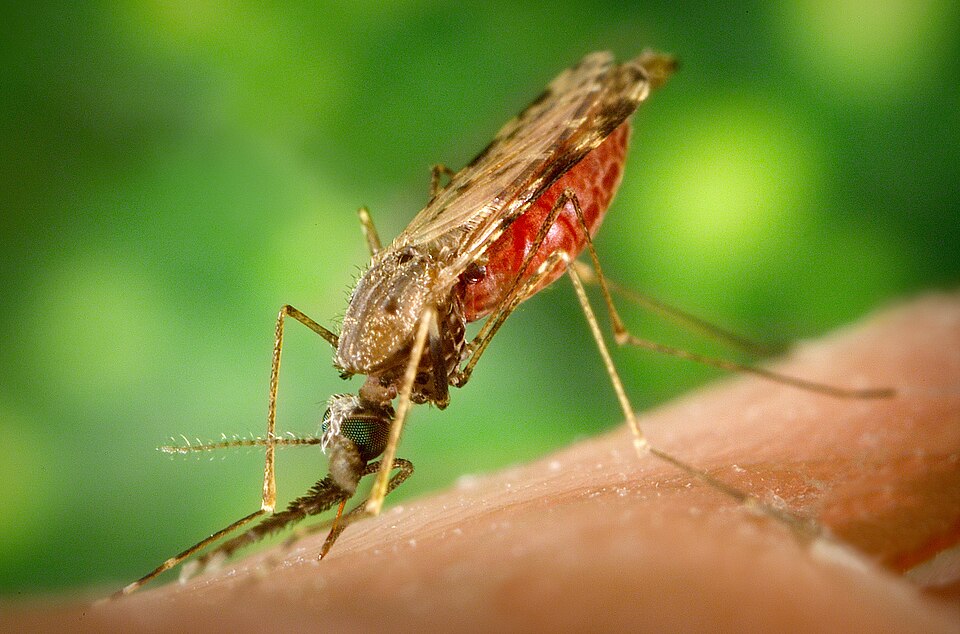
Malaria is caused by Plasmodium parasites — falciparum is the deadliest species — and is transmitted by the bite of an infected female Anopheles mosquito. A parasite is a far harder vaccine target than a virus or a bacterium: it has a multi-stage life cycle in two hosts, it presents different surface proteins at each stage, and natural infection does not confer lasting sterilising immunity, which is why humans in endemic areas can be reinfected year after year. That is why the first malaria vaccine took a century of effort to arrive and why both licensed vaccines aim at the same narrow window — the sporozoite that the mosquito injects, before it reaches the liver.
There are exactly two WHO-recommended malaria vaccines, and prelims papers exploit the pair. RTS,S/AS01, marketed as Mosquirix and developed by GlaxoSmithKline, was recommended by WHO in October 2021 and was the first vaccine ever recommended against any human parasitic disease. R21/Matrix-M followed in October 2023, is made by the Serum Institute of India, and is the one that changes the arithmetic of a mass campaign because it is cheaper and can be produced in far larger volumes. When an exam names a vaccine you have not memorised, decompose the name: here 'Matrix-M' is a well-known adjuvant brand and pairing it with an antigen code is the signature of a subunit vaccine, while the presence of an Indian manufacturer in three of the four options is the examiner telling you the item is really about which Indian company makes what. Anchor it to the exam date of 22 December 2024, by which time R21 was already prequalified and rolling out in African countries.
- R21/Matrix-M is a malaria vaccine: the R21 antigen is a circumsporozoite-protein particle designed at the University of Oxford's Jenner Institute, and Matrix-M is a saponin-based adjuvant from Novavax.
- It is manufactured by the Serum Institute of India, Pune, which is why it is affordable and available in the volumes an African mass-immunisation campaign needs.
- WHO recommended R21/Matrix-M in October 2023 and prequalified it at the end of December 2023; Ghana's Food and Drugs Authority gave the first national approval in April 2023, followed by Nigeria.
- RTS,S/AS01 (Mosquirix, GlaxoSmithKline), recommended by WHO in October 2021, was the first malaria vaccine and remains the other of the two WHO-recommended options.
- There is no licensed vaccine against HIV/AIDS anywhere in the world, which alone eliminates two of the four options in this question.
- Assuming an AIDS vaccine exists because a plausible manufacturer is named beside it. There is no licensed HIV/AIDS vaccine; the option is always wrong.
- Swapping the two Indian majors. R21/Matrix-M and Covishield belong to the Serum Institute of India; Covaxin, Rotavac and the typhoid conjugate vaccine belong to Bharat Biotech.
- Saying R21 was the first malaria vaccine. That was RTS,S/AS01, recommended by WHO in October 2021; R21 followed in October 2023 and is the second.
UPPSC asks vaccines and disease-causing organisms as one-line identification items — name the vaccine, name the platform, name the vector. UPSC embeds them in consider-the-statements questions about how the vaccine works or how the disease is transmitted, so a UPSC-level preparation must add the mechanism to the label.
Widespread resistance of malarial parasite to drugs like chloroquine has prompted attempts to develop a malarial vaccine to combat malaria. Why is it difficult to develop an effective malaria vaccine ?
- (a) Malaria is caused by several species of Plasmodium
- (b) Man does not develop immunity to malaria during natural infection
- (c) Vaccines can be developed only against bacteria
- (d) Man is only an intermediate host and not the definitive host
Answer(b) Man does not develop immunity to malaria during natural infection
Exactly the problem R21/Matrix-M solves, asked fourteen years before the solution arrived. UPSC tested why a malaria vaccine was so hard to make; UPPSC 2024 tests the vaccine that finally did it. The pairing also explains why both licensed vaccines aim at the sporozoite stage.
Which one of the following statements is not correct?
- (a) Hepatitis B virus is transmitted much like HIV.
- (b) Hepatitis B, unlike Hepatitis C, does not have a vaccine.
- (c) Globally, the number of people infected with Hepatitis B and C viruses are several times more than those infected with HIV.
- (d) Some of those infected with Hepatitis B and C viruses do not show the symptoms for many years.
Answer(b) Hepatitis B, unlike Hepatitis C, does not have a vaccine.
The same reasoning that kills options (c) and (d) here — knowing which diseases actually have a licensed vaccine and which do not. Hepatitis B has one and Hepatitis C does not; HIV/AIDS still has none, anywhere.
Which of the following is mRNA vaccine used against Covid-19 infection?
- (a) Sinovac
- (b) Moderna
- (c) Sputnik
- (d) Novavax
Answer(b) Moderna
The identical demand one year earlier — take a branded vaccine name and place it against the right disease and the right platform or maker. Note that Novavax appears there as a distractor and supplies the Matrix-M adjuvant here; the brand names in this space repeat across papers.
Which of the following is NOT mosquito borne disease ?
- (a) Dengue fever
- (b) Filariasis
- (c) Sleeping sickness
- (d) Malaria
Answer(c) Sleeping sickness
Fixes malaria in its vector-borne family, which is the biology behind this question — Anopheles carries Plasmodium, while sleeping sickness is carried by the tsetse fly. Vector plus pathogen plus vaccine is the full unit UPPSC keeps returning to.
- practice — not a real PYQ
Which of the following statements about R21/Matrix-M is correct?
- (a)It is the first malaria vaccine to be recommended by WHO
- (b)It is a malaria vaccine manufactured by the Serum Institute of India and recommended by WHO in 2023
- (c)It is an mRNA vaccine against dengue
- (d)It is a vaccine against tuberculosis developed by Bharat Biotech
Answer(b) It is a malaria vaccine manufactured by the Serum Institute of India and recommended by WHO in 2023 — the first WHO-recommended malaria vaccine was RTS,S/AS01 in October 2021, which is why (a) is wrong.
- practice — not a real PYQ
Malaria in human beings is transmitted by the bite of
- (a)The male Anopheles mosquito
- (b)The female Anopheles mosquito
- (c)The female Aedes aegypti mosquito
- (d)The Culex mosquito
Answer(b) The female Anopheles mosquito — only the female takes a blood meal. Aedes aegypti transmits dengue, chikungunya and Zika; Culex transmits Japanese encephalitis and lymphatic filariasis.