
Consider the following statements with reference to Bairam Khan : 1. Akbar gave the title of Khan-i-Khana to Bairam Khan. 2. This title was not given at the time of appointment of Bairam Khan as Vazir of Empire. Which of the above statements is/are correct ?
- (a)Both 1 and 2
- (b)Neither 1 nor 2
- (c)Only 1
- (d)Only 2
Correct — C, Only 1. Statement 1 is right: the title Khan-i-Khanan ('Khan of Khans') was conferred on Bairam Khan by Akbar in 1556, not inherited and not carried over from an earlier reign. Statement 2 is wrong precisely because the title and the office came together: at Akbar's enthronement at Kalanaur on 14 February 1556, the thirteen-year-old emperor's guardian was simultaneously made vakil-us-saltanat — the regent and chief minister of the empire, the post the question calls 'Vazir of Empire' — and styled Khan-i-Khanan. Since the title was granted at the very moment of that appointment, the claim that it was 'not given at the time of appointment' fails, leaving statement 1 alone correct.
- (a)Both 1 and 2 — Statement 2 cannot stand: the Khan-i-Khanan title was part of the same 1556 grant that made Bairam Khan regent and chief minister, not a later or separate honour.
- (b)Neither 1 nor 2 — Statement 1 is well documented — Akbar is the emperor who conferred Khan-i-Khanan on Bairam Khan; rejecting both statements throws away a true one.
- (d)Only 2 — Exactly reverses the position: it discards the true statement (Akbar gave the title) and keeps the false one (that the title came at some other time).
Bairam Khan (d. 1561) was a Turkoman noble of the Baharlu clan who had served Babur and then Humayun, and who was appointed ataliq (guardian and tutor) of the young prince Akbar. Humayun died in January 1556 and Akbar, then about thirteen, was enthroned at Kalanaur in Punjab on 14 February 1556. Bairam Khan was made vakil-us-saltanat — the highest office of the empire, effectively regent and chief minister — and given the title Khan-i-Khanan at the same time. He governed in Akbar's name for roughly four years, winning the Second Battle of Panipat against Hemu on 5 November 1556, until Akbar dismissed him in 1560; Bairam Khan was killed at Patan in Gujarat on 31 January 1561.
Two things make this question winnable without recall of any date. First, Mughal practice was to grant title and office together as a single act of imperial favour, so 'the title was NOT given at the time of appointment' is the sort of negative claim that should immediately look suspect. Second, note the wording trap in 'Vazir of Empire': in Mughal usage the wazir/diwan headed revenue, while the vakil-us-saltanat that Bairam Khan actually held stood above it as the emperor's alter ego. UPPSC is using 'Vazir of Empire' loosely for that regency, so do not reject statement 2 on the terminology — reject it on the timing.
- Akbar's accession at Kalanaur, 14 February 1556, is when Bairam Khan became vakil-us-saltanat with the title Khan-i-Khanan
- Bairam Khan had been Humayun's leading commander and was appointed Akbar's ataliq (guardian) before Humayun's death in January 1556
- As regent he commanded Akbar's army at the Second Battle of Panipat, 5 November 1556, defeating Hemu
- He was dismissed in 1560 and killed at Patan, Gujarat, on 31 January 1561; his son Abdur Rahim later carried the same title as Abdur Rahim Khan-i-Khanan, one of Akbar's navratnas
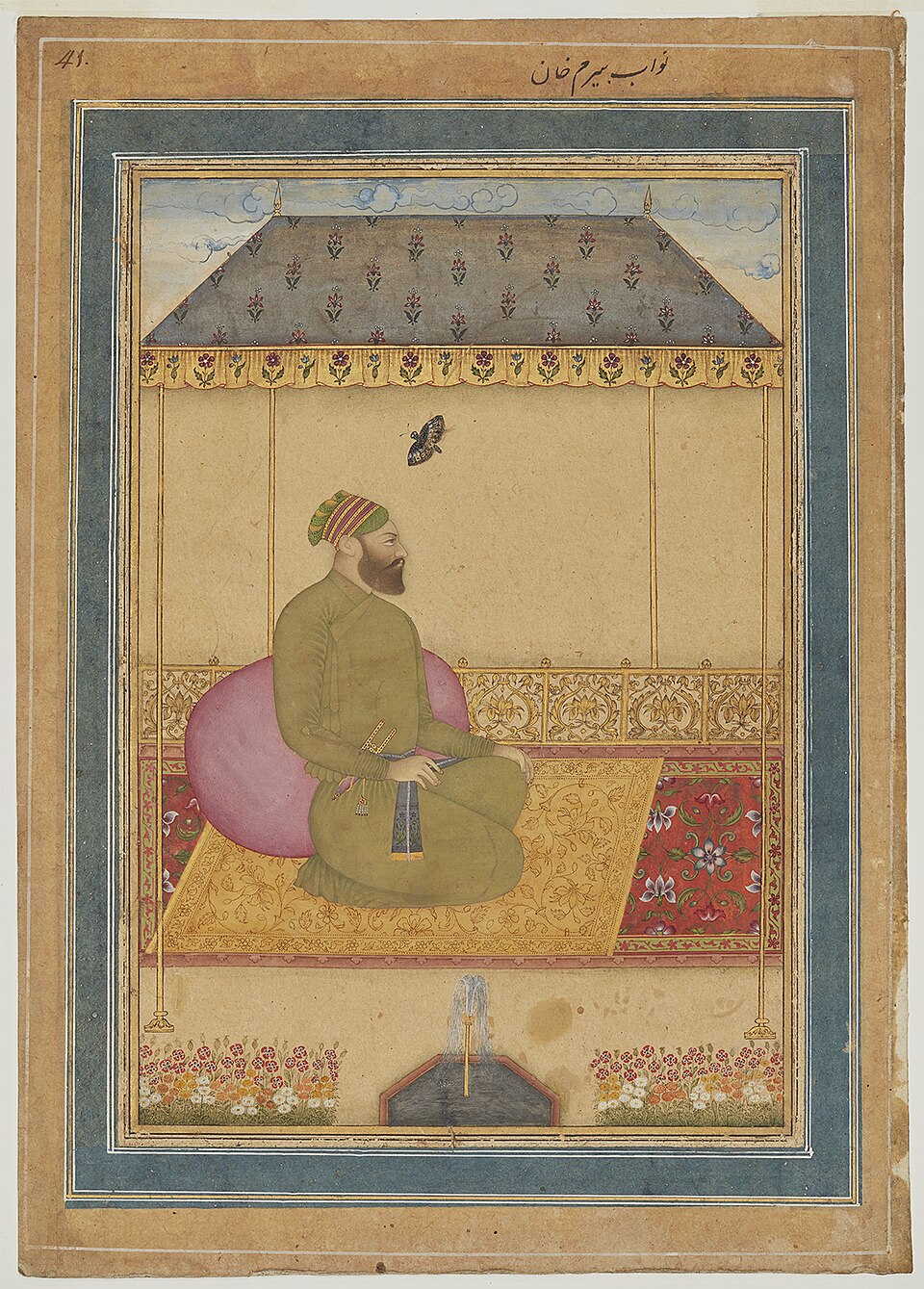
- Assuming Humayun conferred the Khan-i-Khanan title because Bairam Khan served him first — the title came from Akbar in 1556
- Rejecting the second statement for the wrong reason (the loose use of 'Vazir' for what was really the vakil-us-saltanat) instead of for its timing claim
- Confusing Bairam Khan with his son Abdur Rahim, on whom Akbar later CONFERRED the title Khan-i-Khanan — Mughal titles were granted, not inherited
UPPSC likes the two-statement format on Mughal institutions and personalities (the 2019 paper used exactly this shape on the mansabdari system), while UPSC usually tests Akbar's court through offices, chroniclers and cultural output rather than through the regency itself.
Match List I with List II and select the correct answer using the codes given below the lists: List I I. 1556 II. 1600 III. 1686 IV. 1739 List II A) Battle of Haldighati B) Nadir Shah's capture of Delhi C) Death of Shivaji D) Grant of Charter to East India Company E) Accession of Akbar Codes:
- (a) I-C, II-D, III-B, IV-A
- (b) I-E, II-D, III-C, IV-B
- (c) I-E, II-B, III-A, IV-D
- (d) I-A, II-E, III-C, IV-B
Answer(b) I-E, II-D, III-C, IV-B
Turns on the same anchor — 1556, the accession of Akbar. That accession at Kalanaur is precisely the moment at which Bairam Khan was made regent with the title Khan-i-Khanan. Note: the year printed against 'Death of Shivaji' in this item reads 1686; Shivaji died on 3 April 1680 — the paper's own misprint, reproduced here verbatim. Learn 1680.
With reference to Mansabdari system, which of the statements is/are correct ? 1. Mansabdari system was the official nobility of the state, started by Akbar. 2. A Mansabdari was hereditary. Select the correct answer using the codes given below : Codes :
- (a) 1 only
- (b) Both 1 and 2
- (c) 2 only
- (d) Neither 1 nor 2
Answer(a) 1 only
The identical drill on Akbar's nobility: two statements, the first a straightforward true fact about an Akbar-era institution and the second a false claim about how rank/title was conferred — and, as in 2024, only statement 1 survives.
- practice — not a real PYQ
The Second Battle of Panipat (1556), fought during the regency of Bairam Khan, was won by Akbar's forces against :
- (a)Sher Shah Suri
- (b)Hemu (Hemchandra Vikramaditya)
- (c)Sikandar Shah Suri
- (d)Rana Pratap
Answer(b) Hemu (Hemchandra Vikramaditya) — defeated on 5 November 1556 by the Mughal army commanded by Bairam Khan on the boy-emperor's behalf.
- practice — not a real PYQ
In the Mughal administrative hierarchy under Akbar, which office was the highest, held by Bairam Khan as the emperor's regent ?
- (a)Mir Bakhshi
- (b)Diwan-i-Ala
- (c)Vakil-us-Saltanat
- (d)Mir Saman
Answer(c) Vakil-us-Saltanat — the emperor's alter ego, standing above the diwan (revenue), the mir bakhshi (military) and the mir saman (household).