
Which one of the following pairs (Crop – Peculiarity) is not correctly matched ?
- (a)State where rice is grown three times in a year – West Bengal
- (b)Bihar's contribution to rice production – 15·7%
- (c)State with largest area under rice production – Uttar Pradesh
- (d)Isohyets that decide western limit of rice production – 100 cm
Correct — B, Bihar's contribution to rice production – 15·7%. This is the pair that does not hold. Bihar is a significant rice state but a middling one: its share of India's rice output runs at roughly seven per cent, and it does not appear among the top three producers. A figure of 15.7 per cent would put Bihar comfortably ahead of West Bengal, which is in fact the country's largest rice producer year after year, and ahead of Uttar Pradesh and Punjab as well — which is simply not the case. The other three pairs stand. West Bengal really does take three rice crops off the same land in one year — aus, aman and boro — thanks to its heat, humidity and irrigation. Uttar Pradesh carries the largest area under rice in most years (the area ranking does shift between Uttar Pradesh and West Bengal depending on the year and the dataset, but the examiner is using the common textbook statement, and it is West Bengal, not UP, that leads on output). And the 100 cm isohyet is the conventional western limit of rain-fed rice in India: east of that line rice can be raised on rainfall alone, while to its west — Punjab, Haryana, western Uttar Pradesh, Rajasthan — rice is grown only with canal and tube-well irrigation. So the odd pair out, and the answer, is (b).
- (a)State where rice is grown three times in a year – West Bengal — This pair is correct, so it cannot be the answer. West Bengal's three rice seasons are aus (sown before the monsoon, harvested in autumn), aman (the main monsoon crop, harvested in winter) and boro (a summer crop grown on low-lying land with irrigation).
- (c)State with largest area under rice production – Uttar Pradesh — This pair is correct as the examiner intends it: Uttar Pradesh carries the largest area under rice in most years. Note the distinction the question is exploiting — the largest area is not the largest output, and on output West Bengal leads, because its yields are higher.
- (d)Isohyets that decide western limit of rice production – 100 cm — This pair is correct too. The 100 cm isohyet is the standard textbook boundary of rain-fed rice in India; the crop is grown west of it, but only where canal or tube-well irrigation makes up for the deficit.
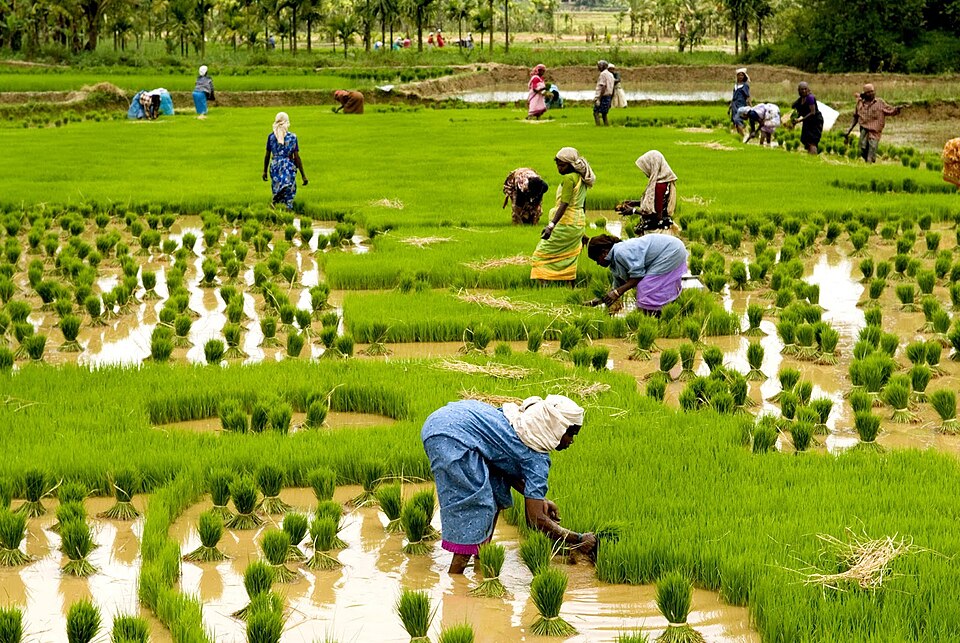
Rice is a tropical crop of high temperature and standing water: it wants a mean temperature above roughly 25°C during the growing season, high humidity, and around 100 cm of water. Where rainfall supplies that, rice is rain-fed and follows the monsoon as a kharif crop; where rainfall falls short, the crop survives only on irrigation. That single fact organises India's rice map — the eastern, north-eastern and coastal belt grows it naturally, while Punjab and Haryana grow it on pumped groundwater and canals.
This is a 'find the false statistic' item, and the trap is the decimal point. A number written as 15.7 per cent looks researched, and candidates instinctively trust the precise-looking figure and go hunting for an error in one of the wordier options instead. The defence is to sanity-check the number against the ranking you already know: West Bengal is India's biggest rice producer, and it sits in the low teens as a share of national output — so a 15.7 per cent share for Bihar would make Bihar the largest producer in the country, which contradicts everything else you know. The second thing this question is really testing is the difference between area and production. The two rankings are not the same, because yields differ; West Bengal leads on output while Uttar Pradesh usually leads on area. Any question that mentions both is trying to catch you conflating them.
- Bihar's share of India's rice output is of the order of 7 per cent — well short of the 15.7 per cent in option (b); West Bengal is the largest producer, and Bihar is not among the top three.
- West Bengal takes three rice crops a year: aus (harvested in autumn), aman (the main monsoon crop, harvested in winter) and boro (a summer crop raised with irrigation on low-lying land).
- Uttar Pradesh carries the largest area under rice in most years, but West Bengal produces the most rice — a clear case of area rank and output rank diverging because of a yield difference.
- The 100 cm isohyet marks the western limit of rain-fed rice; beyond it, in Punjab, Haryana, western Uttar Pradesh and Rajasthan, the crop depends on canal and tube-well irrigation.
- Rice is India's largest crop by area among the kharif crops, and India has been the world's largest exporter of rice for several years running.
- Trusting a decimal. 15.7 per cent looks authoritative but is the fabricated figure here; always test a statistic against the ranking you already know.
- Treating 'largest area under rice' and 'largest rice production' as the same claim. Uttar Pradesh usually leads on area while West Bengal leads on output.
- Assuming rice cannot be grown west of the 100 cm isohyet. It is grown there — Punjab and Haryana are major producers — but on irrigation, not rainfall.
UPPSC habitually sets crop geography as 'which pair is NOT correctly matched', with one invented statistic among three true statements. UPSC prefers ranking and area-share questions on kharif crops, or an Assertion–Reason on why rice concentrates where it does.
With reference to the cultivation of Kharif crops in India in the last five years, consider the following statements: 1. Area under rice cultivation is the highest. 2. Area under the cultivation of jowar is more than that of oilseeds. 3. Area of cotton cultivation is more than that of sugarcane. 4. Area under sugarcane cultivation has steadily decreased. Which of the statements given above are correct?
- (a) 1 and 3
- (b) 2 and 3
- (c) 2 and 4
- (d) 1, 2 and 4
Answer(a) 1 and 3
The same area-versus-production distinction that decides option (c) here — UPSC tests whether you know rice occupies the largest kharif area in India, which is the national version of the state-level claim in this question.
Assertion (A): The eastern coast of India produces more rice than the western coast. Reason (R): The eastern coast receives more rainfall than the western coast.
- (a) Both A and R are individually true and R is the correct explanation of A
- (b) Both A and R are individually true but R is NOT the correct explanation of A
- (c) A is true but R is false
- (d) A is false but R is true
Answer(c) A is true but R is false
Same crop, same reasoning trap — a plausible rainfall figure attached to a true statement about where rice grows. Note that rice concentration follows deltaic alluvium and irrigation, not rainfall totals alone.
Given below are two statements, one is labelled as Assertion (A) and the other as Reason (R). Assertion (A) : Sugarcane and sugar production in U.P. is more than Maharashtra but productivity is less. Reason (R) : Most of the sugar factories in Maharashtra are in cooperative sector. Codes :
- (a) Both (A) and (R) are true and (R) is the correct explanation of (A)
- (b) Both (A) and (R) are true, but (R) is not the correct explanation of (A)
- (c) (A) is true, but (R) is false
- (d) (A) is false, but (R) is true
Answer(b) Both (A) and (R) are true, but (R) is not the correct explanation of (A)
Exactly the distinction that decides option (c) here, applied to sugarcane instead of rice — a state can lead on total output while trailing on productivity, so 'largest area', 'largest production' and 'highest yield' are three separate rankings.
- practice — not a real PYQ
The three rice crops raised in West Bengal in a single year are known as:
- (a)Aus, Aman and Boro
- (b)Kharif, Rabi and Zaid
- (c)Jhum, Aman and Boro
- (d)Aus, Sali and Ahu
Answer(a) Aus, Aman and Boro — aus is the autumn crop, aman the main winter (monsoon) crop and boro the irrigated summer crop. 'Sali' and 'Ahu' are the Assamese names for the winter and autumn crops, and kharif/rabi/zaid are cropping seasons, not rice varieties.
- practice — not a real PYQ
In India, rice cultivation to the west of the 100 cm isohyet is possible mainly because of:
- (a)Higher summer temperatures
- (b)Canal and tube-well irrigation
- (c)The presence of alluvial soil
- (d)A longer frost-free period
Answer(b) Canal and tube-well irrigation — the 100 cm isohyet marks the limit of rain-fed rice, so Punjab, Haryana and western Uttar Pradesh raise the crop on assured irrigation, which is why groundwater depletion has become an issue there.