
Given below are two statements, one is labelled as Assertion (A) and the other as Reason (R). Assertion (A) : Balban made his government firm and centralised all authority in his hands. Reason (R) : He wanted to protect the north-west frontier against Mongol invasions. Select the correct answer from the codes given below :
- (a)Both (A) and (R) are true and (R) is the correct explanation of (A).
- (b)(A) is false, but (R) is true.
- (c)Both (A) and (R) are true, but (R) is not the correct explanation of (A).
- (d)(A) is true, but (R) is false.
Correct — C, both (A) and (R) are true, but (R) is not the correct explanation of (A). Take the truth of each limb first, then the causal link between them, because that is the discipline an assertion-reason item is testing. (A) is true and is the single most familiar fact about Balban. He ruled from 18 February 1266 to 13 January 1287, after already holding real power for twenty years as naib and vizier to the nominal Sultan Nasiruddin Mahmud from 1246. As Sultan he broke up the Turkan-i-Chihalgani, the group of forty Turkish nobles of which he had himself been a member; raised the crown above the nobility with an explicit theory of divine kingship, taking the title Zill-i-Ilahi, Shadow of God, describing the office as niyabat-i-khudai, the vice-regency of God, and claiming descent from the legendary Turkish hero Afrasiyab; imposed the Persian court ceremonies of sijda, prostration, and paibos, kissing the sovereign's feet; kept a sober and formal court; reorganised the army under a separate military department; and ran a network of barids, secret news-writers in every department answerable to him alone. He crushed the Mewatis around Delhi, restored order in the Doab and Katehar, and went in person to put down Tughril Khan's rebellion in Bengal. That is centralisation by any reading. (R) is also true as a statement of fact. The Mongol danger on the north-west was Balban's first strategic problem, and he answered it by fortifying and garrisoning the frontier line, by posting his elder son Prince Muhammad at Multan and his second son Bughra Khan at Samana, and by deliberately refusing distant conquests so that his field army stayed within reach of Delhi. Prince Muhammad was killed fighting the Mongols at the Beas on 9 March 1285 and is remembered as Khan-i-Shahid, the martyr prince. So neither limb is false, which removes (b) and (d) at once. What fails is the causal claim in (a). Balban's absolutism was aimed inwards, not outwards. The Sultanate he inherited had been hollowed out by two decades of puppet sultans after Iltutmish, during which real power sat with the Chihalgani; his target was that oligarchy and the lost prestige of the crown, and every instrument he chose — the theory of kingship, the ceremonial, the destruction of the Forty, the spies, the blood-and-iron suppression of internal disorder — is an instrument against his own nobility and his own subjects. The Mongol threat explains a different and separate set of decisions: the defensive frontier policy, the fortification of the north-west, and his refusal to campaign in the Deccan or even to recover Malwa and Gujarat. Both facts are true; the second does not produce the first. Hence (c). One honest qualification, because a thoughtful student will feel the pull of (a): the two are not unrelated, and some textbooks do argue that only a strong centre could hold the frontier. But the standard causal account of Balban's absolutism runs through the Chihalgani and the prestige of the monarchy, and the commission's key reads the two limbs as independently true — which is what (c) says.
- (a)Both (A) and (R) are true and (R) is the correct explanation of (A). — The designed trap, and it fails only on the causal link, not on the facts. Balban's centralising measures are directed at his own court and countryside — breaking the Chihalgani, the theory of divine kingship, sijda and paibos, the barids, the extermination of the Mewatis, the reconquest of Bengal. None of them is a frontier measure. The Mongol danger explains why he fortified the north-west and why he refused distant campaigns; it is a constraint on his policy rather than the motive for his absolutism. Remember the general rule this item is teaching: two true statements about the same ruler are not automatically cause and effect.
- (b)(A) is false, but (R) is true. — (A) is not false — it is the best-attested generalisation about Balban's reign, and Ziauddin Barani, the chronicler on whom our picture of the period rests, is emphatic about it. The Chihalgani was destroyed, the ceremonial was imposed, the espionage system was built and the internal risings were put down. There is nothing in the assertion to reject.
- (d)(A) is true, but (R) is false. — (R) is true as well. The Mongol threat on the north-west was real and continuous through Balban's reign, and his response is well documented: a fortified and garrisoned frontier, his elder son Prince Muhammad stationed at Multan and Bughra Khan at Samana, and a settled policy of not undertaking distant expeditions. Prince Muhammad's death in battle against the Mongols at the Beas on 9 March 1285 is the clearest proof that the danger and the frontier arrangements were both genuine.
Balban's reign is the point at which the Delhi Sultanate stops being a Turkish military confederacy and becomes a monarchy. Iltutmish had governed with the help of a body of senior Turkish nobles later remembered as the Turkan-i-Chihalgani, the Forty; after his death in 1236 those nobles made and unmade sultans for thirty years, and Balban, one of their own, watched the process from inside. On taking the throne in 1266 he set out to make the sultan unanswerable to them. His method was ideological as much as coercive — a borrowed Sasanian-Persian theory in which the king is the shadow of God on earth and his person must be approached with prostration — and it was backed by an intelligence service and a reorganised army. Alongside this he faced, for the whole of his reign, Mongol pressure on the Punjab frontier, which he met by fortifying rather than by conquering.
An assertion-reason question has three separate judgements in it and the commonest mistake is to collapse them into one. Ask, in order: is A true? Is R true? Does R explain A? Here the first two answers are yes, and it is only the third that decides between (a) and (c). The way to test the third is to ask what each fact was actually aimed at. Balban's centralisation was aimed at the Chihalgani and at the prestige of the crown — the whole apparatus of sijda, paibos, Zill-i-Ilahi, the barids and the blood-and-iron policy points inwards. The Mongol threat points outwards and explains something else entirely: why he never marched on the Deccan, never tried to recover Malwa or Gujarat, and spent his money on frontier forts. Two true facts about one reign, two different objects. Keep the two files separate and the answer is obvious; merge them and you pick (a).
- Ghiyas-ud-din Balban reigned from 18 February 1266 to 13 January 1287, having been naib and vizier — and the real power — under Sultan Nasiruddin Mahmud from 1246.
- He had himself been one of the Turkan-i-Chihalgani, the Forty Turkish nobles; as Sultan he broke the group up, and raised the monarchy with the title Zill-i-Ilahi (Shadow of God) and the doctrine of niyabat-i-khudai, claiming descent from the Turkish hero Afrasiyab.
- His instruments of control: the Persian court ceremonies of sijda (prostration) and paibos (kissing the feet); a strictly formal court; a reorganised military department; and barids, secret reporters in every department answerable only to the Sultan.
- North-west frontier: he fortified and garrisoned the frontier line and posted Prince Muhammad at Multan and Bughra Khan at Samana. Prince Muhammad was killed fighting the Mongols at the Beas on 9 March 1285 and is remembered as Khan-i-Shahid.
- Internal order: the Mewatis around Delhi were suppressed by clearing jungle and planting military outposts, the Doab and Katehar were pacified, and Balban led the campaign into Bengal in person to end Tughril Khan's rebellion.
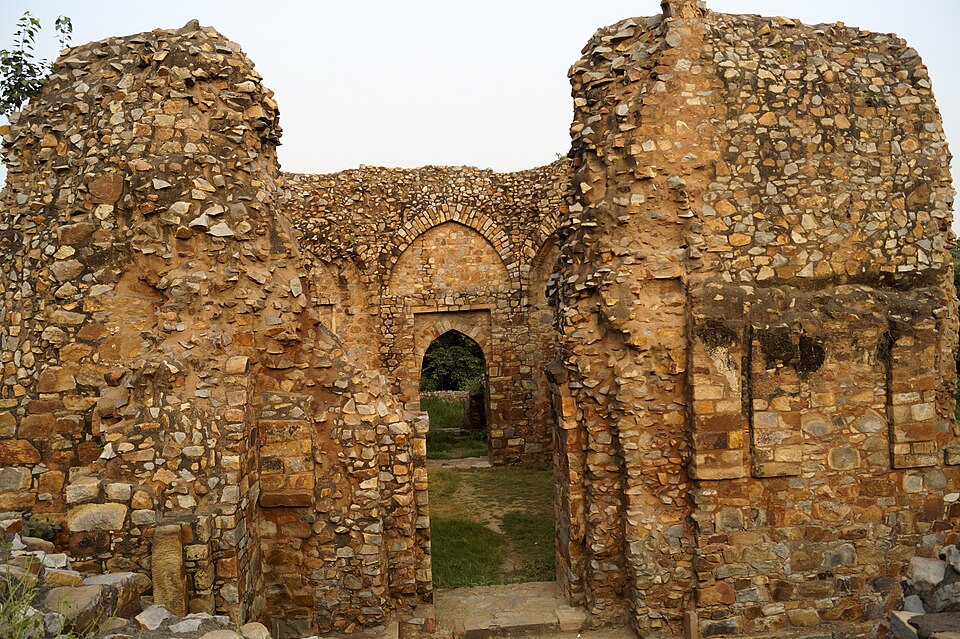
- Balban is buried in the Tomb of Balban in the Mehrauli Archaeological Park, Delhi — the building standard accounts of Indian architecture credit with the earliest use of the true arch in India.
- Treating two true statements as automatically cause and effect. In assertion-reason items, judge the truth of each limb and the explanatory link as three separate questions.
- Placing Genghis Khan's invasion in Balban's reign. The Mongols first reached the Indus in 1221, under Iltutmish; Balban faced the later, continuous frontier pressure, not the first invasion.
- Confusing Balban's Zill-i-Ilahi, a title, with Akbar's Din-i-Ilahi, which was a religious order three centuries later — a pairing UPSC has used as a distractor.
UPPSC uses assertion-reason heavily for medieval polity, and Balban is a favourite subject because so many true statements can be made about him that do not explain one another. UPSC prefers to attack the same material through titles, departments and Mongol chronology — 'Balban assumed the grand title of', 'the Mongols under Genghis Khan invaded India during the reign of'. The examinable unit is ruler plus one signature institution plus one date.
After consolidating his power, Balban assumed the grand title of
- (a) Tute-i-Hind
- (b) Kaisr-i-Hind
- (c) Zil-i-Ilahi
- (d) Din-i-Ilahi
Answer(c) Zil-i-Ilahi
The same assertion asked as a fact: the grand title Balban took after consolidating his power is the sharpest single piece of evidence that he centralised authority, which is limb (A) of this question.
The Mongols under Genghis Khan invaded India during the reign of
- (a) Balban
- (b) Feroze Tughlaq
- (c) Iltutmish
- (d) Muhammad bin Tughlaq
Answer(c) Iltutmish
Pins the Mongol chronology that limb (R) depends on — the first Mongol invasion came under Iltutmish in 1221, not under Balban, whose problem was the continuing frontier pressure that followed.
With reference to Indian history, consider the following statements : 1. The first Mongol invasion of India happened during the reign of Jalal-ud-din Khalji. 2. During the reign of Ala-ud-din Khalji, one Mongol assault marched up to Delhi and besieged the city. 3. Muhammad-bin-Tughlaq temporarily lost portions of north-west of his kingdom to Mongols. Which of the statements given above is/are correct ?
- (a) 1 and 2
- (b) 2 only
- (c) 1 and 3
- (d) 3 only
Answer(b) 2 only
The Mongol threat traced across three reigns, which is what makes it clear that frontier defence is a thread of its own in Sultanate history, running independently of any one sultan's internal policy — exactly the separation this assertion-reason item demands.
Given below are two statements, one is labelled as Assertion (A) and other as Reason (R) : Assertion (A) : The Mughal Empire was originally a Military State. Reason (R) : The vitality of the development of the Central Government System depended on its military power. Select the correct answer using the codes given below. Codes :
- (a) Both (A) and (R) are true and (R) is correct explanation of (A)
- (b) Both (A) and (R) are true, but (R) is not the correct explanation of (A)
- (c) (A) is true, but (R) is false
- (d) (A) is false, but (R) is true
Answer(a) Both (A) and (R) are true and (R) is correct explanation of (A)
The same assertion-reason machinery applied to the closely related question of whether military power explains a centralised state — and there UPPSC's answer is (a), the link holds. Setting the two side by side is the best way to see that the format is decided by the explanatory link, not by the truth of the limbs.
- practice — not a real PYQ
Balban's elder son, who was killed fighting the Mongols in 1285 and is remembered as Khan-i-Shahid, was posted as governor of
- (a)Multan
- (b)Samana
- (c)Lakhnauti
- (d)Awadh
Answer(a) Multan — Prince Muhammad held the Multan command on the north-west frontier and fell in battle against the Mongols at the Beas on 9 March 1285. Balban's second son Bughra Khan was posted at Samana and was later sent to Bengal.
- practice — not a real PYQ
The Persian court practices of sijda (prostration before the Sultan) and paibos (kissing the Sultan's feet) were introduced in the Delhi Sultanate by
- (a)Qutb-ud-din Aibak
- (b)Iltutmish
- (c)Balban
- (d)Alauddin Khalji
Answer(c) Balban — the two ceremonies were part of his deliberate elevation of the monarchy, alongside the title Zill-i-Ilahi and the claim of descent from Afrasiyab.