
Which among the following is a constituent of natural silk?
- (a)Phosphorus
- (b)Nitrogen
- (c)Magnesium
- (d)Potassium
Correct — B, Nitrogen. Natural silk is a protein fibre — it is made mainly of fibroin (the filament) with a sericin gum coating, both of which are proteins. Proteins are polymers of amino acids, and every amino acid contains nitrogen in its amino (–NH2) group. So nitrogen is an essential constituent element of silk (alongside carbon, hydrogen and oxygen).
- (a)Phosphorus — Phosphorus is characteristic of nucleic acids (DNA/RNA), ATP and bone, not of the fibroin/sericin proteins that make up silk.
- (c)Magnesium — Magnesium is the central metal of chlorophyll and a plant/mineral nutrient; it is not a building block of the silk protein.
- (d)Potassium — Potassium is an electrolyte/mineral ion in cells and sap, not a structural element of the silk fibre.
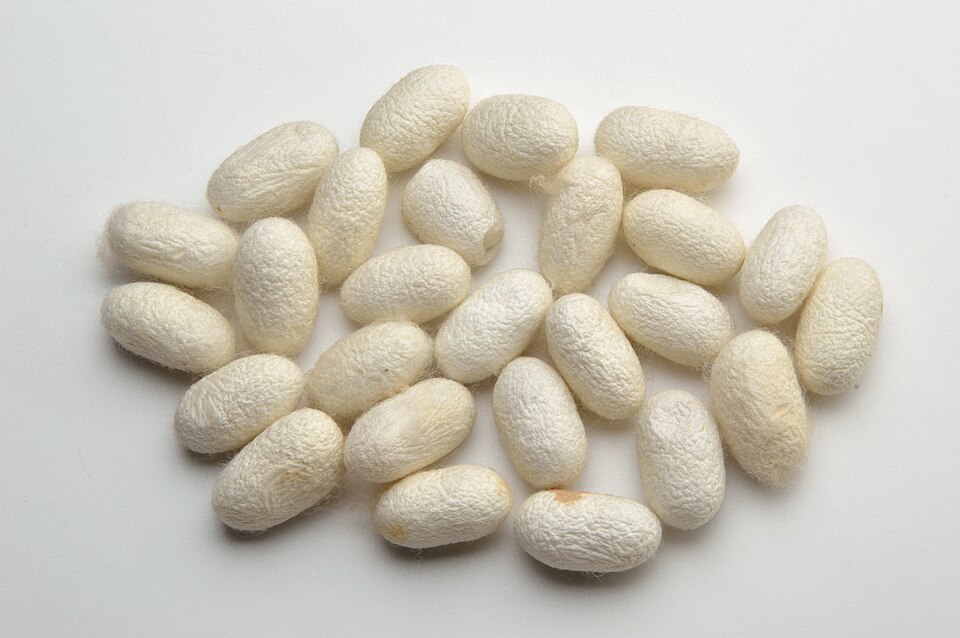
Silk secreted by the silkworm (Bombyx mori) is a natural protein fibre. Its two proteins — fibroin (about 70-75%, the strong core filament) and sericin (the sticky coating removed during degumming) — are built from amino acids rich in glycine, alanine and serine. Because all proteins are chains of nitrogen-bearing amino acids, nitrogen is a defining chemical constituent of silk.
The trick is to realise the question is really asking 'what element defines a protein?'. Silk = protein, protein = amino acids, and the one element that separates a protein from a fat or a carbohydrate (which are only C, H, O) is nitrogen. Phosphorus, magnesium and potassium are all mineral elements that have nothing to do with the silk fibre's backbone.
- Natural silk is a protein fibre made of fibroin and sericin.
- Proteins are made of amino acids, each of which contains nitrogen (the –NH2 group).
- Silk fibroin is dominated by the amino acids glycine, alanine and serine.
- Nitrogen is the element that distinguishes proteins from fats and carbohydrates (which are only C, H, O).
- Picking a 'mineral-sounding' element (P, Mg, K) instead of realising silk is a protein.
- Confusing silk (protein fibre) with cotton or jute, which are cellulose (only C, H, O).
UPSC/UPPSC test biomolecules by asking which element or class defines a substance — link protein (and silk/wool) to nitrogen, and cellulose fibres to carbohydrates.
Which of the following elements are present in all proteins? I. Carbon II. Hydrogen III. Oxygen IV. Nitrogen
- (a) I and II
- (b) I, II and IV
- (c) I, III and IV
- (d) I, II, III and IV
Answer(d) I, II, III and IV — every protein contains carbon, hydrogen, oxygen and nitrogen.
Same underlying idea — proteins always contain nitrogen; silk is a protein, so nitrogen is its defining constituent element.
- practice — not a real PYQ
Which of the following natural fibres is chemically a protein?
- (a)Cotton
- (b)Jute
- (c)Wool
- (d)Flax
Answer(c) Wool — a protein (keratin) fibre; cotton, jute and flax are cellulose (carbohydrate) fibres. - practice — not a real PYQ
The principal protein that forms the core filament of natural silk is:
- (a)Keratin
- (b)Fibroin
- (c)Collagen
- (d)Casein
Answer(b) Fibroin — the main structural protein of silk, coated by sericin.