
Photo chemical smog always contains
- (a)Ozone
- (b)Aluminium ion
- (c)Phosphorus
- (d)Methane
Correct — A, Ozone. Photochemical smog is the oxidising, sunlight-driven haze that builds over traffic-heavy cities on warm, still, sunny days. Nitrogen oxides and volatile organic compounds pouring out of engine exhaust are broken up by ultraviolet light, and the free oxygen atoms released combine with molecular oxygen to make ozone, O3. Ozone is therefore not something anyone emits — it is a secondary pollutant manufactured in the air itself, and it is the invariable product of the reaction chain that defines this kind of smog. That is why air-quality agencies use ground-level ozone as the marker for photochemical smog: if the chemistry has happened, the ozone is there. Alongside it the same chain yields peroxyacetyl nitrate (PAN), aldehydes and nitrogen dioxide, the last of which gives the smog its brownish tint.
- (b)Aluminium ion — Aluminium ion belongs to soil and water chemistry, not to gas-phase atmospheric chemistry. It is mobilised when acid deposition lowers the pH of soils and lakes, which is why it appears in discussions of acid rain damage to forests and fish. Nothing in the photochemical chain — nitrogen oxides, hydrocarbons, sunlight — produces or requires a metal cation.
- (c)Phosphorus — Phosphorus is the classic pollutant of the water cycle, not the air. Excess phosphorus from detergents, fertiliser runoff and sewage drives eutrophication and algal blooms in lakes and rivers. It has no role in the sunlight-driven reactions between nitrogen oxides and hydrocarbons that make photochemical smog.
- (d)Methane — The most tempting wrong answer, because methane is a hydrocarbon and hydrocarbons do feed this chemistry. But methane is by far the least reactive of them — so unreactive that atmospheric chemists deliberately exclude it and work with 'non-methane volatile organic compounds' when studying smog formation. Methane is present in ambient air everywhere on earth, in smog and out of it, so it can neither characterise photochemical smog nor be produced by it. It matters as a greenhouse gas, not as a smog constituent.
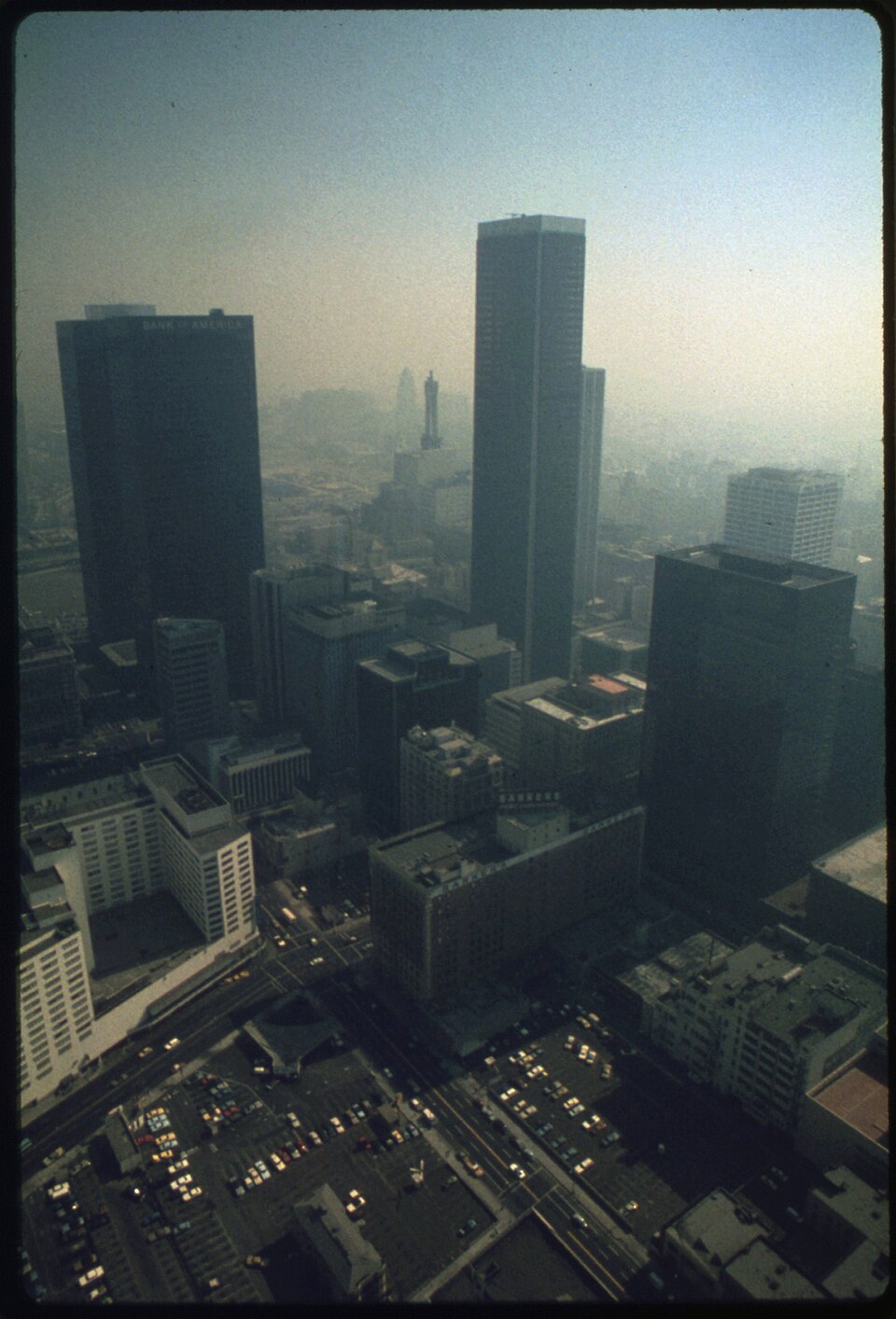
Two entirely different phenomena are called smog. Classical or London smog is reducing: it is smoke plus sulphur dioxide trapped in cool, damp winter air over coal-burning cities, and the Great Smog of London in December 1952 is its defining episode. Photochemical or Los Angeles smog is oxidising: nitrogen oxides and volatile organic compounds from vehicle exhaust are driven by strong sunlight into a chain that produces ozone, peroxyacetyl nitrate, aldehydes and nitrogen dioxide. The distinction between primary and secondary pollutants is the heart of it — nitrogen oxides and hydrocarbons are emitted directly (primary), while ozone and PAN are built in the atmosphere afterwards (secondary).
The word 'always' in the stem is doing the work. It asks which of the four is an invariable constituent, so the test is not 'could this be present' but 'is this what the chemistry necessarily makes'. Ozone is the only option that is a product of the photochemical chain; the other three sit in different compartments of environmental science altogether — aluminium ion in acidified soil and water, phosphorus in eutrophication, methane in the greenhouse budget. The second habit to build here is to keep tropospheric ozone and stratospheric ozone apart in your head. The molecule is identical, but near the ground it is a harmful oxidant that inflames airways and cuts crop yields, while fifteen to thirty kilometres up it is the shield that absorbs ultraviolet radiation. Examiners exploit that split constantly.
- Photochemical smog forms when nitrogen oxides and volatile organic compounds react in strong sunlight, yielding ozone, peroxyacetyl nitrate, aldehydes and nitrogen dioxide
- Ozone in this smog is a SECONDARY pollutant — it is not emitted by any source, but manufactured in the air
- Peroxyacetyl nitrate (PAN) is the other signature product of the chain and a powerful eye irritant
- Classical or London smog is the opposite type — reducing, made of smoke and sulphur dioxide in cool damp winter air
- Ground-level ozone damages lungs and crops; stratospheric ozone shields the earth from ultraviolet radiation — the same molecule with opposite significance
- Treating ground-level ozone as the same thing as the protective ozone layer — one is a pollutant, the other a shield
- Assuming vehicles emit ozone directly; they emit its precursors, and sunlight does the rest
- Blurring photochemical smog with London smog — the first is oxidising and needs sunlight, the second is reducing and needs cold damp air and coal smoke
UPPSC asks it in a single line — what smog contains, or what causes it — and expects the constituent to be named outright. UPSC has asked the same chemistry from both ends: what is produced during the formation of photochemical smog (2003) and which substances react to form it (2013), so learn the reactants and the products as one set.
Which one of following is produced during the formation of photochemical smog?
- (a) Hydrocarbons
- (b) Nitrogen Oxides
- (c) Ozone
- (d) Methane
Answer(c) Ozone
Practically the same question, nineteen years earlier, and with the same wrong option planted — methane. UPSC asked what is produced, UPPSC asked what is always contained, and the answer is ozone either way. The pairing shows how literally these papers recycle a settled fact.
Photochemical smog is a resultant of the reaction among
- (a) NO₂, O₃ and peroxyacetyl nitrate in the presence of sunlight
- (b) CO, O₂ and peroxyacetyl nitrate in the presence of sunlight
- (c) CO, CO₂ and NO₂ at low temperature
- (d) high concentration of NO₂, O₃ and CO in the evening
Answer(a) NO₂, O₃ and peroxyacetyl nitrate in the presence of sunlight
The same smog from the reaction side, and a useful reminder that sunlight is a non-negotiable ingredient — two of the wrong options here fail precisely because they place the chemistry at low temperature or in the evening. Read together with the 2022 question, it fixes both the inputs and the outputs of the chain.
Smog is essentially caused by the atmospheric presence of
- (a) Oxygen and ozone
- (b) Ozone and nitrogen
- (c) Oxygen and nitrogen
- (d) Oxide of nitrogen and sulphur
Answer(d) Oxide of nitrogen and sulphur
The precursor side of the same topic, and the exact contrast worth learning. In 2019 UPPSC asked what CAUSES smog in general and the answer names the oxides — nitrogen for the photochemical type, sulphur for the London type. In 2022 it asked what photochemical smog CONTAINS, and the answer is the ozone those nitrogen oxides go on to make. Cause and product, three years apart.
- practice — not a real PYQ
Peroxyacetyl nitrate (PAN), a powerful eye irritant, is characteristically associated with
- (a)Classical or London smog
- (b)Photochemical smog
- (c)Acid rain
- (d)Stratospheric ozone depletion
Answer(b) Photochemical smog — PAN is formed alongside ozone when nitrogen oxides and volatile organic compounds react in sunlight, and it is one of the two signature secondary pollutants of this smog type.
- practice — not a real PYQ
Which one of the following statements about ground-level ozone is correct?
- (a)It is emitted directly by diesel engines and thermal power stations
- (b)It is a secondary pollutant formed when nitrogen oxides and volatile organic compounds react in sunlight
- (c)It is chemically distinct from the ozone of the stratospheric ozone layer
- (d)It is beneficial at the surface because it absorbs ultraviolet radiation before it reaches people
Answer(b) It is a secondary pollutant formed when nitrogen oxides and volatile organic compounds react in sunlight — no source emits it; the molecule is the same O3 as in the ozone layer, but at the surface it is a harmful oxidant.