
Which one of the following is NOT correctly matched ? Aluminium Plants – Location
- (a)Bharat Aluminium Company Limited (BALCO) – Korba
- (b)Indian Aluminium Company Limited (INDAL) – Hirakud
- (c)Madras Aluminium Company Limited (MALCO) – Chennai
- (d)Hindustan Aluminium Corporation Limited (HINDALCO) – Renukoot
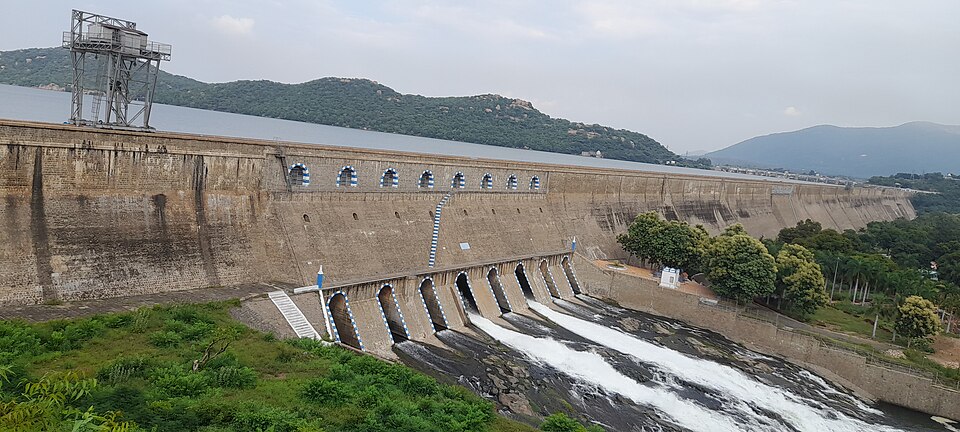
Correct — C, Madras Aluminium Company Limited (MALCO) – Chennai. MALCO's works are at METTUR in Salem district, Tamil Nadu — not at Chennai. The company carried the old name of the city in its title, which is exactly the hook the examiner is fishing with, but the plant itself sits some 350 km inland beside the Mettur Dam on the Kaveri. That siting is not an accident: aluminium smelting is one of the most electricity-hungry industrial processes there is, and Mettur offered cheap hydel power from the dam plus bauxite hauled from the nearby Yercaud hills in Salem district and the Kolli Hills in Namakkal district. Mettur is in fact known as the aluminium city of Tamil Nadu. The other three pairs are all correct, which is what leaves (c) standing: BALCO's smelter-and-power complex is at Korba in Chhattisgarh; the former Indian Aluminium Company (Indal) smelter is at Hirakud in Odisha, drawing on the Hirakud hydel project; and HINDALCO's original works are at Renukoot in Uttar Pradesh, run off the captive Renusagar power plant.
- (a)Bharat Aluminium Company Limited (BALCO) – Korba — Correctly matched, so it cannot be the answer. BALCO's integrated smelter and captive power complex is at Korba in Chhattisgarh, which is the state's aluminium centre.
- (b)Indian Aluminium Company Limited (INDAL) – Hirakud — Correctly matched. Hirakud in Sambalpur district, Odisha, is one of the four classic Indal locations, alongside Alupuram in Kerala, Belagavi in Karnataka and Muri in Jharkhand. Hindalco acquired a controlling stake in Indal in June 2000.
- (d)Hindustan Aluminium Corporation Limited (HINDALCO) – Renukoot — Correctly matched, and the one pair a UPPSC candidate should never get wrong — Renukoot is in Uttar Pradesh, and the plant is powered by the company's own Renusagar station.
The aluminium industry splits into two stages that locate for opposite reasons. Alumina REFINING follows the ore, because bauxite is bulky and loses most of its weight in processing — hence refineries at Muri and Lohardaga in Jharkhand, Belagavi in Karnataka, and Damanjodi and Lanjigarh in Odisha. Aluminium SMELTING follows cheap electricity, because reducing alumina to metal consumes enormous quantities of power — hence smelters at Hirakud beside the Mahanadi hydel project, Renukoot beside Renusagar, Korba on BALCO's captive coal-fired plant, and Mettur beside the Mettur Dam.
The trap is built entirely on a company name. 'Madras Aluminium Company' invites the assumption that the plant is in Madras, just as 'Indian Aluminium Company' invites no assumption at all. Once you know the power rule, the answer is almost predictable without any specific memory: Chennai is a coastal metropolis, not a cheap-power site, and no one would put a smelter there. Every other location on the list is a power site — a hydel project, a coalfield, or a captive station.
- MALCO's alumina refinery and aluminium smelter are at Mettur in Salem district, Tamil Nadu, which is called the aluminium city of Tamil Nadu.
- The Mettur plant drew bauxite from the Yercaud hills in Salem district and the Kolli Hills in Namakkal district, and power from the Mettur Dam.
- BALCO is at Korba in Chhattisgarh; the Indal smelter is at Hirakud in Sambalpur district, Odisha; HINDALCO's original works are at Renukoot in Uttar Pradesh on captive Renusagar power.
- Hindalco acquired a controlling stake of about 74.6 per cent in Indal in June 2000, which is why the two names now appear under one group.
- Reading a company's name as its address. MALCO is at Mettur, not Chennai; Indal's name says nothing about Hirakud.
- Confusing refinery locations with smelter locations — the same company often runs both in different States (Indal at Muri, Belagavi, Alupuram and Hirakud).
- Placing Muri in Chhattisgarh. Muri is in Jharkhand; Chhattisgarh's aluminium centre is Korba — this was the exact error tested in UPPSC 2024.
This table is a permanent fixture: UPSC has run it as a four-pair match-list (2007) and as a location-factor question (2002), and UPPSC has asked it as 'which pair is NOT correctly matched' in both 2022 and 2024. Learn the plant, the State and the power source together.
Match List-I with List-II and select the correct answer using the code given below the Lists : List-I (Aluminium Company) A. BALCO B. HINDALCO C. Indian Aluminium Company D. NALCO List-II (Location) 1. Hirakud 2. Korba 3. Koraput 4. Renukoot
- (a) A-3 B-1 C-4 D-2
- (b) A-2 B-4 C-1 D-3
- (c) A-3 B-4 C-1 D-2
- (d) A-2 B-1 C-4 D-3
Answer(b) A-2 B-4 C-1 D-3
The same four-company table, three of whose pairs are the very ones UPPSC reused fifteen years later. Attempt this one first — it fixes BALCO–Korba, HINDALCO–Renukoot and Indal–Hirakud in one go, and adds NALCO–Koraput.
HINDALCO, an aluminium factory located at Renukoot owes its site basically to
- (a) proximity of raw materials
- (b) abundant supply of power
- (c) efficient transport network
- (d) proximity to the market
Answer(b) abundant supply of power
The reasoning behind the whole table, on a plant in Uttar Pradesh. Once you know smelters chase cheap electricity, 'MALCO at Chennai' looks wrong before you have recalled a single fact about Mettur.
Which one of the following pairs (Aluminium Plant – State) is not correctly matched ?
- (a) Alupuram (Alwaye) – Kerala
- (b) Belagavi – Karnataka
- (c) Muri – Chhattisgarh
- (d) Hirakud – Odisha
Answer(c) Muri – Chhattisgarh
The commission asked the same 'find the wrong aluminium pair' question two years later, this time with the other half of the Indal plant list. Hirakud appears in both papers as a correct pair — a strong hint that this table is worth memorising in full.
- practice — not a real PYQ
Aluminium smelters in India are typically located with reference to which single most important factor?
- (a)Proximity to bauxite mines
- (b)Availability of abundant and cheap electric power
- (c)Access to a seaport for export
- (d)Proximity to the domestic consumer market
Answer(b) Availability of abundant and cheap electric power — smelting is extremely electricity-intensive, which is why Indian smelters cluster at Hirakud, Renukoot, Korba and Mettur, each beside a hydel project or a captive power station.
- practice — not a real PYQ
Which one of the following pairs (aluminium plant – State) is correctly matched?
- (a)Renukoot – Madhya Pradesh
- (b)Korba – Odisha
- (c)Hirakud – Odisha
- (d)Mettur – Karnataka
Answer(c) Hirakud – Odisha. Renukoot is in Uttar Pradesh, Korba is in Chhattisgarh, and Mettur is in Tamil Nadu.