
Which one of the famous buildings of New Delhi has been converted into Prime Ministers' Museum ?
- (a)India Habitate Centre
- (b)Talkatora Stadium
- (c)Vigyan Bhavan
- (d)Teen Murti Bhavan
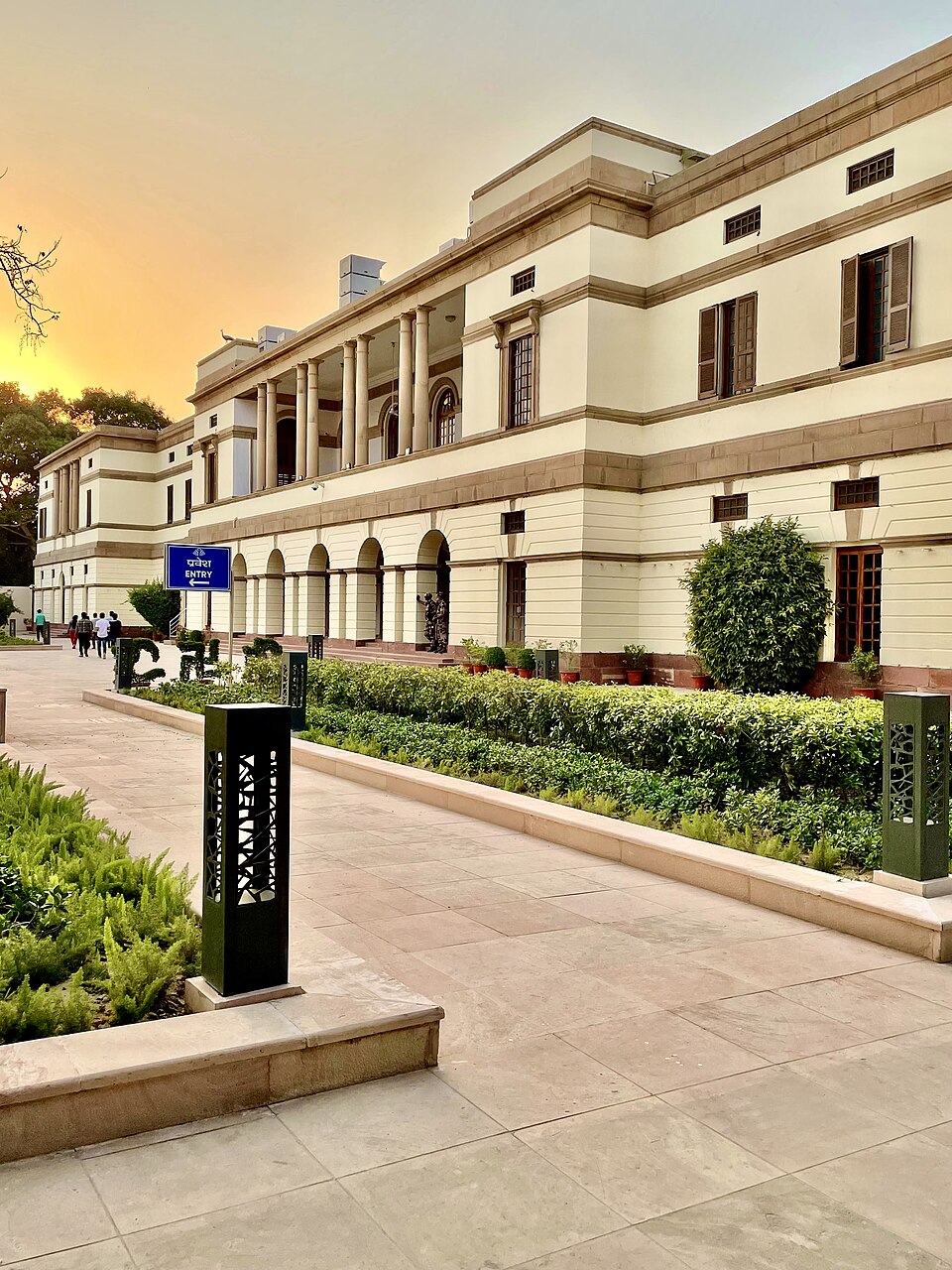
Correct — D, Teen Murti Bhavan. The Prime Ministers' Museum — formally the Pradhan Mantri Sangrahalaya — stands on the Teen Murti Bhavan estate in New Delhi and was inaugurated by Prime Minister Narendra Modi on 14 April 2022, two months before this paper was set on 12 June 2022, which is exactly why it was asked. The building's own history is what makes it the natural site. Teen Murti Bhavan was built in 1929-30, to a design by Robert Tor Russell, as the residence of the British Commander-in-Chief in India. After independence it became the official residence of Jawaharlal Nehru, India's first Prime Minister, and after his death it was opened as the Nehru Memorial Museum and Library on 14 November 1964 by President S. Radhakrishnan. The 2022 project extended that idea from one Prime Minister to all of them: a new Building II, designed by Sikka Associates, added 43 galleries across roughly 15,600 square metres covering every Indian Prime Minister, while the original Nehru residence continues to be shown alongside it. So the answer is not a new building on a new site — it is the conversion and expansion of the Teen Murti estate.
- (a)India Habitate Centre — The India Habitat Centre (the paper prints 'Habitate') is an institutional and conference complex in central Delhi housing offices, auditoria, galleries and restaurants. It hosts exhibitions, but it has not been converted into any museum, least of all one dedicated to the Prime Ministers.
- (b)Talkatora Stadium — Talkatora Stadium is an indoor sports arena in New Delhi, best known as a boxing and indoor-events venue and as a site for political conventions. It remains a stadium; no part of it was turned into the Prime Ministers' Museum.
- (c)Vigyan Bhavan — Vigyan Bhavan is the Government of India's principal conference venue in New Delhi, used for national conventions, international summits and award ceremonies. It is still in that role and was never converted into a museum.
Teen Murti Bhavan is one of the small number of Lutyens-era Delhi buildings whose function has changed with every phase of Indian political history — imperial military residence, then the first Prime Minister's home, then a memorial museum to him, and since 2022 a museum to the office of Prime Minister itself. The 2022 addition, the Pradhan Mantri Sangrahalaya, was conceived as a single narrative of India's political leadership: 43 galleries across roughly 15,600 square metres, one thread for each Prime Minister, sited on the estate rather than replacing the Nehru house. The name 'Teen Murti' comes from the three-soldier memorial at the adjoining circle. Note that the museum's opening and the institutional renaming are separate events: the Nehru Memorial Museum and Library Society was itself renamed the Prime Ministers' Museum and Library Society only in August 2023, more than a year after this exam.
This is a current-affairs question with a heritage answer, and it can be reasoned rather than merely recalled. Ask which of the four options is a building with a residential or memorial past that could plausibly be 'converted'. Talkatora is a stadium, Vigyan Bhavan is a working conference hall and the India Habitat Centre is a modern institutional campus — none of them is the kind of building a national museum gets carved out of, and all three are still doing the job they were built for. Teen Murti Bhavan alone already housed a museum, and already carried a Prime-Ministerial association through Nehru. The word 'converted' in the stem is the tell. Anchor the fact to its date: as of the June-2022 exam the museum had been open for two months, and it continues to operate today.
- The Prime Ministers' Museum (Pradhan Mantri Sangrahalaya) at Teen Murti Bhavan, New Delhi, was inaugurated by Prime Minister Narendra Modi on 14 April 2022.
- Teen Murti Bhavan was built in 1929-30, architect Robert Tor Russell, as the residence of the British Commander-in-Chief in India.
- After independence it became Jawaharlal Nehru's official residence; following his death it opened as the Nehru Memorial Museum and Library on 14 November 1964, inaugurated by President S. Radhakrishnan.
- The new museum block (Building II, Sikka Associates) added 43 galleries over roughly 15,600 square metres, covering every Indian Prime Minister.
- In August 2023 — after this exam — the Nehru Memorial Museum and Library Society was renamed the Prime Ministers' Museum and Library Society.
- Confusing the April 2022 opening of the museum with the August 2023 renaming of the Nehru Memorial Museum and Library Society — two different events a year apart
- Assuming a brand-new museum means a brand-new site; here an existing estate was converted and extended
- Mixing up Delhi's institutional venues — Vigyan Bhavan (conferences), Talkatora (indoor stadium) and the India Habitat Centre (institutional campus) are commonly swapped in options
UPPSC asks this as a straight one-liner naming a building, a museum or a memorial opened in the year or two before the exam — the reward is for reading the year's inaugurations. UPSC rarely asks the building by name and instead tests the associated person or institution. For both, tie every new national institution to its date and its predecessor.
No directly related past PYQ was found.
- practice — not a real PYQ
Teen Murti Bhavan in New Delhi was originally built as the residence of which of the following?
- (a)The Viceroy of India
- (b)The Commander-in-Chief in India
- (c)The Chief Justice of the Federal Court
- (d)The Governor of Punjab
Answer(b) The Commander-in-Chief in India — it was built in 1929-30 to a design by Robert Tor Russell as the Commander-in-Chief's residence, and became Jawaharlal Nehru's official home after independence. The Viceroy's residence was what is now Rashtrapati Bhavan.
- practice — not a real PYQ
The Nehru Memorial Museum and Library at Teen Murti Bhavan was opened to the public in which year?
- (a)1950
- (b)1964
- (c)1975
- (d)1989
Answer(b) 1964 — it was inaugurated on 14 November 1964 by President S. Radhakrishnan, in the year of Jawaharlal Nehru's death, on his birth anniversary.