Match List – I with List – II and select the correct answer from the code given below the lists. List – I (God) A. Shiva B. Vishnu C. Ganesh D. Saraswati List – II (Symbol) 1. Chakra 2. Trident 3. Veena 4. Rope or noose Code :
- (a)A-4, B-3, C-1, D-2
- (b)A-2, B-1, C-4, D-3
- (c)A-1, B-2, C-3, D-4
- (d)A-3, B-2, C-1, D-4
Correct — B, A-2, B-1, C-4, D-3. Each deity is fixed by the attribute that Indian iconography puts in the hand. Shiva goes with the trident: the trishula is his emblem, planted outside his shrines and carried by his ascetics, and it appears with the damaru drum in almost every standing image of him. Vishnu goes with the chakra: the four-armed Vishnu holds shankha, chakra, gada and padma — conch, discus, mace and lotus — and the Sudarshana chakra is the weapon by which he is recognised. Ganesha goes with the rope or noose: in the standard configuration his upper arms hold an axe or a goad on one side and a pasha, a noose, on the other, the noose read as the bond that draws the devotee towards the goal. Saraswati goes with the veena, which is why she is called Veenapani and Veenavadini, the one with the veena in her hand. That gives A-2, B-1, C-4, D-3, which is option (b).
- (a)A-4, B-3, C-1, D-2 — Every pair here is displaced. It hands the noose to Shiva, the veena to Vishnu, the discus to Ganesha and the trident to Saraswati. Only the first has even a shadow of justification — a pasha does appear in some Shaiva forms, and in the hands of Yama and Varuna — but Saraswati never carries a trident and Vishnu is never shown with a veena, so the set collapses.
- (c)A-1, B-2, C-3, D-4 — This is the option that simply runs 1, 2, 3, 4 down the list, and examiners include such a sequence in almost every matching question because it is what a guesser reaches for. On the substance it swaps Shiva's and Vishnu's weapons — giving the discus to Shiva and the trident to Vishnu — and then gives the veena to Ganesha and the noose to Saraswati. All four are wrong.
- (d)A-3, B-2, C-1, D-4 — It makes Shiva a veena-player, gives Vishnu the trident, hands Ganesha the discus and leaves Saraswati with the noose. Shiva is indeed associated with music and is worshipped as Nataraja, the lord of dance, but the instrument in the iconography is the damaru, the hourglass drum, not the veena — and the veena belongs unambiguously to Saraswati.
Hindu images are read the way a coat of arms is read: the deity is identified less by the face than by the ayudhas or attributes held in the hands. Vishnu's set is the shankha (conch), chakra (Sudarshana discus), gada (mace) and padma (lotus), which is why a four-armed figure holding a discus and conch is Vishnu even when the sculpture is worn. Shiva carries the trishula and the damaru, wears the crescent moon and a serpent, and has a third eye. Ganesha, elephant-headed and pot-bellied, holds in the standard four-armed configuration an axe or a goad (ankusha) in one upper hand and a noose (pasha) in the other, with a broken tusk and a bowl of modakas below. Saraswati is shown seated in white with the veena, a manuscript and a rosary, and with the swan or the peacock. These conventions are stable across centuries and across regions, which is exactly why examiners can set a matching question on them.
A four-by-four matching question does not have to be solved four times. Find the one pairing you are certain of and use the code to eliminate. Here Saraswati and the veena is the pairing every candidate knows — and 'D-3' occurs in only one of the four options, so that single anchor decides the question outright. Shiva and the trident does the same work: 'A-2' also appears only once. Whenever a matching item gives you an anchor that is unique across the codes, stop matching and start eliminating. One caution worth carrying beyond this question: the noose is not exclusively Ganesha's. Yama holds a pasha to bind the departing soul and Varuna holds one as lord of oaths and waters, and some Shaiva forms carry it too. Within this particular list, though, the noose has nowhere else to go, because the trident, discus and veena are already spoken for.
- Shiva's emblem is the trishula, the trident, normally paired with the damaru drum; the crescent moon, serpent and third eye complete his iconography.
- Vishnu is shown four-armed with shankha, chakra, gada and padma — conch, discus, mace and lotus — the Sudarshana chakra being his weapon.
- Ganesha in the standard configuration holds an axe or a goad in one upper arm and a pasha, a rope or noose, in the other.
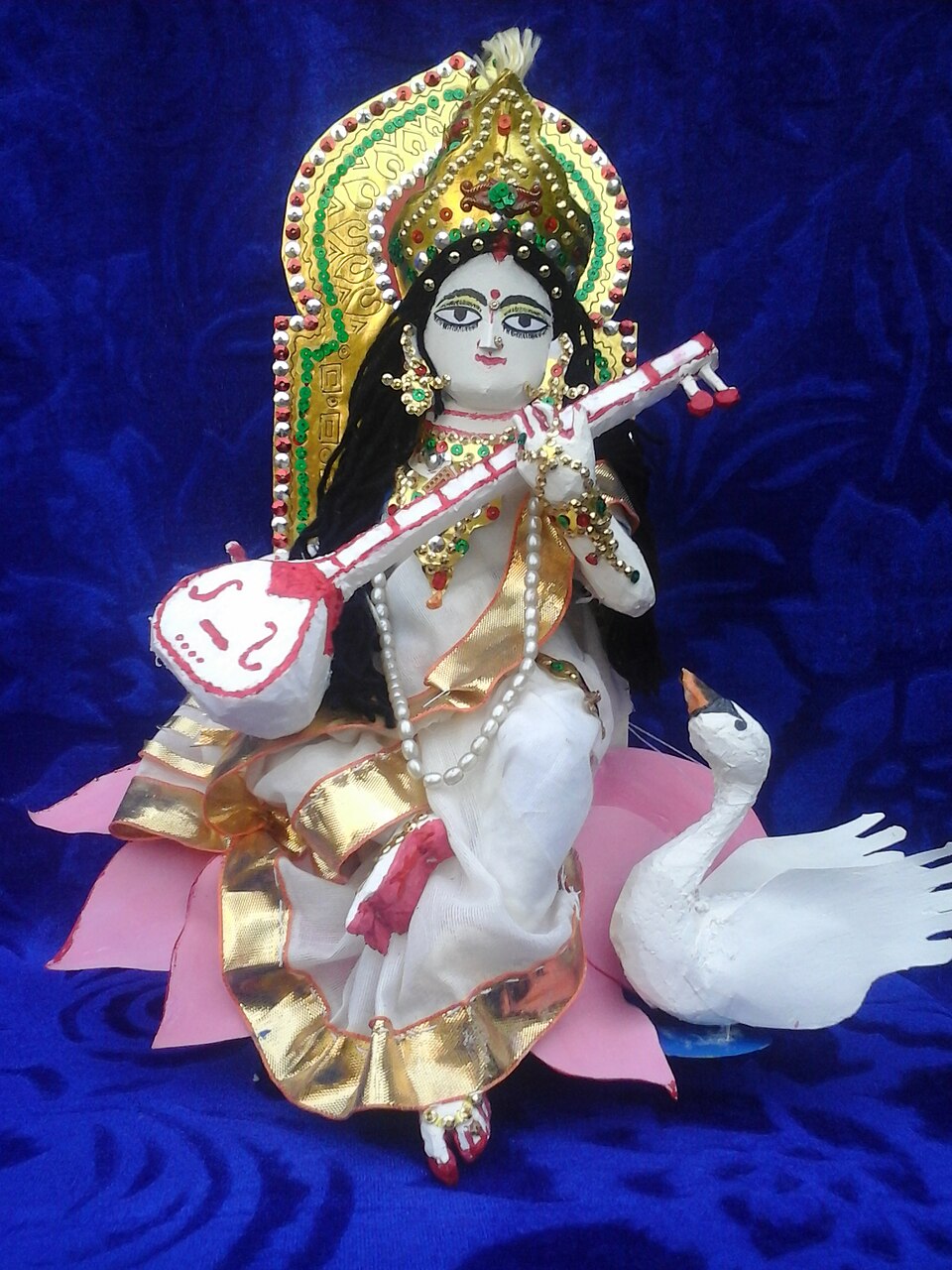
- Saraswati is identified by the veena, from which come her epithets Veenapani and Veenavadini; she is also shown with a book and a rosary.
- The noose is not Ganesha's alone — Yama and Varuna are both classically shown with a pasha — but within this list it can belong to no one else.
- Treating the noose as uniquely Ganesha's — Yama and Varuna are classically shown with a pasha too, though within this list the noose has no other home
- Picking the option that simply reads 1, 2, 3, 4 down the list; it is planted in almost every matching question and is wrong here at every position
- Giving Shiva the veena because of his association with music and dance — the instrument in his iconography is the damaru, the hourglass drum
UPPSC sets art and culture heavily as List-I/List-II matching — deity to attribute, saint to place, text to author, monument to builder — and expects the candidate to solve it by anchoring on one certain pair and eliminating. UPSC asks the same knowledge as a single-answer identification instead: how many arms a Chola Nataraja has, what a named mudra signifies, which site a described sculpture comes from.
Bronze icons of Nataraja cast during the Chola period invariably show the deity with
- (a) eight hands
- (b) six hands
- (c) four hands
- (d) two hands
Answer(c) four hands
The same discipline of reading a Hindu image by its fixed conventions rather than by impression. The Chola Nataraja is always four-armed, carrying the damaru and the flame while the other two hands make the abhaya gesture and point to the raised foot — which is also the clearest demonstration that Shiva's instrument is the drum, not the veena.
Lord Buddha's image is sometimes shown with the hand gesture called 'Bhumisparsha Mudra'. It symbolizes
- (a) Buddha's calling of the Earth to watch over Māra and to prevent Māra from disturbing his meditation
- (b) Buddha's calling of the Earth to witness his purity and chastity despite the temptations of Māra
- (c) Buddha's reminder to his followers that they all arise from the Earth and finally dissolve into the Earth, and, thus this life is transitory
- (d) Both the statements (a) and (b) are correct in this context
Answer(b) Buddha's calling of the Earth to witness his purity and chastity despite the temptations of Māra
Iconography again, this time Buddhist and read from the gesture rather than the object held. The principle is identical: an image carries a fixed vocabulary — attribute, mudra, mount, posture — and knowing the vocabulary lets you identify and interpret a sculpture you have never seen before.
- practice — not a real PYQ
The four attributes conventionally held by a four-armed image of Vishnu are
- (a)trident, drum, rosary and antelope
- (b)conch, discus, mace and lotus
- (c)noose, goad, axe and broken tusk
- (d)veena, book, rosary and water-pot
Answer(b) conch, discus, mace and lotus — shankha, chakra, gada and padma are Vishnu's ayudhas, and the Sudarshana chakra is the attribute by which he is most readily identified.
- practice — not a real PYQ
The epithet 'Veenapani' is applied to which deity, and why?
- (a)Shiva, because he is the lord of dance
- (b)Saraswati, because she is shown holding the veena
- (c)Ganesha, because he removes obstacles from the arts
- (d)Vishnu, because he reclines while Narada plays
Answer(b) Saraswati, because she is shown holding the veena — 'veena-pani' literally means 'the veena in the hand', and the related epithet Veenavadini means 'the player of the veena'.