
Given below are two statements, one is labelled as Assertion (A) and the other as Reason (R). Assertion (A) : Chile is the leading producer of copper in the world. Reason (R) : Andes Region of North Chile is enriched with the largest deposites of Porphyry copper. Select the correct answer from the code given below :
- (a)(A) is true but (R) is false
- (b)Both (A) and (R) are true and (R) is the correct explanation of (A)
- (c)(A) is false but (R) is true
- (d)Both (A) and (R) are true but (R) is not the correct explanation of (A)
Correct — B, Both (A) and (R) are true and (R) is the correct explanation of (A). Start with this paper's code, because every letter has been shifted from its familiar position: in UPPSC 2022 Paper-I, (a) means '(A) is true but (R) is false', (b) means 'Both (A) and (R) are true and (R) is the correct explanation of (A)', (c) means '(A) is false but (R) is true', and (d) means 'Both (A) and (R) are true but (R) is not the correct explanation of (A)'. The option candidates instinctively reach for at (a) is at (b) here. On the substance, the Assertion is true: Chile is the world's largest producer of mined copper, with output of the order of five million tonnes a year, roughly a quarter of world mine production and comfortably ahead of the next producers. The Reason is true as well: that output comes overwhelmingly from giant porphyry copper deposits strung along the Andes of northern Chile, in the Atacama and Antofagasta region, including Escondida, the largest copper mine in the world, and Chuquicamata. And the Reason is the cause of the Assertion, not a fact standing beside it. Chile leads because of what lies under the northern Andes: porphyry deposits are low-grade but enormous, formed around intrusions in subduction-zone volcanic arcs, and the Andean margin is the classic setting for them. Take the geology away and the production leadership has no source. So (b), on this paper's code.
- (a)(A) is true but (R) is false — The Reason is not false. The northern Chilean Andes hold the world's greatest concentration of porphyry copper, and the deposits there are the largest known of their type. Escondida in the Atacama is the world's single biggest copper mine and Chuquicamata is among the largest open pits ever worked; both are porphyry systems.
- (c)(A) is false but (R) is true — The Assertion is not false. Chile has led world copper mine production for decades and also holds the largest copper reserves. One caution that does not affect this option: the ranking that puts Chile first is for mined copper. In smelting and refining capacity the leader is China, which processes more than half the world's copper — a different measure that is easy to confuse with production.
- (d)Both (A) and (R) are true but (R) is not the correct explanation of (A) — This is the option that requires real thought, since both statements are true. It would be right only if Chile's leadership rested on something other than its ore endowment — investment, technology or policy, say. Those matter for how efficiently the copper is extracted, but they cannot create ore. Chile mines the most copper because it has the largest porphyry copper deposits to mine, so the Reason is the explanation and not merely a companion fact.
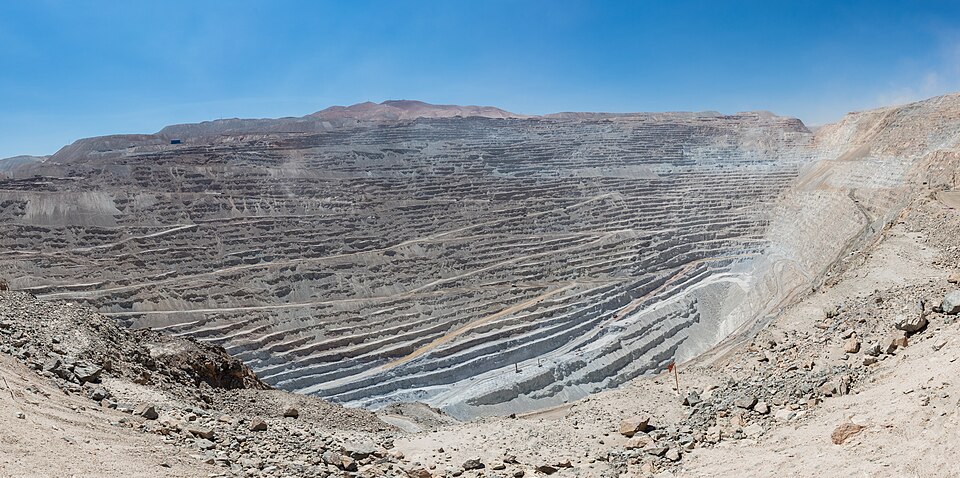
Porphyry copper deposits are the source of most of the world's copper. They form where an oceanic plate subducts beneath a continental margin: rising magma stalls at shallow depth, and hot fluids released from the cooling intrusion deposit copper and molybdenum sulphides through a large volume of fractured rock. The result is a body of very low grade — often well under one per cent copper — but of immense tonnage, which is why these deposits are worked as huge open pits rather than underground. The Andes are the textbook subduction-zone arc, and northern Chile is the richest stretch of it. Chile's copper industry is built on this: Escondida, the world's largest copper mine, and Chuquicamata, one of the largest open pits ever dug, both lie in the northern desert, and the state-owned Codelco is among the biggest copper producers on earth.
In an assertion-reason item about resources, the test is whether the Reason supplies the physical cause of the Assertion. Production leadership in a mineral almost always traces back to geology, so a geological Reason paired with a production Assertion will usually be the explanation — but check that the geology named is the right geology for that mineral, which here it is. Two precision points are worth carrying beyond this question. First, distinguish mining from processing: Chile leads in copper mined, while China leads by a wide margin in copper smelted and refined, and questions can be set on either. Second, treat the ranking below first place as movable — as of the June 2022 exam the usual order after Chile was Peru, with China and the Democratic Republic of the Congo close behind, but the Congo has since moved ahead of Peru, so quote shares and orders loosely rather than as fixed figures. A historical footnote that examiners like: the Atacama copper belt was Bolivian territory until Chile took it in the War of the Pacific of 1879-83, which is how Bolivia became landlocked and lost the copper as well as the coast.
- Chile is the world's largest producer of mined copper, with output of the order of five million tonnes a year — roughly a quarter of world mine production — and it also holds the largest copper reserves.
- That output comes from porphyry copper deposits in the Andes of northern Chile, in the Atacama and Antofagasta region; Escondida is the world's largest copper mine and Chuquicamata one of the largest open pits ever worked.
- Porphyry deposits are low-grade but very large-tonnage bodies formed around shallow intrusions in subduction-zone volcanic arcs — the setting the Andean margin provides.
- Codelco, the state-owned Corporación Nacional del Cobre, is among the largest copper producers in the world.
- Mine production and refining are separate rankings: Chile leads in copper mined, while China accounts for more than half of world copper smelting and refining capacity.
- Reading the assertion-reason letters from habit — in this paper (a) is 'A true, R false', (b) is 'both true and R explains A', (c) is 'A false, R true' and (d) is 'both true but R does not explain A'
- Choosing 'both true but R does not explain A' when the Reason states the physical cause of the Assertion, as a geological endowment does for a production ranking
- Confusing leadership in copper mining, which is Chile's, with leadership in copper smelting and refining, which is China's
UPPSC asks world mineral geography as locality-to-mineral recall — which mineral a named mining district is famous for — and as assertion-reason items that pair a production fact with its geological cause. UPSC has asked this exact Chile-and-porphyry pairing before, which makes it one of the most reliably repeated propositions in economic geography.
Assertion (A): Chile continues to be an important producer of copper in the world. Reason (R): Chile is endowed with the world’s largest deposit of porphyry copper.
- (a) Both A and R are true, and R is the correct explanation of A
- (b) Both A and R are true, but R is not a correct explanation of A
- (c) A is true, but R is false
- (d) A is false, but R is true
Answer(a) Both A and R are true, and R is the correct explanation of A
The same assertion-reason pair, asked by UPSC twenty-three years earlier and answered the same way on the substance — both true, and the porphyry endowment explains the production. It is also the clearest possible warning about codes: the identical meaning is keyed (a) there and (b) here, because UPPSC 2022 reorders every option.
Match List I with List II and select the correct answer using the codes given below the Lists: List I (Minerals) I. Mineral oil II. Copper III. Manganese IV. Bauxite List II (Major producer) A) Zambia B) Guyana C) Venezuela D) Gabon Codes:
- (a) I-C, II-A, III-D, IV-B
- (b) I-C, II-A, III-B, IV-D
- (c) I-A, II-C, III-B, IV-D
- (d) I-A, II-C, III-D, IV-B
Answer(a) I-C, II-A, III-D, IV-B
The same area of economic geography — matching a mineral to the country known for producing it. Copper here goes to Zambia, the leading African producer of the Katanga-Copperbelt line, which is a useful contrast: Zambia is the other name examiners attach to copper, while the world leader remains Chile.
'Mount Newman' is famous for which of the following minerals?
- (a) Copper
- (b) Manganese
- (c) Iron ore
- (d) Bauxite
Answer(c) Iron ore
The same recall of world mining districts and what they yield, with copper planted as the distractor. Mount Newman in Western Australia is iron ore; the copper districts of this scale are the Chilean porphyry mines of the northern Andes.
Postmasburg and its adjacent areas of South Africa is major producer of which of the following minerals ?
- (a) Uranium
- (b) Bauxite
- (c) Manganese
- (d) Mica
Answer(c) Manganese
Another named mining region tested for its mineral, which is how UPPSC most often asks world economic geography. Learning these districts as a set — Postmasburg for manganese, Mount Newman for iron ore, Chuquicamata and Escondida for copper — covers the whole family of questions.
- practice — not a real PYQ
Porphyry copper deposits, which supply most of the world's copper, are characteristically associated with
- (a)ancient shield areas of Precambrian rock
- (b)subduction-zone volcanic arcs such as the Andes
- (c)deep-sea sedimentary basins on passive continental margins
- (d)rift valleys formed by continental divergence
Answer(b) subduction-zone volcanic arcs such as the Andes — the shallow intrusions and hot mineralising fluids of such arcs produce the low-grade, large-tonnage bodies mined as open pits.
- practice — not a real PYQ
Consider the following statements about world copper. Which one is correct?
- (a)Chile leads the world in both copper mine production and copper refining capacity
- (b)Chile leads the world in copper mine production, while China accounts for the largest share of copper smelting and refining
- (c)Zambia is the world's largest producer of mined copper
- (d)Copper is chiefly obtained from sedimentary deposits laid down in shallow seas
Answer(b) Chile leads the world in copper mine production, while China accounts for the largest share of copper smelting and refining — the two rankings are different and are commonly confused.