
In India the First Municipal Corporation was set up in which one among the following places?
- (a)Calcutta
- (b)Madras
- (c)Bombay
- (d)Delhi
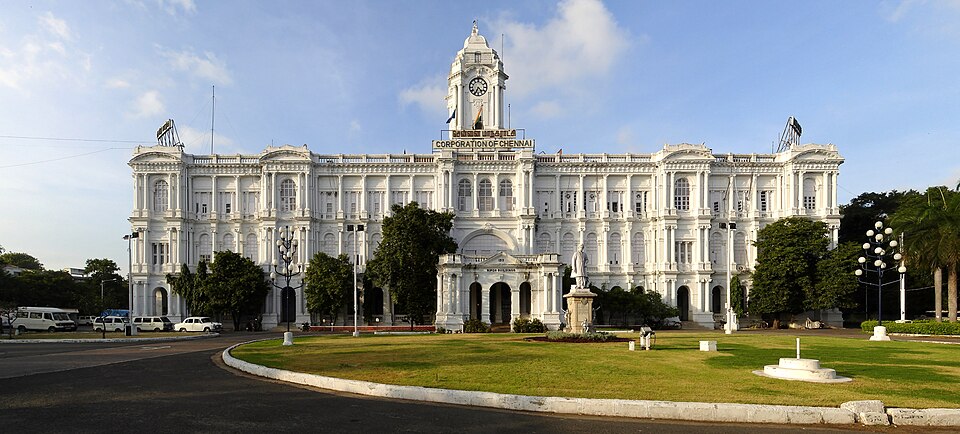
Correct — B, Madras. The first municipal corporation in India was established at Madras (present-day Chennai) in 1688 under a Royal Charter granted by King James II to the English East India Company. It created a Mayor and Corporation for the city, making Madras the birthplace of modern urban local self-government in India. The corporations of the other Presidency towns, Bombay and Calcutta, came later under the Royal Charter of 1726. Hence Madras is the answer.
- (a)Calcutta — Wrong — although Calcutta became the capital of British India, its municipal corporation was set up later (the 1726 Charter created corporations at the Presidency towns), decades after Madras's 1688 corporation.
- (c)Bombay — Wrong — Bombay likewise received its corporation under the Royal Charter of 1726, after Madras (1688); it was not the first.
- (d)Delhi — Wrong — Delhi was not a Presidency town of the East India Company; its Municipal Corporation (MCD) is a much later, 20th-century body (1958), far after Madras.
Urban local self-government in India began under the British East India Company. The Madras Municipal Corporation, created by the 1688 Royal Charter of James II, was the first in India. This predates the later landmark reforms — Lord Ripon's Resolution of 1882 (the 'Magna Carta' of local self-government) and the 74th Constitutional Amendment Act, 1992, which finally gave municipalities constitutional status under Part IX-A.
All four options are large cities, so the discriminator is chronology: only Madras got a corporation as early as 1688, while Bombay and Calcutta followed under the 1726 Charter and Delhi's is modern. Anchor: 'First municipal corporation = Madras, 1688.'
- The first municipal corporation in India was set up at Madras (Chennai) in 1688 by a Royal Charter of King James II.
- Corporations at Bombay and Calcutta were created later, under the Royal Charter of 1726.
- Lord Ripon's Resolution of 1882 is called the 'Magna Carta' of local self-government in India.
- The 74th Constitutional Amendment Act, 1992 gave urban local bodies constitutional status (Part IX-A).
- Assuming Calcutta (capital of British India) was first — the first corporation was at Madras
- Confusing the first corporation (1688) with the 74th Amendment (1992) that made municipalities constitutional
UPPSC & UPSC ask 'the first municipal corporation was set up at ___' or pair reforms with dates — memorise Madras 1688, Bombay/Calcutta 1726, Ripon 1882, 74th Amendment 1992.
In India, the first Municipal Corporation was set up in which one among the following ?
- (a) Calcutta
- (b) Madras
- (c) Bombay
- (d) Delhi
Answer(b) Madras
Identical question and answer — UPSC 2009 asked the same thing, with Madras (1688) as the first municipal corporation in India.
- practice — not a real PYQ
Which reform is often called the 'Magna Carta of local self-government' in India?
- (a)Government of India Act, 1935
- (b)Lord Ripon's Resolution of 1882
- (c)Charter Act of 1833
- (d)Minto-Morley Reforms, 1909
Answer(b) Lord Ripon's Resolution of 1882 — it promoted elected local bodies and is called the Magna Carta of local self-government. - practice — not a real PYQ
The 74th Constitutional Amendment Act, 1992 primarily deals with which of the following?
- (a)Panchayati Raj institutions
- (b)Municipalities / urban local bodies
- (c)Cooperative societies
- (d)Scheduled and Tribal Areas
Answer(b) Municipalities / urban local bodies — it added Part IX-A, giving urban local bodies constitutional status.