
Largest saline water lake in India is
- (a)Chilka
- (b)Sambhar
- (c)Lonar
- (d)Wullar
Correct — B, Sambhar. Sambhar Salt Lake in Rajasthan (about 80 km south-west of Jaipur, spread across the Jaipur, Nagaur and Ajmer districts) is India's largest inland saline (salt) lake. It is a shallow, ephemeral, endorheic (closed-basin) wetland fed by seasonal streams such as the Mendha and Rupangarh with no outlet to the sea, so inflowing water leaves only by evaporation and salts concentrate — which is why it is India's biggest inland source of common salt. It was designated a Ramsar wetland of international importance in 1990. Hence Sambhar is the answer.
- (a)Chilka — Wrong — Chilika (Odisha) is a brackish-water coastal lagoon opening into the Bay of Bengal; it is the largest lagoon of that type, but its salinity comes from tidal seawater mixing, not evaporative concentration in a closed basin, so it is not classed as India's largest inland saline lake. It is the classic trap because it is 'salty'.
- (c)Lonar — Wrong — Lonar Lake (Buldhana, Maharashtra) is a saline-cum-alkaline crater lake formed by a meteorite impact in Deccan basalt; it is famously saline but far smaller than Sambhar, so it is not the largest.
- (d)Wullar — Wrong — Wular Lake (Jammu & Kashmir), fed by the Jhelum, is one of India's largest FRESHWATER lakes of tectonic origin — not a saline lake at all.
A saline (salt) lake forms in an endorheic basin — a closed drainage with no outlet to the sea — where inflowing water can escape only by evaporation, concentrating dissolved salts. India's largest such inland salt lake is Sambhar, in the semi-arid Aravalli tract of Rajasthan. This is distinct from a coastal lagoon such as Chilika, whose salinity comes from exchange with seawater rather than evaporative build-up.
The trap is Chilika, which students link with 'salt water', but Chilika is a brackish coastal lagoon, not an inland salt lake. Sort the options by origin: Sambhar (inland, evaporative, salt-producing) vs Chilika (coastal lagoon) vs Lonar (impact crater lake) vs Wular (freshwater tectonic lake). 'Largest saline/salt lake = Sambhar' is the anchor.
- Sambhar Salt Lake (Rajasthan) is India's largest inland saline lake, about 80 km south-west of Jaipur.
- It is a shallow, endorheic, seasonal lake and India's largest inland source of common salt.
- Sambhar was designated a Ramsar wetland of international importance in 1990.
- Chilika is a brackish coastal lagoon, Lonar is a meteorite-impact crater lake, and Wular is a large freshwater lake.
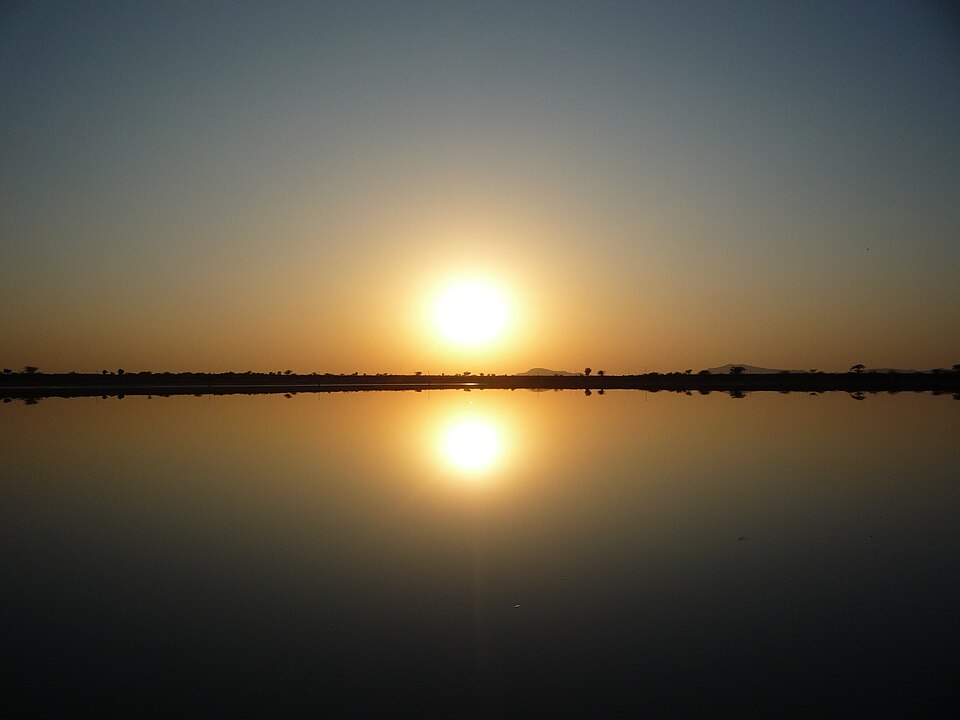
- Choosing Chilika because it is salty — it is a coastal lagoon, not an inland salt lake
- Treating Wular (a freshwater lake) as a saline lake
UPPSC & UPSC ask for the 'largest saline/salt lake' or to classify a listed lake as freshwater/brackish/saline — remember Sambhar = largest inland salt lake (Rajasthan); Chilika = largest brackish lagoon.
Lake Sambhar is nearest to which one of the following cities of Rajasthan?
- (a) Bharatpur
- (b) Jaipur
- (c) Jodhpur
- (d) Udaipur
Answer(b) Jaipur
Same lake — UPSC has directly tested Sambhar (the salt lake of this question), locating it nearest Jaipur in Rajasthan.
- practice — not a real PYQ
Sambhar Salt Lake, India's largest inland saline lake, is located in which State?
- (a)West Bengal
- (b)Gujarat
- (c)Rajasthan
- (d)Madhya Pradesh
Answer(c) Rajasthan — Sambhar lies about 80 km south-west of Jaipur and is India's biggest inland salt source. - practice — not a real PYQ
Which one of the following lakes was formed by a meteorite impact?
- (a)Sambhar
- (b)Lonar
- (c)Wular
- (d)Chilika
Answer(b) Lonar — a saline crater lake in the Deccan basalt of Buldhana district, Maharashtra, formed by a meteorite impact.