
Which one of the following is associated with 'Albedo' ?
- (a)Transmitting power
- (b)Absorbing power
- (c)Emissive power
- (d)Reflecting power
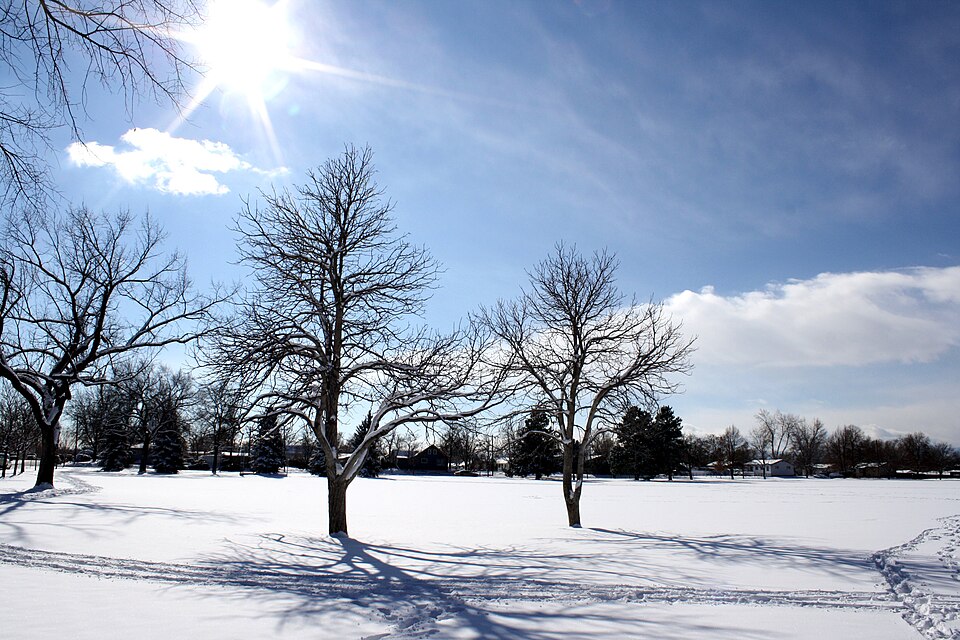
Correct — D, reflecting power. Albedo is the fraction of the solar radiation falling on a surface that the surface reflects straight back, expressed either as a ratio from 0 to 1 or as a percentage. A perfect mirror would have an albedo of 1, an ideal black body 0. Fresh clean snow is the highest natural reflector at roughly 80 to 90 per cent, thick cloud is comparable, a sand desert lies in the 25 to 40 per cent range, and forest canopy and open ocean sit below about 10 per cent. Averaged over the whole planet, Earth's albedo is close to 30 per cent — that is, about a third of the sunlight arriving at the top of the atmosphere is returned to space without ever warming anything. Albedo therefore says nothing about how much radiation a body lets through, how much it soaks up, or how much it radiates on its own account; it measures reflection alone.
- (a)Transmitting power — Transmissivity describes radiation that passes THROUGH a body — sunlight through window glass or clear water. Albedo counts only what bounces back off the surface; most natural land surfaces transmit almost nothing at all.
- (b)Absorbing power — The intended trap, because the two are directly linked and easy to invert. For an opaque surface, absorbed radiation equals 1 minus the albedo — so a HIGH albedo means LOW absorption. Fresh snow, with albedo near 0.9, absorbs almost nothing, which is exactly why snowfields stay cold and slow to melt. Calling albedo 'absorbing power' reverses the physics.
- (c)Emissive power — Emissivity is the ability of a body to radiate energy at its own temperature — for the Earth that means outgoing long-wave infrared radiation, governed by the Stefan-Boltzmann relation. Albedo belongs to the incoming short-wave half of the heat budget, emissivity to the outgoing long-wave half. Snow illustrates that they are independent: it has a very high albedo for sunlight yet is close to a black body in the infrared.
Earth's heat budget has an incoming short-wave side and an outgoing long-wave side. On the incoming side, insolation reaching a surface is either reflected or absorbed; albedo is the reflected fraction, and it varies with the nature of the surface, its colour and roughness, and the angle of the sun. On the outgoing side, everything that was absorbed is eventually re-radiated as long-wave infrared, and the greenhouse gases of the atmosphere intercept part of it. Because albedo decides how much energy enters the system in the first place, it is one of the main controls on regional and global temperature.
The four options are the four things a surface can do with radiation — reflect it, transmit it, absorb it, or emit its own — and only one of them is what albedo names. The Latin root helps: albus means white, and whiteness is reflectivity. The commonest error is option (b), because reflection and absorption are two sides of one balance and a hurried candidate grabs the wrong side. Fix it with a single image: fresh snow is blindingly bright BECAUSE it reflects, and it is cold BECAUSE it therefore absorbs so little. The same relationship drives the ice-albedo feedback that makes the Arctic warm faster than the rest of the planet.
- Albedo = reflected solar radiation divided by incident solar radiation, expressed as a ratio from 0 to 1 or as a percentage; the word comes from Latin albus, 'white'.
- Fresh snow has the highest albedo among natural surfaces, roughly 80 to 90 per cent; dense forest and open ocean are among the lowest, often under 10 per cent, with sand desert in between.
- Earth's mean planetary albedo is about 30 per cent — roughly a third of incoming solar energy is returned to space unabsorbed.
- Ice-albedo feedback: melting ice exposes darker ocean or land, which absorbs more radiation, warms further and melts more ice — a positive feedback central to Arctic amplification.
- Albedo is a short-wave (incoming solar) property, while emissivity governs long-wave (terrestrial infrared) radiation; a surface can have high albedo and high emissivity at the same time.
- Equating albedo with absorption — they are complements: for an opaque surface, absorption = 1 minus albedo.
- Treating albedo as a fixed constant for a surface type; it changes with sun angle, with the age and dirtiness of snow, and with cloud thickness.
- Mixing up albedo with emissivity — the first concerns incoming short-wave sunlight, the second outgoing long-wave infrared.
Both commissions ask albedo in two shapes — a bare definition, as here, or a ranking question ('which reflects back more sunlight'). UPSC used the ranking form in 2010 and a statement-based form in 2008, and UPPSC repeated the ranking form verbatim in 2021, so one clear grasp of the concept covers all of them.
Consider the following statements: 1. The albedo of an object determines its visual brightness when viewed with reflected light. 2. The albedo of Mercury is much greater than the albedo of the Earth. Which of the statements given above is/are correct?
- (a) 1 only
- (b) 2 only
- (c) Both 1 and 2
- (d) Neither 1 nor 2
Answer(a) 1 only
The same definition, tested by application — statement 1 is UPPSC's answer restated: albedo is about reflected light and therefore about brightness, not absorption or emission.
Which one of the following reflects back more sunlight as compared to the other three?
- (a) Sand desert
- (b) Paddy crop land
- (c) Land covered with fresh snow
- (d) Prairie land
Answer(c) Land covered with fresh snow
Albedo asked without using the word — the ranking form of the same concept, where fresh snow wins precisely because its reflecting power is the highest of any natural surface.
Which one of the following reflects back more sunlight as compared to other three ?
- (a) Sand Desert
- (b) Paddy crop land
- (c) Land covered with fresh snow
- (d) Prairie land
Answer(c) Land covered with fresh snow
UPPSC returned to albedo two years later in the ranking form — a near-verbatim lift of the UPSC 2010 question, showing how directly this concept repeats across both exams.
- practice — not a real PYQ
Which one of the following surfaces has the highest albedo?
- (a)Dense tropical forest
- (b)Fresh snow cover
- (c)Open ocean surface
- (d)Freshly ploughed black soil
Answer(b) Fresh snow cover — it reflects roughly 80 to 90 per cent of incoming sunlight, far more than forest, ocean or dark soil, all of which absorb most of what falls on them.
- practice — not a real PYQ
The ice-albedo feedback operating in the polar regions is best described as
- (a)a negative feedback that stabilises polar temperatures
- (b)a positive feedback that amplifies warming
- (c)a process driven entirely by outgoing long-wave radiation
- (d)a process unrelated to the reflectivity of the surface
Answer(b) a positive feedback that amplifies warming — melting ice exposes darker ocean and land of lower albedo, which absorb more solar radiation, raise temperatures further and melt still more ice.