
The book 'Venushilpa' by Chitracharya Upendra Maharathi relates to which of the following form of arts?
- (a)Jewellery
- (b)Painting
- (c)Bamboo art
- (d)Marble carving
Correct — C, Bamboo art. The official UPPSC key marks bamboo art, and the title itself carries the argument: in Sanskrit 'venu' means bamboo and 'shilpa' means craft or applied art, so 'Venushilpa' reads literally as 'the craft of bamboo'. The attribution also fits the man. Upendra Maharathi (1908–1981), born at Narendrapur in Odisha and trained at the Government College of Art & Craft, Kolkata, spent his working life in Bihar, where he served as a special designer in the state's Department of Industries and became the central figure in the revival of Bihar's handloom and handicraft traditions — cane and bamboo work among them. Bihar's craft research institute at Patna, the Upendra Maharathi Shilp Anusandhan Sansthan, is named after him. One honest caveat, stated plainly because this page is read by students: the book 'Venushilpa' itself could not be traced to any independently verifiable catalogue or archive. What is documented is Maharathi's biography and his handicraft-revival work, and the key's answer is consistent both with the title's etymology and with that work.
- (a)Jewellery — Nothing in the title or in Maharathi's documented career points to ornament-making. He is remembered as a painter-designer who worked on Bihar's handloom and handicraft revival and on architectural design, not as a jeweller, and 'venu' names a plant material, not a metal or a gem.
- (b)Painting — This is the trap, and a well-built one. 'Chitracharya' literally means master of painting, and Maharathi was an art-school-trained artist. But the honorific describes the man's standing, not the subject of this particular book. The title names the material — 'venu', bamboo — and the commission's key marks bamboo art, not painting.
- (d)Marble carving — Marble carving belongs to India's stone-sculpture tradition. The word 'shilpa' on its own can mean sculpture, which is exactly why this option tempts a candidate reading only the second half of the compound; the qualifier 'venu' fixes the medium as bamboo, not stone.
Indian craft vocabulary is often self-describing: a compound name usually pairs the material with the act of making. 'Venu' (bamboo) + 'shilpa' (craft/applied art) is one such compound, and decoding it is the fastest route to this answer. Behind the word sits a real institutional story — the twentieth-century effort to document and revive regional handicrafts after the decline of artisan livelihoods under colonial industrial competition. Upendra Maharathi was that effort's key figure in Bihar: an artist who moved from studio painting into design for craftspeople, working through the state Department of Industries, and who also designed the Vishwa Shanti Stupa (World Peace Pagoda) at Rajgir.
Treat this as a vocabulary question wearing a current-affairs costume. Even a candidate who has never heard of the book can get it: split the title, recognise 'venu' as bamboo — the same root behind the bamboo flute — and only one option survives. The pull towards painting comes entirely from the honorific 'Chitracharya' in the stem, which is a deliberate misdirection: UPPSC frequently plants a title or epithet that points at a different field from the one the question actually asks about. Note also the Bihar setting — bamboo and cane craft is a living tradition across eastern and north-eastern India, so the material is not exotic to the region the artist worked in.
- Upendra Maharathi (1908–1981) was born at Narendrapur in Odisha and trained at the Government College of Art & Craft, Kolkata.
- He settled in Bihar and worked as a special designer in the state's Department of Industries, leading the revival of its handloom and handicraft traditions.
- He designed the Vishwa Shanti Stupa (World Peace Pagoda) at Rajgir, Bihar.
- The Upendra Maharathi Shilp Anusandhan Sansthan, Bihar's craft research institute at Patna, is named after him.
- In Sanskrit 'venu' = bamboo and 'shilpa' = craft or applied art; the UPPSC key treats 'Venushilpa' as a work on bamboo art.
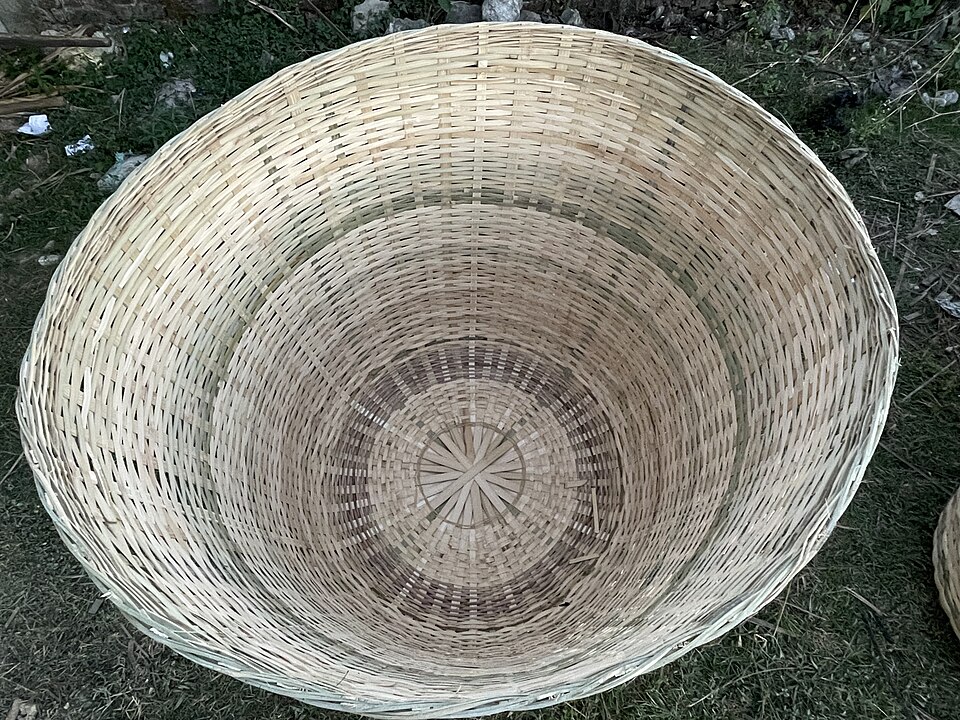
- The book 'Venushilpa' itself is hard to source — it does not turn up in ordinary library catalogues, so do not go looking for publication details to confirm it; solve the question from the title's meaning and the key.
- The honorific 'Chitracharya' in the stem points to painting and is the single biggest reason candidates pick (b).
- Reading only 'shilpa' and answering 'sculpture/marble carving' — the material qualifier at the front of the compound is what decides the answer.
UPPSC likes short 'work or person → field' items drawn from regional cultural history, often with a state hook; UPSC asks the same idea as a definitional 'X refers to' art question (Kalamkari, 2015), so learn the craft term along with its medium and its home region.
Kalamkari painting refers to
- (a) a hand-painted cotton textile in South India
- (b) a handmade drawing on bamboo handicrafts in North-East India
- (c) a block-painted woollen cloth in Western Himalayan region of India
- (d) a hand-painted decorative silk cloth in North-Western India
Answer(a) a hand-painted cotton textile in South India
Exactly the same skill — being handed the name of an Indian art form and having to say what medium and region it denotes. Note that one of its wrong options is bamboo handicraft, the very medium that is correct here.
Match List – I (Centre of Handicrafts) with List – II (State) and select the correct answer using the code given below the lists: A. Mon B. Nalbari C. Pasighat D. Tura ; 1. Arunachal Pradesh 2. Assam 3. Meghalaya 4. Nagaland
- (a) 4 2 1 3
- (b) 4 3 2 1
- (c) 1 3 4 2
- (d) 1 2 4 3
Answer(a) A-4, B-2, C-1, D-3
The handicraft-mapping version of the same topic — Nalbari and Pasighat in that list are cane-and-bamboo craft centres, so it builds the picture of where bamboo art actually lives in India.
- practice — not a real PYQ
The Upendra Maharathi Shilp Anusandhan Sansthan, an institute devoted to handicrafts, is located in
- (a)Patna
- (b)Bhubaneswar
- (c)Lucknow
- (d)Guwahati
Answer(a) Patna — the Bihar state craft research institute at Patna is named after Upendra Maharathi, who led the revival of the state's handicrafts.
- practice — not a real PYQ
The Vishwa Shanti Stupa (World Peace Pagoda) at Rajgir, Bihar, was designed by
- (a)Nandalal Bose
- (b)Upendra Maharathi
- (c)Jamini Roy
- (d)Ram Kinkar Baij
Answer(b) Upendra Maharathi — besides his handicraft work, he designed the Rajgir peace pagoda, which is why he is remembered as a designer as much as a painter.