
'Moribund Delta' is a subdivision of which of the following Delta ?
- (a)Krishna-Godawari Delta
- (b)Mahanadi Delta
- (c)Bengal Delta
- (d)Cauvery Delta
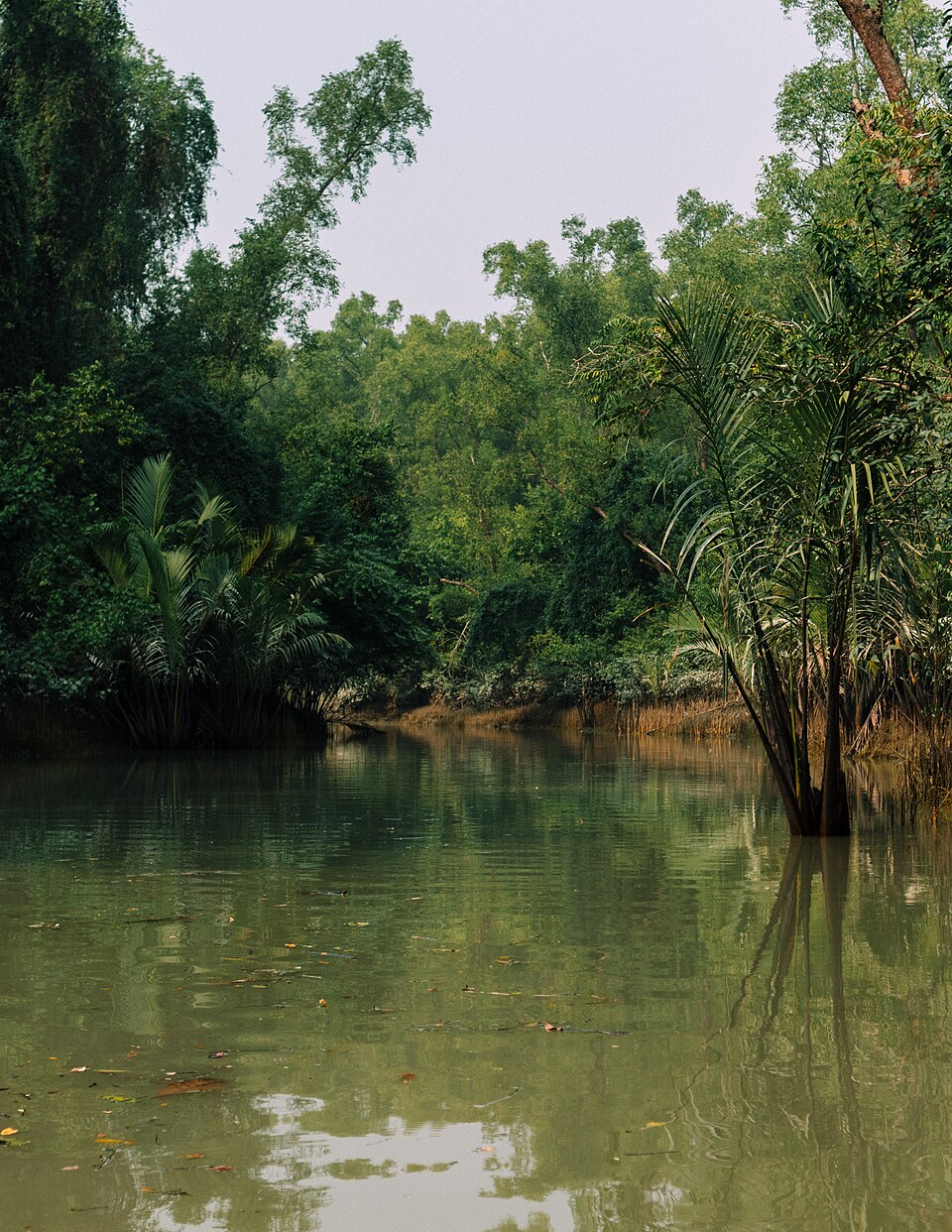
Correct — C, the Bengal Delta. The Ganga-Brahmaputra delta is so large that Indian geographers describe it in parts, and the standard scheme is a three-fold one: an active or tidal delta in the south-east, where the Sundarbans are still being built out of fresh silt; a mature delta in the middle, around the Hooghly and Kolkata; and a moribund or decaying delta in the north-west, across Nadia and Murshidabad and continuing into Bangladesh. The moribund tract earns its name because the Ganga's main discharge has migrated steadily eastward into the Padma, starving the old western distributaries — the Bhagirathi, Jalangi, Mathabhanga, Bhairab and Ichhamati. Cut off from a strong flow, they silted up into sluggish spill channels, ox-bows and marshes, and stopped building new land. No other Indian delta is subdivided this way, so 'moribund delta' is a term that belongs specifically to Bengal.
- (a)Krishna-Godawari Delta — The Krishna and Godavari build a joint deltaic plain on the Andhra coast that is famous as a rice bowl and as the KG hydrocarbon basin. It is an active, wave-and-tide-influenced delta, and Indian geography does not divide it into moribund, mature and active tracts.
- (b)Mahanadi Delta — The Mahanadi delta around Cuttack and Kendrapara in Odisha is a comparatively compact arcuate delta, known for the Bhitarkanika mangroves and for flood problems, not for a decaying sub-division. The moribund terminology is never applied to it.
- (d)Cauvery Delta — The Cauvery delta of Thanjavur, the granary of the south, is one of the oldest engineered deltas in the world — its distributaries have been controlled since the Grand Anicut was built across the river. It is described as an old and heavily irrigated delta, but not through the moribund-mature-active classification of Bengal.
A delta is not a single, uniformly growing landform. Where a distributary still carries plenty of sediment, the delta front advances into the sea and the tract is called active; where the river's flow has moved elsewhere, the abandoned lobe stops growing, its channels silt up and it becomes moribund — geologically alive but hydrologically dying. The Ganga-Brahmaputra-Meghna delta, the largest in the world, shows both states at once because the Ganga has been shifting its main course eastward for centuries. The precise names and boundaries of the sub-divisions vary a little between authors, but 'moribund delta' consistently refers to the decaying north-western tract of the Bengal delta.
The word does the work here: moribund means dying, so the question is really asking which Indian delta has a part that has stopped growing. Only the Bengal delta is big enough and old enough to have one — a delta split across two countries, whose main river has walked eastward and left its western half behind. If you can also picture the opposite end of the same delta, the Sundarbans still gaining land from fresh silt, you have the whole classification in one image.
- The Ganga-Brahmaputra-Meghna delta is the largest delta in the world and is shared between India and Bangladesh.
- Its standard sub-divisions are the moribund (decaying) delta in the north-west, the mature delta around the Hooghly, and the active or tidal delta of the Sundarbans in the south-east.
- The moribund tract covers the Nadia-Murshidabad country of West Bengal and continues across the border; its silted distributaries survive as sluggish spill channels, ox-bows and marshes, historically associated with stagnant water and malaria.
- The cause is the eastward migration of the Ganga's main flow into the Padma, which starved the western distributaries of water and sediment.
- The Farakka Barrage, commissioned in 1975, diverts Ganga water through a feeder canal into the Bhagirathi-Hooghly precisely to flush this silted system and keep Kolkata port navigable.
- Reading moribund as 'flooded' or 'infertile'. It means the tract has stopped receiving fresh silt and stopped growing; the older alluvium there is still farmed.
- Assuming the Bengal delta is uniformly active because the Sundarbans are famously growing. The active tract is only its south-eastern edge.
- Transferring the moribund-mature-active vocabulary to the Mahanadi, Godavari or Cauvery deltas. It is Bengal-specific in Indian textbooks.
UPPSC asks for the label — which delta owns a named sub-division; UPSC prefers the process behind it, asking why deltas form or fail to form, or testing the shifting courses of the Bengal rivers.
Assertion (A): West-flowing rivers of Peninsular India have no deltas. Reason (R): These rivers do not carry any alluvial sediment.
- (a) Both A and R are individually true and R is the correct explanation of A
- (b) Both A and R are individually true but R is not the correct explanation of A
- (c) A is true but R is false
- (d) A is false but R is true
Answer(c) A is true but R is false
The same idea from the other side — a delta lives or dies on whether sediment keeps arriving where the river meets the sea, which is why the Narmada and Tapi never build one and why the starved western Bengal delta stopped growing.
Given below are two statements, one is labelled as Assertion (A) and other as Reason (R): Assertion (A): Teesta river was earlier a tributary of Ganga now it is a tributary of Brahmaputra. Reason (R): River capturing is a major feature of Himalayan rivers. Select the correct answer using the codes given below.
- (a) Both (A) and (R) are true and (R) is correct explanation of (A)
- (b) Both (A) and (R) are true, but (R) is not correct explanation of (A)
- (c) (A) is true, but (R) is false
- (d) (A) is false, but (R) is true
Answer(a) Both (A) and (R) are true and (R) is correct explanation of (A)
The same process that created the moribund delta — rivers of the Bengal plains abandoning their old channels — tested through the Teesta's eastward switch away from the Ganga system.
- practice — not a real PYQ
Which part of the Bengal delta is described as the active or tidal delta, where new land is still being formed?
- (a)The Nadia-Murshidabad tract
- (b)The Sundarbans
- (c)The Rarh plain
- (d)The Barind tract
Answer(b) The Sundarbans — the seaward, south-eastern edge of the delta still receives fresh silt and tidal deposition, while the north-western Nadia-Murshidabad tract is the moribund delta.
- practice — not a real PYQ
The Farakka Barrage was built primarily to
- (a)generate hydroelectric power for eastern India
- (b)divert Ganga water into the Bhagirathi-Hooghly to improve navigability at Kolkata port
- (c)control floods in the Brahmaputra valley
- (d)irrigate the Barind tract of northern Bengal
Answer(b) Divert Ganga water into the Bhagirathi-Hooghly to improve navigability at Kolkata port — the barrage feeds water into the silted western distributary system of the delta to flush the channel.