
Which one of the following cities is NOT located on the Trans-Siberian rail route ?
- (a)Kazan
- (b)Omsk
- (c)Sochi
- (d)Chita
Correct — C, Sochi. The Trans-Siberian runs eastward from Moscow across the Urals and the whole width of Siberia to Vladivostok on the Pacific. Sochi lies in exactly the opposite direction — it is a Black Sea resort city in Krasnodar Krai, in the far south-west of European Russia at the foot of the Caucasus, served by the North Caucasus Railway and best known internationally for hosting the 2014 Winter Olympics. It appears on no branch of the Trans-Siberian, whether the main line, the Trans-Manchurian or the Trans-Mongolian.
- (a)Kazan — Kazan, the capital of Tatarstan on the Volga, sits on the Moscow-to-Urals eastward corridor and is tied into the Trans-Siberian network by the line running on to Yekaterinburg — so it is not the odd one out. (Strictly, the classic main line leaves Moscow via Yaroslavl and Kirov rather than Kazan; Kazan is on the southern approach to the Urals. Either way it lies on the route east, not away from it.)
- (b)Omsk — Omsk is a main-line Trans-Siberian city — a major junction of western Siberia standing on the Irtysh river, between Yekaterinburg and Novosibirsk.
- (d)Chita — Chita, capital of Zabaykalsky Krai east of Lake Baikal, is likewise a main-line station on the Trans-Siberian, in the Transbaikal stretch between Ulan-Ude and Khabarovsk.
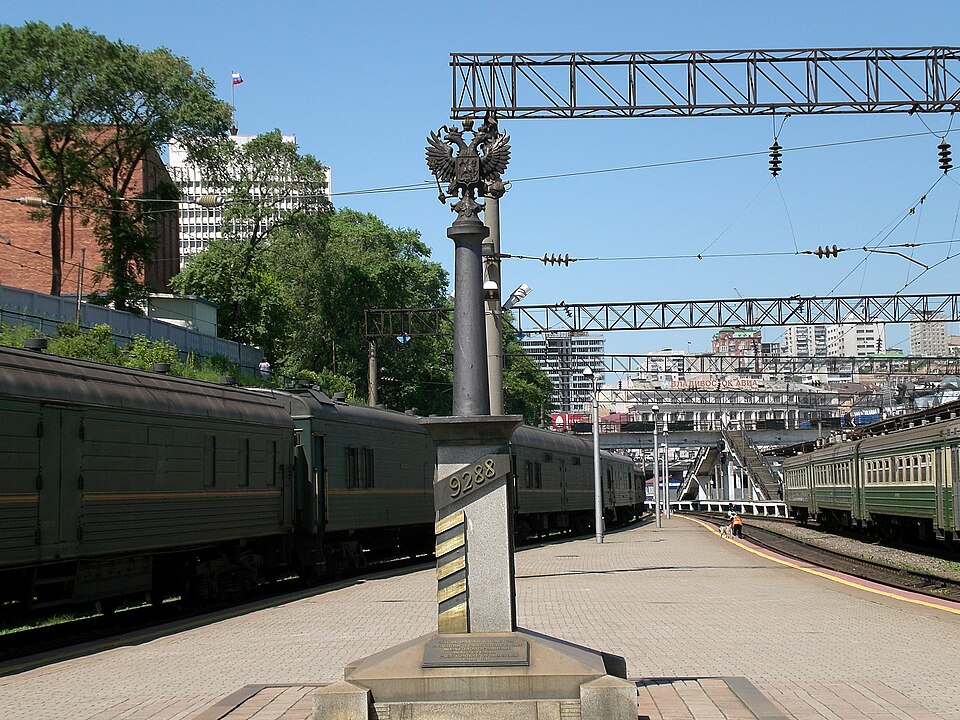
The Trans-Siberian Railway is the longest continuous railway line in the world, running about 9,289 km from Moscow's Yaroslavsky station to Vladivostok on the Sea of Japan. Construction began in 1891 under Tsar Alexander III and the through route was completed in 1916. It knitted European Russia to the Pacific, opened Siberia's mineral and forest wealth to settlement and exploitation, and remains the strategic spine of Russian land transport — which is why economic-geography syllabi treat it alongside the Trans-Canadian, Trans-Andean and Trans-Australian lines.
For a 'which one is NOT on the route' question you do not need the full station list — you need one city that is geographically impossible. Sochi is that city: it is a subtropical Black Sea resort on the Caucasus coast, thousands of kilometres to the south-west of anything Siberian. Omsk (western Siberia) and Chita (Transbaikal) are both squarely Siberian, and Kazan lies on the Volga on the way east from Moscow. Fixing the general direction of travel — Moscow eastwards — resolves the question faster than recalling timetables.
- Trans-Siberian Railway: Moscow (Yaroslavsky station) to Vladivostok, about 9,289 km, the world's longest continuous rail line; begun 1891, through route completed 1916.
- Main-line cities eastward include Yaroslavl, Yekaterinburg (the Urals), Omsk, Novosibirsk, Krasnoyarsk, Irkutsk, Ulan-Ude, Chita, Khabarovsk and Vladivostok.
- Two great branches leave the main line: the Trans-Manchurian, which cuts through north-eastern China, and the Trans-Mongolian, which turns south at Ulan-Ude for Ulaanbaatar and Beijing.
- Sochi is on the Black Sea coast in Krasnodar Krai, on the North Caucasus Railway — the opposite corner of Russia from Siberia; it hosted the 2014 Winter Olympics.
- Irkutsk, near the southern tip of Lake Baikal, is the classic Trans-Siberian landmark, and the older Circum-Baikal line skirting the lake is a famous engineering stretch.
- Treating any large Russian city as a Trans-Siberian city. St Petersburg, Volgograd, Rostov-on-Don, Murmansk and Sochi are all major, and none is on the line.
- Older textbooks describe the Trans-Siberian as running from 'Leningrad (St Petersburg) to Vladivostok' — the operational main line today starts at Moscow's Yaroslavsky station, so read the option wording carefully.
- Confusing the Trans-Mongolian and Trans-Manchurian branches with the main line to Vladivostok — all three share the track west of Lake Baikal.
World economic geography questions on transcontinental railways come in two shapes — 'which city is NOT on the route' (this one) and a match-list pairing each railway with its two terminal cities. Learn the terminals and three or four anchor cities per line.
Match List I with List II and select the correct answer by using the codes given below the lists: List I: I. European transcontinental railway, II. Trans Andean railway, III. Trans-Siberian railway, IV. Orient Express List II: A) Paris to Istanbul, B) Leningrad to Vladivostok, C) Leningrad to Volgograd, D) Buenos Aires to Valparaiso, E) Paris to Warsaw
- (a) I-E, II-D, III-B, IV-A
- (b) I-A, II-D, III-C, IV-B
- (c) I-E, II-A, III-B, IV-C
- (d) I-A, II-B, III-C, IV-D
Answer(a) I-E, II-D, III-B, IV-A
The same transcontinental-railway geography: UPSC pins the Trans-Siberian to its Vladivostok terminus (and, in the older textbook convention, to Leningrad in the west), which is exactly the route knowledge this UPPSC question probes.
- practice — not a real PYQ
The eastern terminus of the Trans-Siberian Railway is
- (a)Khabarovsk
- (b)Vladivostok
- (c)Magadan
- (d)Irkutsk
Answer(b) Vladivostok — the Pacific port at the end of the roughly 9,289-km line from Moscow; Khabarovsk and Irkutsk are intermediate cities and Magadan is not on the railway at all.
- practice — not a real PYQ
The Trans-Mongolian branch of the Trans-Siberian Railway leaves the main line and runs south to
- (a)Beijing
- (b)Seoul
- (c)Almaty
- (d)Tashkent
Answer(a) Beijing — the Trans-Mongolian turns south at Ulan-Ude and crosses Mongolia via Ulaanbaatar into China.