
Which of the following statement is NOT true ?
- (a)Species diversity increases from equator towards poles.
- (b)Tropics harbour more species than temperate areas.
- (c)Greatest biodiversity occurs in Amazonean rain forest.
- (d)Species diversity decreases from temperate areas towards poles.
Correct — A, 'Species diversity increases from equator towards poles.' The stem asks which statement is NOT true, and this one states the latitudinal gradient of species diversity backwards. For almost every group of organisms, species richness is at its maximum near the equator and falls steadily as you move towards either pole. The standard NCERT illustration is birds: Colombia, sitting on the equator, has roughly 1,400 species; New York at about 41°N has around 105; Greenland at about 71°N only about 56. The remaining three statements all describe that same gradient correctly, so (a) is the odd one out and the required answer.
- (b)Tropics harbour more species than temperate areas. — This statement is TRUE, so it cannot be the answer to a 'NOT true' question. The tropical belt (23.5°N to 23.5°S) is the richest zone on Earth for practically every taxonomic group.
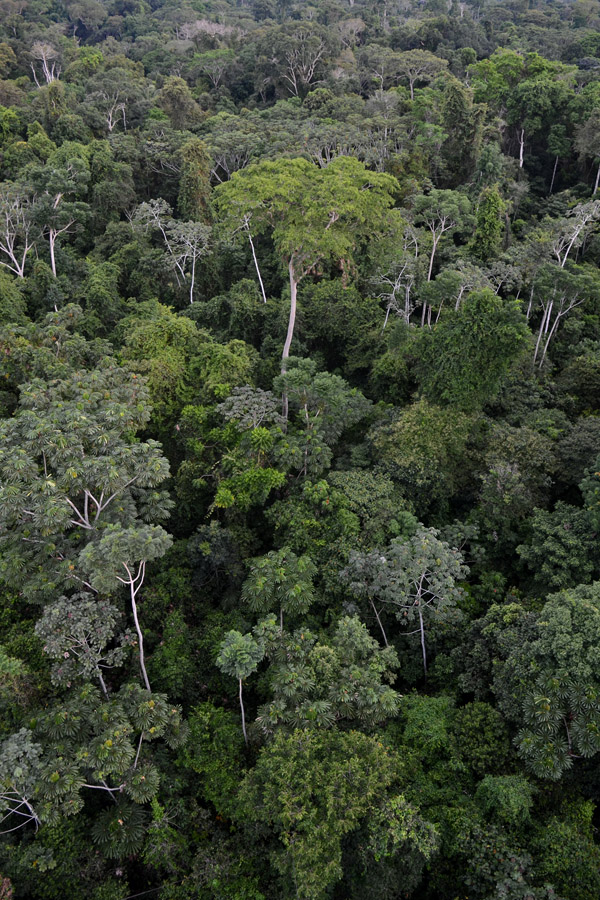
- (c)Greatest biodiversity occurs in Amazonean rain forest. — This statement is TRUE, so it cannot be the answer. The Amazonian rainforest of South America is the standard textbook example of the most species-rich region on the planet, counted in tens of thousands of plant species besides its fishes, birds, mammals, amphibians, reptiles and enormous invertebrate fauna.
- (d)Species diversity decreases from temperate areas towards poles. — This statement is TRUE, so it cannot be the answer. It simply states the higher-latitude half of the same gradient: moving from temperate latitudes into the Arctic and Antarctic, species richness keeps falling.
The latitudinal gradient in species diversity is one of the oldest and best-documented patterns in ecology: species richness peaks in the tropics and declines towards both poles, for plants, birds, fishes and insects alike. Three explanations are usually offered. (i) Evolutionary time — temperate latitudes were repeatedly disrupted by Pleistocene glaciations, while tropical latitudes remained relatively undisturbed for millions of years, giving speciation a far longer uninterrupted run. (ii) Environmental constancy — tropical climates are less seasonal and more predictable, which favours narrow niche specialisation and lets more species coexist. (iii) Energy — more solar radiation reaches the tropics, supporting higher primary productivity and therefore a greater diversity of consumers.
This is a 'NOT true' item, so read every option for direction rather than for content. All four options describe the same gradient; three state it correctly and one reverses it. Fix a single anchor in memory — richness is maximum at the equator, minimum at the poles — and any option claiming diversity rises towards the poles is instantly the false one. Candidates lose this question by skimming past the word NOT and marking a statement that is perfectly true.
- Latitudinal gradient: species diversity is maximum at the equator and decreases towards both poles.
- The tropics (23.5°N to 23.5°S) hold more species than temperate or polar regions for almost every taxonomic group.
- The Amazonian rainforest is the textbook example of the greatest biodiversity on Earth.
- NCERT's bird illustration: Colombia (equatorial) about 1,400 species; New York (41°N) about 105; Greenland (71°N) about 56.
- Usual explanations for tropical richness: longer undisturbed evolutionary time, a less seasonal and more constant climate, and higher solar energy and productivity.
- Missing the word NOT in the stem and marking one of the three true statements.
- Assuming biodiversity hotspots are only tropical — several, such as the California Floristic Province and the Mediterranean Basin, are not.
- Confusing species richness (the number of species) with species evenness, or with genetic diversity within a species.
UPPSC likes the 'which statement is NOT correct' framing on the latitudinal gradient; UPSC tends to test the same ground through species–area relationships, hotspot lists, and questions on why a particular region (for example the Himalaya) is unusually species-rich.
The Himalayan Range is very rich in species diversity. Which one among the following is the most appropriate reason for this phenomenon?
- (a) It has a high rainfall that supports luxuriant vegetative growth
- (b) It is a confluence of different bio-geographical zones
- (c) Exotic and invasive species have not been introduced in this region
- (d) It has less human interference
Answer(b) It is a confluence of different bio-geographical zones
Both questions test why species richness varies from region to region — UPSC asks for the reason behind the Himalaya's exceptional richness (a meeting ground of biogeographic realms), while UPPSC tests the broader latitudinal gradient that governs the same pattern.
- practice — not a real PYQ
The number of species per unit area is generally highest in:
- (a)the polar tundra
- (b)temperate grasslands
- (c)equatorial rainforests
- (d)cold deserts
Answer(c) equatorial rainforests — the latitudinal gradient places peak species richness at the equator and the minimum at the poles.
- practice — not a real PYQ
Which one of the following is NOT usually offered as an explanation for the greater species diversity of the tropics?
- (a)Tropical latitudes have had a long, relatively undisturbed evolutionary history
- (b)Tropical environments are less seasonal and more constant
- (c)The tropics receive more solar energy and are more productive
- (d)The tropics were repeatedly covered by glaciers during the Ice Ages
Answer(d) — it was the temperate and higher latitudes that were repeatedly glaciated; the tropics largely escaped, which is exactly why they accumulated more species.