
Which one of the following materials contains calcium ?
- (a)China clay
- (b)Corundum
- (c)Gypsum
- (d)Talc
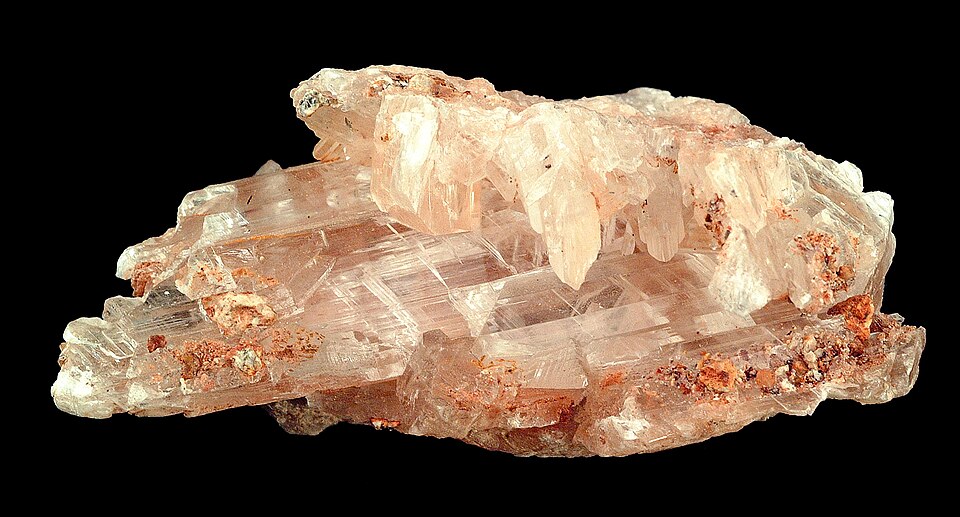
Correct — C, Gypsum. Gypsum is calcium sulphate dihydrate, CaSO4·2H2O — calcium sits in the formula itself. It is the calcium mineral behind Plaster of Paris (heating gypsum to about 150 °C drives off three-quarters of its water to give the hemihydrate, CaSO4·½H2O) and it is the small percentage of material ground in with cement clinker to slow the setting of Portland cement. Each of the other three options is an aluminium or magnesium mineral with no calcium in it at all.
- (a)China clay — China clay is kaolin, whose mineral is kaolinite — a hydrated aluminium silicate, Al2Si2O5(OH)4. It contains aluminium, silicon, oxygen and hydrogen, but no calcium. It is the raw material of porcelain and a coating filler for paper.
- (b)Corundum — Corundum is aluminium oxide, Al2O3 — no calcium. It is Mohs hardness 9 and is used as an abrasive; ruby and sapphire are its gem varieties, coloured by traces of chromium and of iron/titanium respectively.
- (d)Talc — Talc is a hydrated magnesium silicate, Mg3Si4O10(OH)2 — magnesium, not calcium. It is the softest mineral on the Mohs scale (hardness 1), used for talcum powder and, in massive form, as soapstone.
This is a straight formula-recall question: identify the cation in each common industrial mineral. Group them by the metal they carry — calcium minerals include gypsum (CaSO4·2H2O), calcite/limestone (CaCO3), fluorite (CaF2), apatite (calcium phosphate) and quicklime (CaO); aluminium minerals include bauxite, corundum (Al2O3) and kaolin; magnesium minerals include talc, magnesite (MgCO3), while dolomite carries both calcium and magnesium.
The trap is that all four options are soft, pale, powdery industrial minerals that feel interchangeable — china clay, talc and gypsum are all sold as white powders. The only discriminator is the chemical formula. A second useful hook: three of the four options are Mohs reference minerals (talc 1, gypsum 2, corundum 9), so this option set doubles as a hardness-scale revision.
- Gypsum = calcium sulphate dihydrate, CaSO4·2H2O; heating it gives Plaster of Paris, CaSO4·½H2O
- China clay (kaolin) = Al2Si2O5(OH)4, a hydrated aluminium silicate; talc = Mg3Si4O10(OH)2, a hydrated magnesium silicate
- Corundum = Al2O3, Mohs hardness 9; ruby and sapphire are its gem varieties
- Mohs scale reference minerals include talc 1, gypsum 2, corundum 9 and diamond 10
- A small proportion of gypsum is added to cement clinker as a setting retarder; Rajasthan is India's leading gypsum-producing state
- Assuming 'china clay' is chemically exotic — it is simply a hydrated aluminium silicate
- Mixing up talc (magnesium) with gypsum (calcium) because both are soft white powders
- Thinking corundum must be a carbon or silicon mineral just because it is very hard
Asked as 'which contains element X', as 'the chemical formula/composition of Y is', or as a mineral–use match list. Memorise one formula plus one signature use for every common industrial mineral.
Consider the following statements: 1. Banking soda is used in fire extinguishers. 2. Quicklime is used in the manufacture of glass. 3. Gypsum is used in the manufacture of Plaster of Paris. Which of the statements given above is/are correct?
- (a) 1 and 2
- (b) 2 and 3
- (c) 1 only
- (d) 1, 2 and 3
Answer(d) 1, 2 and 3
Same underlying knowledge — statement 3 is true precisely because gypsum is calcium sulphate dihydrate, which on heating yields Plaster of Paris; statement 2 turns on quicklime being calcium oxide.
Which of the following is NOT correctly matched?
- (a) Acid present in vinegar - Acetic acid
- (b) Compound present in bones - Calcium phosphate
- (c) Souring of milk - Nitric acid
- (d) Acid present in gastric juice - Hydrochloric acid
Answer(c) Souring of milk - Nitric acid
The same everyday-chemistry skill — knowing which compound is actually present in a familiar material (calcium phosphate in bone there, calcium sulphate in gypsum here).
- practice — not a real PYQ
Plaster of Paris is obtained by heating which one of the following?
- (a)Limestone
- (b)Gypsum
- (c)Talc
- (d)Bauxite
Answer(b) Gypsum — heating CaSO4·2H2O gives the hemihydrate CaSO4·½H2O, i.e. Plaster of Paris.
- practice — not a real PYQ
Gypsum is added to cement clinker mainly in order to
- (a)increase the final strength of concrete
- (b)slow down the setting of cement
- (c)give cement its grey colour
- (d)make cement waterproof
Answer(b) slow down the setting of cement — gypsum acts as a setting retarder, giving workable time before the paste hardens.