
Nitrogen fixing bacteria make combination with cells of the roots of
- (a)Pulses
- (b)Rice
- (c)Wheat
- (d)Sugarcane
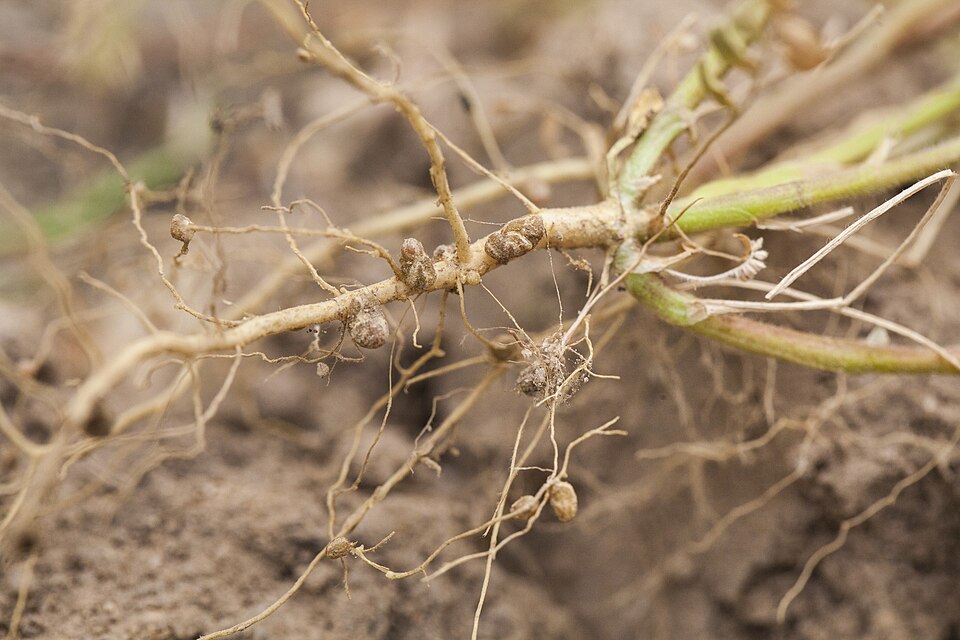
Correct — A, Pulses. Nitrogen-fixing bacteria of the Rhizobium group (Rhizobium, Bradyrhizobium, Mesorhizobium, Sinorhizobium) infect the root hairs of leguminous plants — the pulses: gram/chickpea, arhar, moong, urad, masoor, pea, plus groundnut and soybean — and multiply inside the cortical cells of the root, which swell into visible root nodules. Inside the nodule the bacteria change into bacteroids and use the enzyme nitrogenase to reduce atmospheric N2 into ammonia that the plant can use; in return the plant supplies sugars and makes leghaemoglobin, a pink oxygen-binding pigment that keeps free oxygen away from the oxygen-sensitive nitrogenase. This literal 'combination with cells of the roots' is a legume speciality, and it is why pulses leave the soil richer in nitrogen and are the standard rotation crop after a cereal.
- (b)Rice — Rice is a cereal of the grass family (Poaceae) and forms no root nodules. Flooded paddy fields do gain biologically fixed nitrogen, but from free-living cyanobacteria (Anabaena, Nostoc) in the standing water and from the Azolla water-fern, which houses Anabaena azollae in its leaf cavities — not from bacteria living inside the root cells.
- (c)Wheat — Wheat is also a non-leguminous cereal with no nodule symbiosis. Its nitrogen comes from soil organic matter and applied urea/ammonium fertiliser; engineering cereals to nodulate is an active research goal, not a field reality.
- (d)Sugarcane — Sugarcane is a grass too. Some nitrogen-fixing bacteria are reported living inside sugarcane tissue as endophytes, but that is an associative relationship — sugarcane forms no root nodules, so it is not the root-cell symbiosis this question describes.
Atmospheric nitrogen is 78% of the air but is locked in an N2 triple bond that plants cannot break. Only certain prokaryotes carry nitrogenase, the enzyme that reduces N2 to ammonia — this is biological nitrogen fixation. It comes in three forms: symbiotic (Rhizobium inside legume root nodules; Frankia inside the nodules of Casuarina and Alnus), free-living (Azotobacter, Clostridium, and the cyanobacteria Anabaena and Nostoc), and associative/endophytic (Azospirillum with cereal roots). Only the symbiotic form involves the bacterium living inside the plant's own root cells.
The phrase 'make combination with cells of the roots' is pointing at symbiosis inside root tissue, i.e. root nodules. Then the options sort themselves: rice, wheat and sugarcane are all grasses, and only 'Pulses' names the legume family. Whenever an exam offers one legume against three cereals/grasses in a nitrogen question, the legume is almost always the answer.
- Rhizobium + legume (pulse) roots form root nodules; inside them nitrogenase converts N2 into ammonia
- Leghaemoglobin, the pink pigment of a nodule, shields nitrogenase from oxygen
- Rice, wheat and sugarcane belong to the grass family and form no root nodules
- Nitrogen for paddy is fixed by free-living cyanobacteria (Anabaena, Nostoc) and by the Azolla-Anabaena fern symbiosis
- Non-legume root nodules do exist: the actinomycete Frankia nodulates Casuarina and Alnus
- Assuming rice gets no biologically fixed nitrogen at all — it does, but from cyanobacteria and Azolla in the water, not from root nodules
- Confusing Rhizobium (symbiotic, in nodules) with Azotobacter (free-living in soil) and mycorrhiza (fungal, mainly helps phosphorus uptake)
- Treating every soil bacterium as a nitrogen fixer
UPPSC and UPSC ask this as 'which crop hosts nitrogen-fixing bacteria', 'which organism is a biofertilizer for rice', or as a statement set on the nitrogen cycle — the legume-Rhizobium-nodule chain is the fact that keeps paying.
Which of the following are nitrogen-fixing plants? 1. Alfalfa 2. Amaranth 3. Chickpea 4. Clover 5. Purslane (Kulfa) 6. Spinach Select the correct answer using the code given below:
- (a) 1, 3 and 4 only
- (b) 1, 3, 5 and 6 only
- (c) 2, 4, 5 and 6 only
- (d) 1, 2, 4, 5 and 6
Answer(a) 1, 3 and 4 only
Exactly the same test — alfalfa, chickpea and clover are legumes that host Rhizobium in root nodules, while amaranth, purslane and spinach are non-legumes that cannot fix nitrogen.
Which one of the following organisms can serve as a biofertilizer for rice crop?
- (a) Blue-green algae
- (b) Rhizobium sp
- (c) Mycorrhizal fungi
- (d) Azotobacter sp
Answer(a) Blue-green algae
The mirror image of this question and the direct answer to its 'Rice' distractor — rice gets fixed nitrogen from free-living blue-green algae in the flooded field, because Rhizobium can only work inside legume root nodules.
- practice — not a real PYQ
The pink pigment leghaemoglobin found in the root nodules of legumes mainly serves to:
- (a)Fix atmospheric nitrogen directly
- (b)Protect the nitrogenase enzyme from oxygen
- (c)Transport sugars from the leaves to the bacteria
- (d)Give the nodule its characteristic shape
Answer(b) Protect the nitrogenase enzyme from oxygen — leghaemoglobin binds free O2 and keeps the interior of the nodule nearly oxygen-free, because nitrogenase is destroyed by oxygen.
- practice — not a real PYQ
Which one of the following is used as a biofertilizer specifically for paddy (rice) fields?
- (a)Rhizobium
- (b)Azolla
- (c)Bacillus thuringiensis
- (d)Trichoderma
Answer(b) Azolla — the floating water fern whose leaf cavities house the nitrogen-fixing cyanobacterium Anabaena azollae, ideal for flooded paddy. Rhizobium needs legume roots, Bt is an insecticidal bacterium and Trichoderma is a biocontrol fungus.