
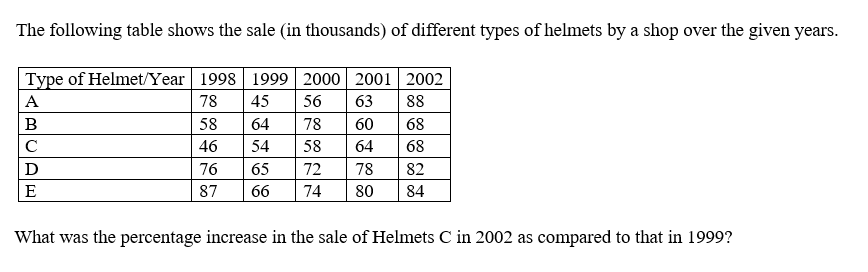
The following table shows the sale (in thousands) of different types of helmets by a shop over the given years. Type of Helmet/Year → 1998 | 1999 | 2000 | 2001 | 2002 A — 78 | 45 | 56 | 63 | 88 B — 58 | 64 | 78 | 60 | 68 C — 46 | 54 | 58 | 64 | 68 D — 76 | 65 | 72 | 78 | 82 E — 87 | 66 | 74 | 80 | 84 What was the percentage increase in the sale of Helmets C in 2002 as compared to that in 1999?
- (a)25.93%
- (b)27.62%
- (c)26.39%
- (d)28.26%
Answer
Why
Correct — A. The stem is a table image: helmet sales in thousands for types A to E across 1998 to 2002, then the question about Helmet C, 2002 against 1999.
Helmet C in 1999 = 54
Helmet C in 2002 = 68
Rise = 68 − 54 = 14
Percentage increase = rise ⁄ earlier value × 100
= 14⁄54 × 100 = 1400⁄54
= 25.925…, which to two decimals is 25.93% → option (a)
The 'in thousands' unit sits on both figures and cancels in the ratio, so the raw table numbers are usable as they stand.
Why the others are wrong
- (b)27.62% — The rise is fixed at 14, so only the base can move — and 27.62% would need a base of about 50.7, a number that appears nowhere in the Helmet C row.
- (c)26.39% — Close enough to tempt a careless rounder, but 14⁄54 is 25.93% to two places. Reaching 26.39% would take a base near 53, and Helmet C's 1999 figure is 54.
- (d)28.26% — Neither obvious mis-anchoring reaches it: comparing 2002 with 1998's 46 gives 22⁄46 = 47.83%, and taking the 2002 figure 68 as the base gives 14⁄68 = 20.59%.
Concept
Percentage increase always takes the earlier value as the base: (new − old) ⁄ old × 100.
The table gives sales in thousands for five helmet types across five years. Helmet C's row reads 46, 54, 58, 64 and 68 for 1998 to 2002 — a steady climb, which is why a base error still produces a plausible-looking percentage.
Because both figures sit in the same row under the same unit, 'in thousands' cancels and no conversion is needed.
Options quoted to two decimals are a signal that the division is not exact, so carry it out.
The stem is an image of a five-row, five-column table with the question printed beneath it. Only the Helmet C row and the years 1999 and 2002 are needed — the other twenty-three numbers exist to slow the read.
Key facts
- Percentage increase = (new value − old value) ⁄ old value × 100.
- Helmet C reads 46, 54, 58, 64 and 68 thousand across 1998 to 2002.
- 68 − 54 = 14, and 14⁄54 × 100 = 25.93% to two decimal places.
- A unit shared by both figures cancels in a ratio, so percentage change never needs conversion.
Study next
Common traps
- Using 2002 as the base and computing 14⁄68 = 20.59%.
- Comparing 2002 with 2001's 64 rather than 1999's 54, which gives only 6.25%.
- Reading down the wrong row — Helmet B also ends 2002 at 68.
SSC runs three or four questions off a single table, mixing a percentage change with an average or a ratio.
Data interpretation also appears at Quant Q.2 (a table of printer output, raised by 15%), Quant Q.4 (a graph of refrigerator production asking for one company's share of the total) and Quant Q.11 (a table of T-shirt production asking which company averaged most).
Related PYQs
No directly related past PYQ was found.