
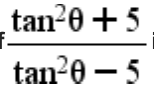
If then the value of is:
- (a)
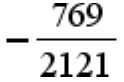
- (b)

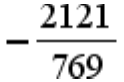
- (c)

- (d)
Answer
Why
Correct — D. Rule: every term of the given ratio has the same degree in sinθ and cosθ, so dividing through by cosθ turns the whole thing into tanθ.
(7tanθ + 4)/(9tanθ − 2) = 5/4
Cross-multiply: 28tanθ + 16 = 45tanθ − 10
26 = 17tanθ → tanθ = 26/17
tan²θ = 676/289
Now the expression, multiplying top and bottom by 289:
(676 + 5×289)/(676 − 5×289) = (676 + 1445)/(676 − 1445)
= 2121/(−769) = −2121/769 → option (d)
The sign is negative because tan²θ ≈ 2.34 is smaller than 5.
Why the others are wrong
- (a)−769/2121 is the answer turned upside down. It is what you get by evaluating (tan²θ − 5) over (tan²θ + 5); read the fraction in the order the question prints it.
- (b)769/2121 is wrong twice over — inverted and positive. 769 belongs in the denominator, and it arrives negative because tan²θ ≈ 2.34 falls short of 5.
- (c)The magnitude is right and the sign is not. tan²θ − 5 = 676/289 − 5 is a negative number, so the fraction as a whole is negative.
Concept
An expression is homogeneous when every term of the numerator and every term of the denominator carries the same power of sinθ and cosθ combined. Dividing it through by cosθ replaces each sinθ/cosθ with tanθ and the angle itself never has to be found.
That matters here because tanθ = 26/17 is not a standard angle — there is no θ to look up, and none is needed.
The last decision is the sign. Once tan²θ is known, whether tan²θ − 5 comes out positive or negative settles it.
The question is set as two images. The condition reads (7sinθ + 4cosθ)/(9sinθ − 2cosθ) = 5/4, and the expression asked for is (tan²θ + 5)/(tan²θ − 5).
All four options are images of the same two numbers — 2121/769 and 769/2121 — each with and without a minus sign, so sign and orientation are the only things separating them.
Key facts
- Dividing a homogeneous sin-cos ratio by cosθ replaces every sinθ/cosθ with tanθ.
- Cross-multiplying 4(7sinθ + 4cosθ) = 5(9sinθ − 2cosθ) reduces to 26cosθ = 17sinθ.
- So tanθ = 26/17 and tan²θ = 676/289 ≈ 2.34, which is less than 5.
- Multiplying (tan²θ + 5)/(tan²θ − 5) top and bottom by 289 gives 2121/(−769).
Study next
Common traps
- Mis-collecting after cross-multiplication: 28sinθ + 16cosθ = 45sinθ − 10cosθ gives 26cosθ = 17sinθ.
- Dropping the minus sign and marking 2121/769.
- Chasing the value of θ, which is neither a standard angle nor needed at any point.
SSC gives one linear sin-cos ratio and asks for a second expression built out of tanθ. In this item the four options are the same two numbers in all four sign-and-inversion combinations, so the sign check is worth as many marks as the algebra.
Related PYQs
No directly related past PYQ was found.