
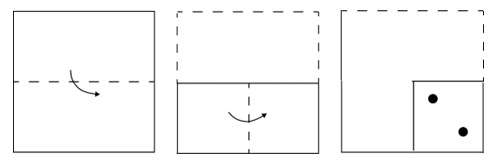
A square sheet of paper is folded along the dotted lines successively in the directions shown and is then punched in the last. How would the paper look when unfolded?
- (a)
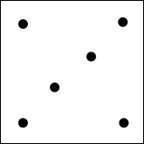
- (b)
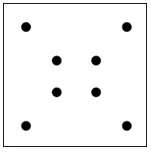
- (c)
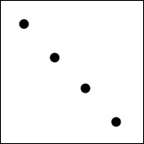
- (d)
Answer
Why
Correct — B. Count layers before you look at the pictures.
Rule: each fold doubles the layers, and each punch makes one hole per layer.
Fold 1 brings the top half down onto the bottom; fold 2 brings the left half across onto the right, leaving the bottom-right quarter.
Two folds → 4 layers. Two punches × 4 layers = 8 holes.
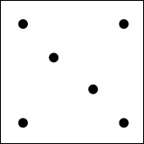
The creases are the vertical and horizontal centre lines, so the finished pattern must be symmetric about both. Option (b) is the only one showing eight holes — four near the corners and four in a block round the centre — with that double symmetry.
Why the others are wrong
- (a)Six holes, not eight. Its two inner holes are related by a half-turn about the centre, not by reflection; folding produces mirror images, so the inner holes have to come as a symmetric block of four.
- (c)Four holes strung along one diagonal — the punched pattern copied once, as though the folds added no layers. It is symmetric about neither centre line.
- (d)Six holes again, with the inner pair set diagonally — the same fault as option (a) turned the other way. Two short of the required eight, and with no symmetry about the vertical crease.
Concept
Every fold doubles the layers, so two folds make a four-layer packet and one punch produces four holes.
Count the layers, multiply by the number of punches, and you know the number of holes before you even look at the options — here two punches on four layers means eight.
Then use symmetry. Because the creases ran along the vertical and horizontal centre lines, the finished pattern must be symmetric about both. Any option that fails either the count or the symmetry goes straight out.
The punch nearer the packet's outer corner ends up near the corners of the open sheet; the punch nearer the creases ends up near the centre.
That is why the correct picture pairs four corner holes with a tight block of four around the middle.
Key facts
- Two folds give four layers, so each punch makes four holes and two punches make eight.
- Creases along the vertical and horizontal centre lines force the unfolded pattern to be symmetric about both.
- Option (b) is the only one showing eight holes: options (a) and (d) show six, option (c) shows four.
Study next
Common traps
- Counting folds instead of layers — two folds give four layers, not two.
- Unfolding in the same order as the folds rather than in reverse.
- Accepting an option because its corner holes look right — three options here carry plausible corner holes and differ only in the middle.
SSC's punch items give two or three folds with one or two punches, and simply counting the holes removes most of the options before any positional reasoning begins. The cut version sits directly before it at Reasoning Q.19 in this shift (9 Sep 2024, 12:30).
Related PYQs
No directly related past PYQ was found.