
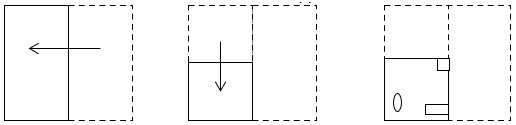
A paper is folded and cut as shown below. How will it appear when unfolded?
- (a)
- (b)
- (c)
- (d)
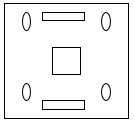
Answer
Why
Correct — D. Two folds make a four-layer packet, so unfold by reversing them one crease at a time.
Rule: a cut lying clear of a crease gives separate copies; a cut touching a crease merges with its own mirror image into one larger shape.
Fold 1 turns the right half onto the left, fold 2 turns the top half down. The packet is the bottom-left quarter.
The oval lies clear of both creases → four separate ovals, one near each corner.
The bar sits on the packet's right edge, which is the vertical crease → its copies join into one wide bar, repeated near the opposite edge by the horizontal crease.
The notch fills the packet's top-right corner, touching both creases → its four copies fuse into a single rectangle at the sheet's centre. That is option (d).
Why the others are wrong
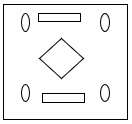
- (a)The centre shape is a diamond. Reflecting a rectangular notch in two perpendicular creases gives a larger rectangle, never a rotated one — nothing in the packet is cut on the slant. The bars and the four ovals are otherwise right.
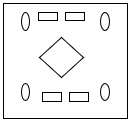
- (b)The top and bottom bars are drawn as two short rectangles with a gap between them. Those cuts reach the vertical crease, so their copies must meet along it and merge into one continuous bar. Its centre diamond is wrong for the same reason as in option (a).
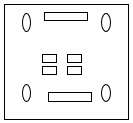
- (c)The centre shows four separate small rectangles. That is what a notch stopping short of both creases would give. This notch sits in the packet's corner, on both creases, so its four copies join into one shape.
Concept
Fold-and-cut items turn on a single rule: a cut made through an n-layer packet reappears n times on unfolding, mirrored about each crease in turn.
What shapes the final picture is *where* the cut sits relative to those creases. A cut lying wholly inside the packet gives separate copies.
A cut that touches a crease lands on top of its own mirror image along that line, and the two merge into one shape of double the size. Work the folds backwards, one crease at a time, and test every cut against both.
All four options carry the same four corner ovals, so the ovals settle nothing.
The item is decided entirely by the two cuts that touch a crease — the bar on the packet's right edge and the notch in its corner.
Key facts
- Fold 1 takes the right half onto the left and fold 2 takes the top half down, leaving the bottom-left quarter as a four-layer packet.
- The oval sits clear of both creases, so it unfolds into four separate ovals, one near each corner.
- A cut touching a crease merges with its mirror image: the corner notch becomes one rectangle at the centre, and the bar becomes one wide bar in each half.
Study next
Common traps
- Getting the number of copies right but ignoring the creases, so cuts that must merge are drawn separately — exactly the fault in options (b) and (c).
- Unfolding in the order the folds were made instead of reversing them.
- Reading the dashed outline in the figure as part of the paper — it only marks where the sheet used to be.
SSC lays the fold sequence across two or three panels and puts the cuts on the final packet, and the options usually differ in one feature only — so find the cut that touches a crease and let it do the eliminating. The punch version follows immediately at Reasoning Q.20 in this shift (9 Sep 2024, 12:30).
Related PYQs
No directly related past PYQ was found.