
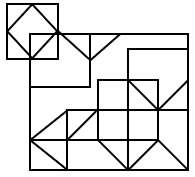
How many triangles are there in the given figure?
- (a)21
- (b)20
- (c)18
- (d)19
Answer
Why
Correct — A. Rule: count pocket by pocket — undivided triangles first, then the ones two of them combine into.
Top-left square — 5. The diamond on the four edge midpoints cuts a triangle off each corner; the rectangle's top and left edges close a fifth against the diamond.
Chevron under the top line — 3. Two slants meeting on a vertical: left half, right half, whole.
Right-hand pocket — 3. Two halves from the slant across the small cell, a third from the slant dropping to its foot.
Band under the middle horizontal — 2. One slant, corner to corner.
Left-hand arrow — 4. Two slants meet on the left edge and a horizontal splits the arrow: upper half, lower half, whole. The base closes a fourth below.
Bottom row — 4. Two slants meet on the base: two halves and the whole. A further slant closes an upward triangle beside them.
5 + 3 + 3 + 2 + 4 + 4 = 21 → option (a).
Why the others are wrong
- (b)20 — One short. A count of 20 has caught every small triangle but dropped one of the three compound ones — the wide chevron, the left-hand arrow, or the downward triangle in the bottom row. Each reads as two finished halves.
- (c)18 — 18 is exactly the undivided count. Every pocket has been read correctly and nothing double-counted. What is missing is the last step, combining adjacent pairs into the three larger triangles.
- (d)19 — Two short, so 18 undivided plus one compound. All three compound triangles have a line running through them, which is why each reads as two finished shapes and why two of them are so easy to leave out.
Concept
Triangle counting is a bookkeeping exercise, not a perception exercise. An unsystematic sweep double-counts some triangles and misses others, and it gives no way to know which.
The reliable order is: label every intersection, take the pockets one at a time, count the undivided triangles inside each, then look for triangles made of two or more of them.
Two standing results do most of the work. A rectangle with one diagonal drawn gives two triangles. Two slants meeting at a point and closed by a straight line across their upper ends give three, the two halves and the whole.
This figure prints small and several of its lines meet at very nearly the same point, so a few junctions are hard to resolve on the paper.
Redraw it large on the rough sheet and mark every intersection before counting anything.
Key facts
- A square with a diamond drawn on its four edge midpoints yields four triangles, one at each corner.
- A rectangle with one diagonal yields two triangles, and the rectangle itself is not one of them.
- Two slants meeting at a point and closed by a line across their upper ends yield three triangles: the two halves and the whole.
- This figure holds 18 undivided triangles and 3 compound ones, giving 21.
Study next
Common traps
- Counting the same triangle twice because the sweep restarted from a different corner
- Stopping at the undivided triangles and never combining adjacent pairs
- Counting a trapezium or a crossed square as a triangle because part of its outline looks like one
SSC prints a figure-count item in most Tier-I reasoning sections, and the options always sit within two or three of each other, so a near-miss earns nothing.
The four options here are 18, 19, 20 and 21, which is the usual spread and the reason the count has to be systematic rather than quick.
Related PYQs
No directly related past PYQ was found.