
Six numbers 21, 22, 23, 24, 25 and 26 are written on different faces of a dice. Three positions of this dice are shown in the figure. Find the number on the face opposite to 24.
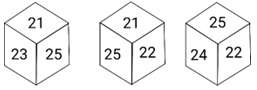
- (a)26
- (b)25
- (c)22
- (d)21
Answer
Why
Correct — D. The three pictures are one die in three positions, so look for a face that stays put between two of them.
Views 2 and 3 both show 22 on the right face. The die has therefore only been rolled about the axis running through 22.
View 2: top 21, left 25. View 3: top 25, left 24. The face that was on the left has come to the top, which is a single quarter-turn. A further quarter-turn would bring 24 to the top.
Rule: on a quarter-turn ring, the first face and the third are opposite each other. The tops run 21, then 25, then 24, so 21 is two quarter-turns from 24.
Two quarter-turns is a half-turn, and a half-turn carries a face onto the face opposite it. So 21 lies opposite 24 — option (d).
Why the others are wrong
- (a)26 — 26 never appears in any of the three views. Running the same rotation through views 1 and 2 fixes the pairs as 21 with 24, 22 with 23 and 25 with 26, which leaves 26 opposite 25.
- (b)25 — View 3 shows 24 and 25 on the same die. Two faces you can see at once share an edge, and adjacent faces are never opposite.
- (c)22 — View 3 shows 24 and 22 together as well, so they are adjacent. This one is ruled out by a single glance, without any rotation at all.
Concept
Every dice question rests on two facts. Any two faces drawn in the same view are adjacent, and a face has exactly four neighbours plus one opposite.
When two views share a face, they are the same die rolled about the axis through that shared face, and the other faces march round a ring of four.
Reading that ring in order is faster and safer than the elimination method, because it settles two opposite pairs at once instead of one.
Key facts
- Any two faces visible in a single view of a die are adjacent, so neither can be the other's opposite.
- Holding one face fixed and rotating produces a ring of four faces, in which the first and third are opposite, as are the second and fourth.
- For this die the three pairs work out as 21 with 24, 22 with 23 and 25 with 26.
Study next
Common traps
- Treating the three drawings as three different dice rather than one die in three positions
- Assuming a face keeps its position between views when the die has been rolled
- Choosing the number that never appears, on the reasoning that it must be the hidden one
SSC gives two or three views of one die and asks for a single opposite face. Two views that share a face are the gift in the question and turn it into one rotation.
When no face is shared, fall back on listing the neighbours of the target face until only one number is left.
Related PYQs
No directly related past PYQ was found.