
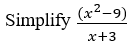
Simplify (x² − 9)⁄(x + 3)
- (a)

- (b)

- (c)

- (d)

Answer
Why
Correct — C. The stem is an image asking you to simplify (x² − 9)⁄(x + 3), and the numerator is a difference of two squares.
Factorise: x² − 9 = x² − 3² = (x + 3)(x − 3)
Rewrite: (x + 3)(x − 3) ⁄ (x + 3)
Cancel the common factor (x + 3), legal for x ≠ −3: x − 3
Option (c) is the image reading x − 3 → option (c).
Check with x = 5: (25 − 9)⁄8 = 2, and 5 − 3 = 2.
Why the others are wrong
- (a)Option (a) is the image x − 9, which keeps the 9 from x² − 9 rather than the 3 from its factor (x − 3). Cancelling leaves the root of the square, never the square itself.
- (b)Option (b) is the image x + 3 — the denominator copied back. That is the factor that cancels away, not the one that survives.
- (d)Option (d) is the image √(x² − 9), which would follow only if the whole fraction sat under a root. No radical appears anywhere in the expression.
Concept
One identity carries the question: a² − b² = (a + b)(a − b). Spotting it turns a fraction into a cancellation.
Here a = x and b = 3, so x² − 9 factors as (x + 3)(x − 3) and the denominator is one of those two factors.
Cancelling a common factor is valid wherever that factor is non-zero, which is why the simplified form x − 3 carries the restriction x ≠ −3.
The stem and all four options are printed as images in this paper, not as text — each option letter carries a picture of an expression, so the card names them as option (a), option (b) and so on.
Key facts
- a² − b² = (a + b)(a − b), so x² − 9 = (x + 3)(x − 3).
- (x² − 9)⁄(x + 3) = x − 3 for every x except x = −3, where the original fraction is undefined.
- Substituting one convenient value checks a simplification fast: x = 5 gives 16⁄8 = 2 = 5 − 3.
Study next
Common traps
- Cancelling the 9 against the 3 term by term, which is never legal inside a sum
- Forgetting that x = −3 must be excluded, since the original fraction is undefined there
- Starting long division when the identity finishes the job in one line
SSC sets these as one-step identity items: the whole question is whether you see a² − b² before you start expanding. Here even the options are pictures, so there is nothing to write out.
Related PYQs
No directly related past PYQ was found.