
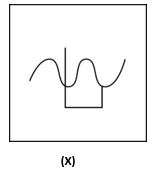
Select the option figure in which the given figure (X) is embedded (rotation is NOT allowed).
- (a)
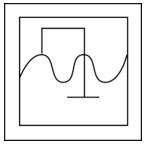
- (b)
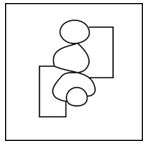
- (c)
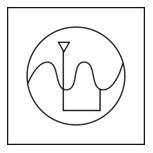
- (d)
Answer
Why
Correct — C. Figure (X) is three joined parts, and all three must survive intact.
Rule: an embedded figure must appear complete and unrotated; extra lines drawn around it are allowed.
X consists of a wave with two crests and two troughs, a straight vertical stem coming down onto the first trough, and an open-topped rectangle whose two uprights stand on the two troughs.
Option (c) carries all three inside a circle: the same double-humped wave running left to right, the same vertical stem meeting the first trough, and the same open-topped rectangle slung between the two troughs. Its extra circle and the small triangle capping the stem do not disturb the match.
Why the others are wrong
- (a)Its bracket sits above the wave and opens downward onto the crests, and the shape below the wave is a T, a horizontal bar crossed by the stem. Neither piece is what X draws.
- (b)Built from ovals and closed blobs with two plain rectangles behind them. There is no wave anywhere in it, so X's leading feature is simply absent.
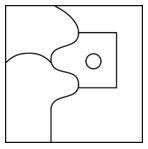
- (d)Its curves form a jigsaw-style outline and its only rectangle is a plain square holding a small circle. Nothing here reproduces X's stem-and-open-rectangle assembly.
Concept
An embedded-figure item asks whether every line of X survives inside an option, in the same orientation and the same relative arrangement. Extra lines in the option are permitted. Missing or re-oriented lines are not.
The efficient method is to pick X's most awkward junction and hunt only for that. Here it is the open-topped rectangle hanging between two troughs of a wave — a joint that is hard to draw by accident.
Because the stem says rotation is NOT allowed, an option that would match only after turning the page is wrong on the question's own terms.
The option figures are pictures, not text, so the printed option strings are blank in the paper's response sheet. Read each picture against X's three parts rather than against the others.
Key facts
- Figure (X) has three parts: a two-crest wave, a vertical stem meeting the first trough, and an open-topped rectangle standing on both troughs.
- Option (c) draws all three parts, adding a surrounding circle and a small triangle above the stem.
- The instruction rules rotation out, so the match must be found in X's own orientation.
Study next
Common traps
- Matching on the wave alone when more than one option draws a wavy line
- Accepting a match that needs the option turned, although rotation is ruled out
- Rejecting the right option because it carries extra lines, which embedding permits
SSC prints this stem word for word — 'Select the option figure in which the given figure (X) is embedded (rotation is NOT allowed)' also stands at Reasoning Q.6 on 9 Sep 2024 (16:00) and Reasoning Q.18 on 11 Sep 2024 (12:30).
A variant numbers the option figures (1) to (4) instead of lettering them, as at Reasoning Q.24 on 11 Sep 2024 (09:00).
Related PYQs
No directly related past PYQ was found.