
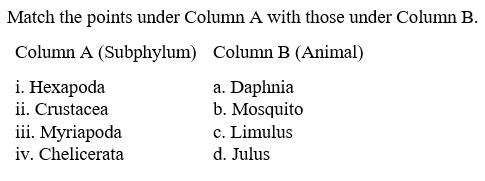
Match the points under Column A with those under Column B. Column A (Subphylum) | Column B (Animal) i. Hexapoda | a. Daphnia ii. Crustacea | b. Mosquito iii. Myriapoda | c. Limulus iv. Chelicerata | d. Julus
- (a)i-b, ii-a, iii-d, iv-c
- (b)i-d, ii-c, iii-b, iv-a
- (c)i-a, ii-b, iii-c, iv-d
- (d)i-b, ii-c, iii-a, iv-d
Answer
Why
Correct — A. The stem is an image. Column A lists four subphyla of Arthropoda — i. Hexapoda, ii. Crustacea, iii. Myriapoda, iv. Chelicerata — and Column B lists four animals: a. Daphnia, b. Mosquito, c. Limulus, d. Julus.
Take them one at a time.
i. Hexapoda means six legs, the insects, and the mosquito is an insect: i-b.
ii. Crustacea are the gill-breathing, largely aquatic arthropods, and Daphnia the water flea is one: ii-a.
iii. Myriapoda are the many-legged forms, and Julus is a millipede: iii-d.
iv. Chelicerata carry chelicerae and no antennae, and Limulus is the horseshoe crab: iv-c.
That reads i-b, ii-a, iii-d, iv-c — option (a).
Why the others are wrong
- (b)i-d, ii-c, iii-b, iv-a — It files Julus under Hexapoda. A millipede carries two pairs of legs on most of its many segments, nowhere near six in all, so it cannot be a hexapod, and this pairing leaves the mosquito with Myriapoda.
- (c)i-a, ii-b, iii-c, iv-d — This is the straight-down pairing i-a, ii-b, iii-c, iv-d, which makes Daphnia an insect and the mosquito a crustacean. Daphnia is the water flea, a crustacean despite the name.
- (d)i-b, ii-c, iii-a, iv-d — It gets i-b right and then slips: Limulus is put under Crustacea. The horseshoe crab has chelicerae and no antennae at all, which places it in Chelicerata.
Concept
Phylum Arthropoda is divided by head appendages and leg count. Hexapoda, the insects, have three pairs of legs and one pair of antennae. Crustacea are mainly aquatic, breathe through gills, and are the only arthropods with two pairs of antennae.
Myriapoda — centipedes and millipedes — have a long trunk of many leg-bearing segments.
Chelicerata are defined as much by what they lack: no antennae, and the first pair of appendages modified into pincer-like chelicerae. Spiders, scorpions and the horseshoe crab sit here.
Column B gives genus names rather than common names — Daphnia for the water flea, Julus for a millipede, Limulus for the horseshoe crab. That translation is the real difficulty of the item, not the classification.
Key facts
- Hexapoda are the insects, with three pairs of legs and a single pair of antennae.
- Crustacea are the only arthropods with two pairs of antennae, and Daphnia the water flea is a crustacean.
- Julus is a millipede and belongs to the subphylum Myriapoda.
- Limulus, the horseshoe crab, is a chelicerate: it has chelicerae and no antennae.
Study next
Common traps
- Reading Daphnia as an insect because it is called the water flea.
- Matching straight down the two columns when the options offer that as a choice.
- Putting Limulus with the crabs, which are crustaceans, because of the name horseshoe crab.
SSC asks arthropod classification either as an image match like this or as a one-line example question — the same phylum is asked directly at 19 Sep 2024, 09:00, GA Q.6, where the keyed example is the butterfly.
Related PYQs
No directly related past PYQ was found.