
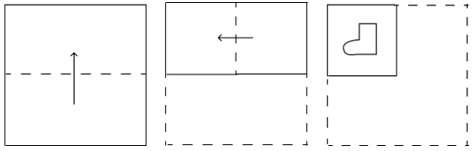
A paper is folded and cut as shown below. How will it appear when unfolded?
- (a)
- (b)
- (c)
- (d)
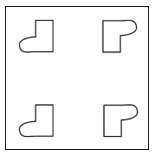
Answer
Why
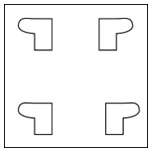
Correct — C. Rule: two folds, four layers — the cut is punched four times, and the copies are mirror images across each fold line.
The bottom half folds up along the horizontal mid-line, then the right half folds left along the vertical mid-line, so all the cutting is done on the top-left quarter.
The cut there is a boot: an upright rectangular leg with a rounded foot running left from its base.
Undo the vertical fold and the top-right quarter receives the left-right mirror — the same leg, foot now running right.
Undo the horizontal fold and the whole top half reflects downward, so both lower copies stand on their heads and the rounded foot moves to the top of the leg.
Four boots, feet down along the top edge and feet up along the bottom edge, is option (c).
Why the others are wrong
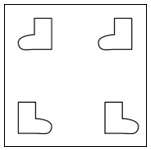
- (a)The two shapes along the top of (a) are identical to each other. A fold line has to reflect, so the top-left and top-right copies are obliged to face opposite ways.
- (b)Every foot in (b) points up. The quarter that was actually cut has its foot at the bottom of the leg, so the two copies along the top edge must show it that way.
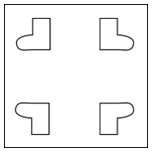
- (d)The left-hand pair in (d) are the same shape top and bottom, and so are the right-hand pair. The horizontal fold has produced no up-down flip at all.
Concept
This is the same four-layer reflection as any two-fold item, but the cut is chiral — a boot has a left and a right, so a reflection produces a shape you cannot reach by sliding the original.
That makes the item easier rather than harder. You can read the answer off orientations alone, without tracking where anything sits.
Across the vertical fold the two copies must face opposite ways. Across the horizontal fold they must stand on their heads. Anything that fails either test is out.
The four copies form two mirror pairs, one pair for each fold. An option whose four shapes are not two such pairs is wrong before you compare it with the cut that was drawn.
Key facts
- Two folds give four layers, so a single cut opens into four copies.
- Reflecting an asymmetric shape across a vertical line reverses its left and right.
- Reflecting it across a horizontal line turns it upside down.
- The unfolded sheet must be symmetric about both fold lines that were used.
Study next
Common traps
- Sliding the cut into the other quarters instead of reflecting it
- Undoing the first fold before the second, which swaps which axis flips what
- Accepting an option whose four copies all face the same way
SSC uses three panels here — the sheet with the first fold marked by a dashed line and an arrow, the folded state with the second fold marked, then the final quarter with the cut drawn in.
Paper folding also runs at Reasoning Q.14 of this same 26 Sep 2024, 09:00 paper, and again 18 Sep 2024, 12:30, Reasoning Q.11 and Q.20.
Related PYQs
No directly related past PYQ was found.