
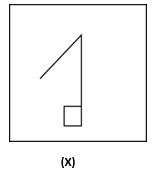
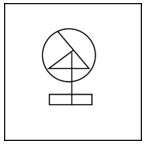
Select the option figure in which the given figure (X) is embedded (rotation is NOT allowed).
- (a)
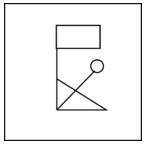
- (b)
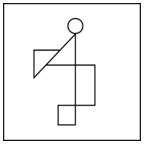
- (c)
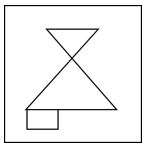
- (d)
Answer
Why
Correct — B. Rule: rotation is not allowed, so (X) has to appear at the same size, the same angle and with its parts in the same relative places.
Figure (X) is three strokes. A long vertical stem. A straight line that leaves the top of that stem and runs down to the left.
And a small square pressed against the stem's left side near the bottom, with the stem forming the square's right edge.
Option (b) carries all three unchanged. The stem drops from the small circle at the top, the same down-left diagonal leaves that same top point, and the small square sits against the stem's left side at the lower end.
The triangle, the rectangle and the circle in (b) are extra lines drawn across it, which is what an embedded-figure item is supposed to do.
Why the others are wrong
- (a)(a) has no square anywhere. Its only quadrilateral is a wide rectangle about twice as long as it is tall, and it sits at the top of the vertical line rather than beside its lower end.
- (c)The small square in (c) hangs below a horizontal base line, using that base as its top edge. (X) needs its square to sit beside a long vertical stem, and (c) has no vertical stem at all.
- (d)The quadrilateral in (d) is a shallow rectangle that the vertical line runs through the middle of. In (X) the square lies wholly to the left of the stem and touches it along one side.
Concept
An embedded-figure item asks whether a given shape survives intact inside a busier drawing. The phrase rotation is NOT allowed is doing real work: a copy turned even a quarter turn does not count.
The efficient method is to pick the least common feature of (X) and hunt only for that, rather than comparing whole pictures.
Here that feature is the small square hanging on the left of a long vertical, with the vertical as the square's right edge. Nothing else in (X) is distinctive on its own.
Length and proportion count as much as shape. A square drawn at half the size of (X)'s square, or a rectangle where (X) has a square, is a different figure even when the arrangement looks familiar.
Key facts
- (X) consists of a long vertical stem, a diagonal leaving its top and falling to the left, and a small square on the stem's left near the bottom.
- The instruction rotation is NOT allowed means the embedded copy must keep the printed orientation.
- In option (b) the stem, the diagonal and the small square all appear at the printed size and angle.
- Extra lines crossing the embedded figure are expected and do not disqualify an option.
Study next
Common traps
- Accepting a rotated copy when the question has explicitly ruled rotation out
- Matching on the busiest feature rather than the rarest one
- Treating a wide rectangle as close enough to the square (X) actually contains
SSC prints the target as figure (X) beside four option figures, with the rotation ban stated in the stem. Embedded-figure items also run 25 Sep 2024, 09:00, Reasoning Q.4 and 23 Sep 2024, 09:00, Reasoning Q.20.
Related PYQs
No directly related past PYQ was found.