
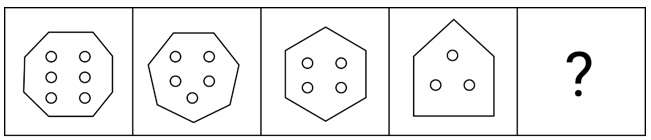
Select the figure from among the given options that can replace the question mark (?) in the following series.
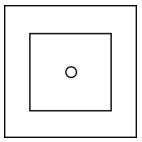
- (a)
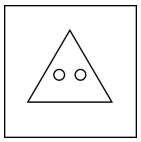
- (b)
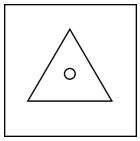
- (c)
- (d)
Answer
Why
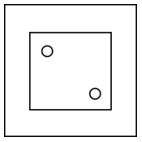
Correct — D. Two independent counts run down together, one step per box.
Rule: the polygon sheds a side and the figure sheds a dot at every step.
Sides: 8 (octagon), 7, 6, 5 (pentagon) → 4, a square.
Dots: 6, 5, 4, 3 → 2.
Option (d) is a square carrying two circles, which is exactly what the fifth box needs.
Why the others are wrong
- (a)The square is right, the dot count is not. Option (a) drops to a single circle, which would need the dots to fall by two at this step when every earlier step drops exactly one.
- (b)Three sides, not four. Option (b) holds the dot count at two but overshoots the polygon, jumping from the pentagon straight to a triangle and skipping the square the side count demands.
- (c)Both counts overshoot. Option (c) runs the polygon down to three sides and the dots down to one, applying two steps of the rule where the series asks for one.
Concept
Figural series at this level usually run two independent counters inside one frame. Score each counter separately rather than hunting for a single visual pattern.
Here the counters are the number of sides of the outer polygon and the number of circles inside it. Both happen to fall by one per box.
Read them apart even so. A series can hold one counter steady while the other moves, and merging them into a single impression leaves you nothing to check the options against.
The outer shapes are drawn as regular polygons, but the dots inside them are not laid out regularly — the pentagon carries its three dots as one above two. Count the dots, do not try to match their arrangement.
Key facts
- An octagon has 8 sides, a heptagon 7, a hexagon 6, a pentagon 5 and a square 4.
- The side count falls 8, 7, 6, 5, so the fifth box needs a four-sided figure.
- The circle count falls 6, 5, 4, 3, so the fifth box needs two circles.
Study next
Common traps
- Reading only the polygon and picking any four-sided option without checking the dot count.
- Miscounting the pentagon as a hexagon because it is drawn house-shaped, with a flat base and a peak.
- Treating the dot arrangement as part of the pattern when only the dot total moves.
The same stem, word for word, carries figural series at 24 Sep 2024, 16:00, Reasoning Q.19 and at 10 Sep 2024, 16:00, Reasoning Q.18. Reasoning Q.19 of this sitting reuses it with stacked arcs in place of polygons.
Related PYQs
No directly related past PYQ was found.