
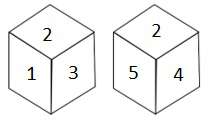
Two different positions of the same dice are given below. Which is the number on the face opposite the face containing 5?
- (a)3
- (b)2
- (c)1
- (d)6
Answer
Why
Correct — C. Read what the two views share before hunting for the pair.
View 1: 2 on top, 1 on the left face, 3 on the right face.
View 2: 2 on top again, 5 on the left face, 4 on the right face.
Because 2 keeps its position, the die has only been spun about its vertical axis. A quarter-turn would carry either 1 or 3 into a visible position, and view 2 shows neither, so the spin is a half-turn.
A half-turn brings the two hidden side faces to the front. The face that was hidden behind 1 now stands where 1 stood, so 5 was behind 1. The face opposite 5 is 1 — option (c).
Why the others are wrong
- (a)3 — 3 occupies the right face in view 1. A half-turn carries that face out of sight and brings its opposite into the same position, and view 2 shows 4 there, so 3 pairs with 4.
- (b)2 — 2 is on top in both views, so it is seen alongside 1, 3, 5 and 4. A face is never opposite a face shown in the same picture as itself.
- (d)6 — 6 appears in neither view. It is the face hidden opposite the 2 that both views show on top, so it cannot also be opposite 5.
Concept
Two views of one die carry two different kinds of information: which faces touch, and how the die was turned between the pictures.
Take adjacency first. Every face seen with 2 in the same picture touches 2, so 1, 3, 5 and 4 are all adjacent to it. That leaves 6 opposite 2 with no further work.
Then take the turn. When a face keeps its position across both views, the die has been rotated about the axis through that face. Here 2 stays on top, so only the amount of spin remains to be settled, and the visible numbers settle it.
The argument for a half-turn is worth stating carefully: a quarter-turn in either direction leaves one of 1 and 3 on show, and view 2 shows neither.
Key facts
- Faces seen together in one view are adjacent and can never be opposite.
- 2 is on top in both views, so 6, the face in neither view, is opposite 2.
- A half-turn about the vertical axis brings both hidden side faces into view at once.
- The pairs on this die are 2 with 6, 1 with 5, and 3 with 4.
Study next
Common traps
- Assuming the two views must be a quarter-turn apart
- Pairing 1 with 4 and 3 with 5, which is the split a quarter-turn would have produced
- Treating the face common to both views as a candidate, when it is adjacent to everything shown beside it
The identical stem, with the die drawn in two isometric views, is used at 11 Sep 2024, 12:30, Reasoning Q.21, which asks for the face opposite 1, and at 12 Sep 2024, 16:00, Reasoning Q.25, which also asks for the face opposite 5.
Related PYQs
No directly related past PYQ was found.