
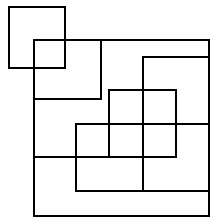
How many squares are there in the figure shown below?
- (a)14
- (b)12
- (c)13
- (d)11
Answer
Why
Correct — C. Sort the squares by side length and count each length to exhaustion.
One cell wide: 5 — the four cells of the 2 by 2 block on the right, plus the cell to the left of that block's lower row.
Two cells wide: 5 — the block itself, two stacked at the right edge, one at the bottom left, and one closing off the big square's top-left corner.
At the top left: 2 — the small square that juts out, and the patch where it crosses the big square.
The big square itself: 1
5 + 5 + 2 + 1 = 13 — option (c).
Why the others are wrong
- (a)14 — 14 counts one shape too many. The 2 by 2 arrangement also contains 1 by 2 and 2 by 1 strips, and a strip has four corners but unequal sides.
- (b)12 — 12 is what you get by counting the two overlapping squares at the top left and walking past the small square where they cross. That patch is a square in its own right.
- (d)11 — 11 misses more than one size. The five one-cell squares and the five two-cell squares already reach ten, before the top-left pair and the big square itself are added.
Concept
Counting figures is a bookkeeping problem, not a spotting problem. Sort by size, count each size completely, then add.
Two errors dominate. Composite squares get missed — a 2 by 2 arrangement of cells is a square in its own right, as well as the four cells inside it. And rectangles get counted: a 1 by 2 strip is not a square.
A third error is specific to this drawing. Two squares overlap, and the region they share is closed on all four sides and is a square too, even though no single stroke draws its outline.
The overlap patch is the whole difference between 13 and 12, and 12 is on the option list. Look for it wherever two outlines cross rather than nest.
Key facts
- The drawing holds five squares one cell wide and five of double that side.
- The small square at the top left overlaps the big one, and the patch they share is closed on all four sides and counts as a square of its own.
- The outer boundary of the whole drawing is the thirteenth square.
- A 1 by 2 rectangle inside the grid has unequal sides and must not be counted.
Study next
Common traps
- Missing the square formed where two drawn squares overlap
- Counting the cells of a 2 by 2 arrangement but not the arrangement itself
- Including 1 by 2 rectangles, which is how the drawing yields 14 instead of 13
The counting stem recurs with a different drawing and a different key: 10 Sep 2024, 09:00, Reasoning Q.14 keys 14, 13 Sep 2024, 16:00, Reasoning Q.18 keys 11, and 17 Sep 2024, 12:30, Reasoning Q.1 keys 20.
Related PYQs
No directly related past PYQ was found.