
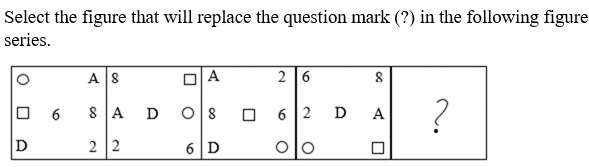
Select the figure that will replace the question mark (?) in the following figure series.
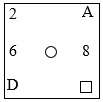
- (a)
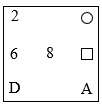
- (b)
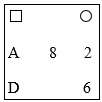
- (c)
- (d)
Answer
Why
Correct — B. Each box holds the same seven symbols in seven cells, so the item is entirely about where each one moves.
Rule: two shuffles alternate. The rearrangement that turns box 1 into box 2 returns from box 3 to box 4, so the one that turns box 2 into box 3 is the one that produces box 5.
That shuffle sends top-left to middle-left, middle-left to top-left, top-right to the centre, the centre to bottom-left, bottom-left to top-right, middle-right to bottom-right and bottom-right to middle-right.
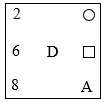
Box 4 reads 6 and 8 across the top, 2, D and A across the middle, and the circle and the square along the bottom.
Applying the shuffle puts 2 top-left, the circle top-right, 6 middle-left, 8 in the centre, the square middle-right, D bottom-left and A bottom-right — option (b).
Why the others are wrong
- (a)Option (a) has 2, 6 and D in the right cells but drops the circle into the centre. The centre must take whatever stood at box 4's top-right, which is 8.
- (c)Option (c) opens with the square in the top-left, where the shuffle sends box 4's middle-left symbol, 2. Its middle row reads A 8 2 where the pattern requires 6, 8, square.
- (d)Option (d) leaves D in the centre. D alternates between the bottom-left cell and the centre across the four given boxes, so in box 5 it has to be back at bottom-left.
Concept
Every box carries the same seven symbols — a circle, a square, D, A, 6, 8 and 2 — in seven of the nine cells, with the top-centre and bottom-centre cells always empty. Nothing enters and nothing leaves, so the whole item is a question about position.
The safest entry point is a symbol with a short cycle. D alternates between the bottom-left cell and the centre, which one glance across the four boxes shows, and that alone eliminates an option.
Then ask whether the box-to-box rearrangement repeats. Here it does, on a two-step cycle, so the shuffle box 5 needs is the one already displayed from box 2 to box 3.
A permutation this irregular is not worth memorising as a picture. Track two or three symbols, write down where each has to land, and let the options be tested against that.
Key facts
- The seven symbols appear exactly once in every box, so any valid answer repeats all seven.
- D occupies the bottom-left cell in boxes 1 and 3 and the centre in boxes 2 and 4.
- The rearrangement from box 1 to box 2 is the same as the one from box 3 to box 4, which is what makes box 5 predictable.
Study next
Common traps
- Looking for a rotation or a reflection of the whole box when the movement is a permutation.
- Judging by the top-left cell alone, which options (a), (b) and (d) all fill with 2.
- Assuming D stays in the centre because that is where box 4 leaves it.
The instruction here — select the figure that will replace the question mark in the following figure series — is printed inside the picture rather than as question text, so the stem reads blank. Figure series of this kind also appear at 9 Sep 2024, 12:30, Reasoning Q.8 and at 11 Sep 2024, 09:00, Reasoning Q.5.
Related PYQs
No directly related past PYQ was found.