
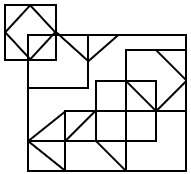
How many triangles are there in the given figure?
- (a)19
- (b)18
- (c)17
- (d)16
Answer
Why
Correct — A. Rule: count the half-square triangles first, then the larger ones made by joining two of them.
The figure is a staircase of squares. A triangle exists wherever a drawn diagonal closes against two other drawn lines, so work block by block and add.
Top-left square with the inscribed diamond, its four corner triangles: 4
That diamond's lower-right side, cutting the top-left corner of the overlapping second square: 1
The wide V hanging from the long top edge, two halves plus the whole they form: 3
On the right, two slants meeting the border and closing against it: 2
The square below and left of them, split by one diagonal: 2
In the lower staircase, one square split by a diagonal: 2
The next square along, with only one closed half: 1
The bottom-left arrowhead, three half-square triangles plus the large one two of them form: 4
4 + 1 + 3 + 2 + 2 + 2 + 1 + 4 = 19, option (a).
Why the others are wrong
- (b)18 — 18 misses one of the two composite triangles — the wide V at the top and the arrowhead at the bottom left each count in their own right as well as in halves.
- (c)17 — 17 is the tally of the half-square triangles alone, with both composites left out. It is the commonest wrong answer on figures like this.
- (d)16 — 16 drops a small triangle as well as both composites. An easy one to miss sits at the top-left corner of the overlapping square, where the diamond's edge slices across it.
Concept
Triangle counting is bookkeeping, not insight. Split the figure into blocks that do not share a diagonal, count inside each block, then add the blocks up.
Inside a block, count by size: first every triangle with no line crossing it, then every triangle made of exactly two of those, then three. Stop when the next size has no candidates.
Here nearly every diagonal is a single line across one square, which yields two triangles and nothing bigger. Two places have a pair of diagonals meeting at a point, and a larger triangle forms at each.
The two overlapping squares at the top left make the figure look busier than it is. The inscribed diamond contributes four corner triangles, and its lower-right side, running on into the second square, contributes one more — the diamond itself is a quadrilateral and counts for nothing.
Key facts
- A single diagonal across a square creates two triangles, not one.
- A diamond inscribed in a square cuts off four corner triangles.
- Two diagonals meeting at a point on a straight edge create three triangles, two small ones and their union.
Study next
Common traps
- Counting only the smallest triangles and stopping at 17
- Forgetting that a half already counted can also form part of a larger triangle
- Treating the inscribed diamond as a triangle when it has four sides
The one-line stem with four close numeric options is set at 25 Sep 2024, 16:00, Reasoning Q.8 (keyed 17) and at 12 Sep 2024, 16:00, Reasoning Q.10 (keyed 14). The figure changes, the counting discipline does not.
Related PYQs
No directly related past PYQ was found.